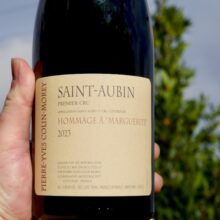
Pierre-Yves Colin-Morey Saint-Aubin 2024

Product information

Pierre-Yves Colin-Morey Saint-Aubin 2024

Chardonnay from Saint-Aubin, Côte du Beaune, Burgundy, France

$197

$190ea in any 3+
$183ea in any 6+
Closure: Cork

Description

A blend of four vineyards, Pierre-Yves’s 2024 Saint-Aubin Village is a success, unfurling from the glass with aromas of white flowers, fresh hazelnut, pear and peach mingled with buttered toast. On the palate, it is medium- to full-bodied, with a chalky personality and considerable flesh for the vintage, underpinned by racy acidity and culminating in a long, precise finish.

Kristaps Karklins, The Wine Advocate 88-90 Points


A discreet application of wood sets of bright and airy aromas of mostly citrus, acacia blossom and pear. The succulent but attractively detailed and punchy middle weight flavors also exude a subtle minerality on the lightly austere, clean and agreeably dry finale.

Allen Meadows, Burghound 87-90 Points

In stock

Check out all of the wines by Pierre-Yves Colin-Morey

Why is this Wine so Yummy?

I met Pierre-Yves when back in 1999 whilst doing vintage at Domaine Bernard-Moreau. Just another of the down to earth lads from the region.

It was funny that drinking a 2016 Bourgogne from him took me to the textures and energy we sought at Yarra Yering. It goes to show just how far Aussie Chardonnay has come and how difficult it can be to distinguish between the two.

The texture of the PYCM wines is outstanding matching the core of fruit. These are exceptional Chardonnays.

Two irreproachable sources of really fine, precise, ageworthy white burgundy are the world-famous Domaine Jean-François Coche-Dury of Meursault and the up-and-coming négociant Pierre-Yves Colin-Morey of Chassagne-Montrachet. A clear sense of evolution is in the air at both… The list of those seeking allocations of Coche white burgundies is already wildly over-subscribed but it may not be too late to secure some Colin-Morey wines. Pierre-Yves, son of Marc Colin, has very much gone his own way, adding carefully to his own vineyards with a small roster of hand-picked growers from whom he buys. His wines are as intense as he is, and he, another Côte de Beaune producer to have moved his wine showroom out of his kitchen to separate premises, seems utterly dedicated to making the wines better every year. JANCIS ROBINSON MW 

The 2024 Vintage at Pierre-Yves Colin-Morey

Pierre-Yves Colin was away at the time of my appointment but his son Matthis, who also works at the domaine, capably handled the tasting while describing the 2024 growing season as “one that was basically a challenge from start to finish. We had almost every problem that you can have all in the same season. The challenges included frost, a lousy flowering, oidium, mildew and even a bit of botrytis at the end of the season. We made 17 treatments in total, which basically means that we were constantly on our tractors in the vineyards. On the plus side, we picked from the 12th to the 22nd of September under basically ideal conditions so that definitely helped. Yields for the chardonnay, while variable, were actually pretty good in the context of the vintage at between 35 to 40 hl/ha. Potential alcohols averaged right at 12% so most wines were chaptalized between .5 and 1%. We did zero bâtonnage (lees stirring) as we felt as though the wines already had enough richness and we didn’t want to compromise the precision. As to the wines, they’re clearly still developing but they really changed over the course of the élevage. I like them a lot as they’re highly energetic and already you just feel like having the next glass, always a good sign!” The younger Colin again noted that everything was aged in in 350L barrels and that the wines will be bottled unfined and unfiltered using natural cork and between 45 and 50 ppm of free SO2. Lastly, and as I noted last year in case anyone missed it, Marc Colin, father of Pierre-Yves, made his final vineyard distributions so the domaine is the exceptionally lucky recipient of a tiny parcel of 267 square meters of Montrachet. Depending on the vintage, this should make around 150 bottles annually. Lastly, Colin noted that they bought in very little fruit in 2024 as they are now farming an additional 5 ha of vineyards from the Château de Maltroye.

Allen Meadows – Burghound

Pierre-Yves Colin, together with his two sons—Mathis, who joined the domaine in 2020, and Clément, who followed in 2023—are typically among the earliest to pick. In 2024, however, mindful of the importance of capturing the optimal harvest date, they picked considerably later than many of their neighbors, beginning on September 19 and continuing through the end of the month. Yields averaged around 40 hectoliters per hectare, except in the Hautes-Côtes de Beaune, where they were roughly half that. At harvest, grapes registered between 11.7% and 12.7% potential alcohol. The 2024 vintage has emerged with wines that are clearly articulated by their respective terroirs, marked by tension and a subtle reductive edge. They are scheduled to be bottled in June 2026, after nearly two years of élevage, a regimen that should render them well suited to a broad drinking window.

Pierre-Yves works with 17 hectares, 13 of which are estate-owned. When he purchases fruit from the remaining four hectares, it is—with few exceptions—sourced from vineyards that his team cultivates and harvests themselves, applying the same rigor and accountability as to their own vines.

Depending on the vintage, the grapes are typically—though not every year—crushed and subjected to long pressing cycles lasting four to five hours, extracting firmly yet slowly. Vinification and maturation then proceed in barrel, with approximately 95% of the volume raised in larger 350-liter barrels (depending on the size of the cuvée, it is worth noting) from Tonnelleries François Frères and Chassin, of which between one-fifth and one-quarter are renewed annually. With increased cellar space, Pierre-Yves has now extended the élevage of his lesser appellations to match that of his top cuvées, maturing them for 22 months on the lees and racking to tank for the first time only one month prior to bottling. There is no lees-stirring, no fining and no filtration.

It is also worth recalling that since relocating to his new, significantly colder cellars in Chassagne-Montrachet’s industrial zone, his wines retain higher levels of free sulfur dioxide for any given addition, so less is being used, with the first additions made after the completion of malolactic fermentation—though in certain years, such as 2015 and 2019, malolactic was blocked in 20% to 25% of the barrels of each cuvée—and the final additions occurring roughly six months before bottling. All wines are sealed with natural cork.

Kristaps Karklins – The Wine Advocate

About Pierre-Yves Colin-Morey

“The quality Colin is achieving is starting to put him in an elite group and I suspect he will continue to improve. If so, Colin may soon rival for the best micro negociant in Burgundy specializing in whites.”
Burghound, July 2009
Established as one of the young rising stars of Burgundy, Pierre-Yves Colin-Morey in 2005 left his family Domaine, Marc Colin, where he gained a solid reputation for his outstanding white wines. Pierre-Yves took control of a share of the family vineyards (Domaine Marc Colin) from 2006 vintage. His first vintages have been made from vineyards and growers that he works closely with buying the wine as must and aging the wines in barrels which he has supplied. If the resulting wines meet his standards the barrels of wine purchased are then matured in his own cold cellar below his house in Chassagne Montrachet.

These wines are produced with natural yeasts, no lees stirring and no filtration that are built to age classically up to 10 years or more.Domaine Pierre-Yves Colin-Morey is based in the wine appellation of Chassagne-Montrachet in Burgundy. The eldest son of Marc Colin, Pierre-Yves worked at the family domaine from 1994 to 2005. Meanwhile, with his wife Caroline (née Morey) he had established a négociant business in 2001 under the name Colin-Morey. After the 2005 harvest he left the family domaine, taking with him his six-hectare share of the vineyards, which now form part of the Colin-Morey label.

Pierre-Yves’s techniques have evolved since leaving the family domaine, in part in response to the problem of premature oxidation. There is no more battonage and the cellar is no longer heated to encourage the malolactic fermentation.

The wines are kept in barrel longer (the barrels are from François Frères and Chassin, with about one third new wood, including 350-litre casks), the St-Aubins being bottled before the next harvest but the remainder being kept on lees for up to 18 months. The bottles are sealed with wax on top of corks which have not been treated with peroxide.

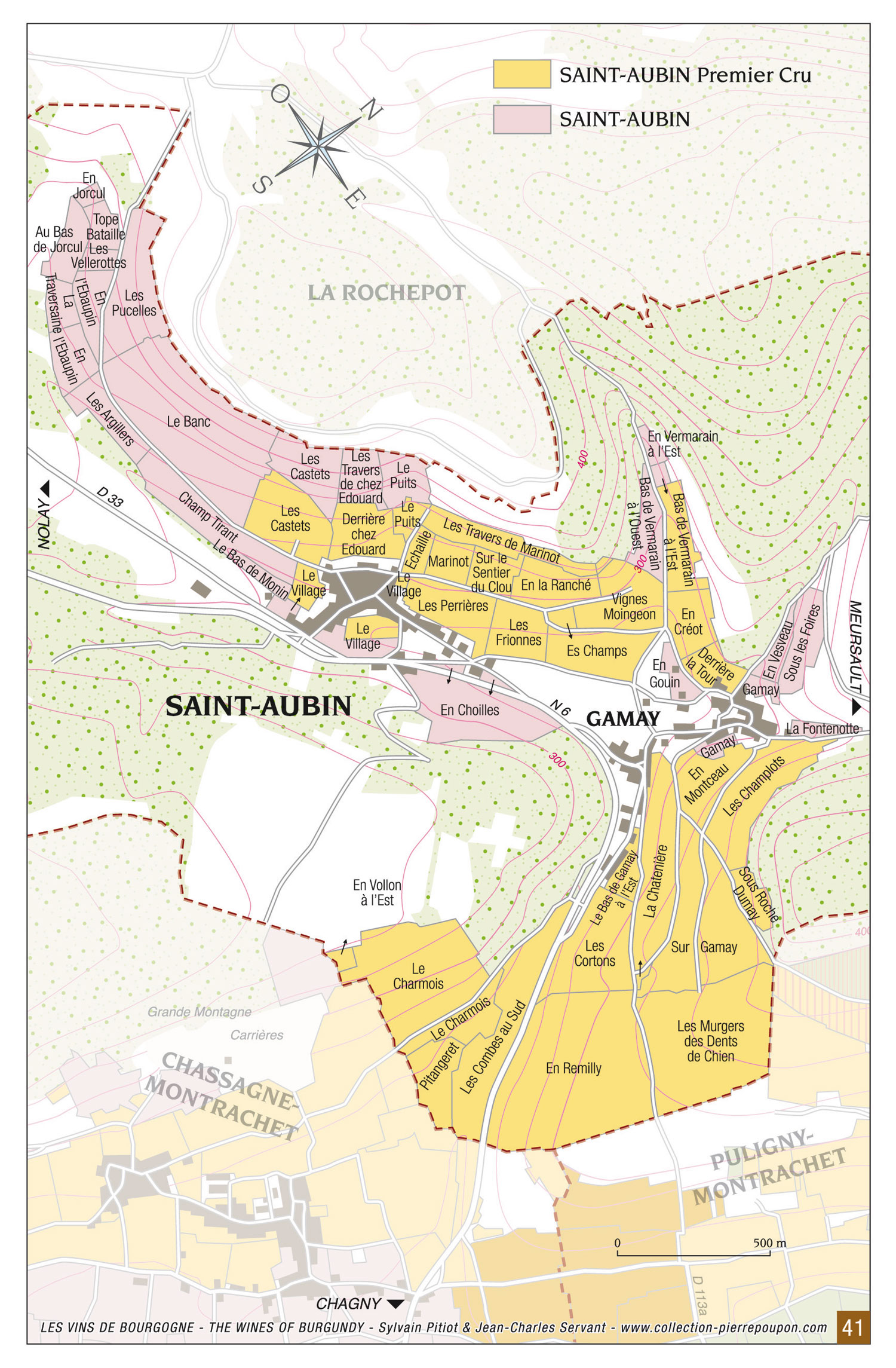
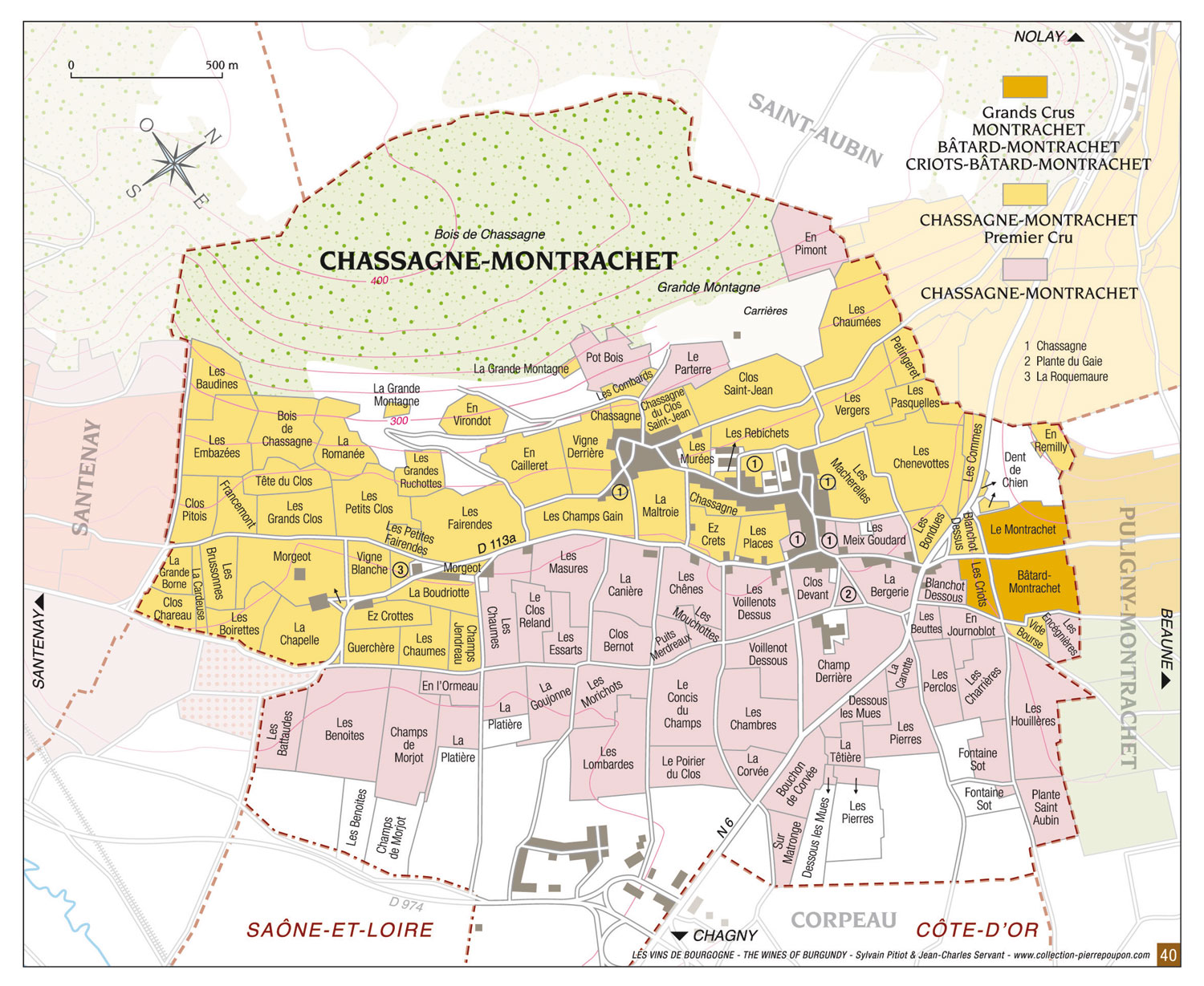
His own vineyards are mostly to be found in the wine appellation of St-Aubin, including premiers crus Chatèniere, Champlots and Remilly, and Chassagne-Montrachet: village Ancegnières and premiers crus Chenevottes and Caillerets.

However, the full range of wines from purchased grapes covers wines from Puligny-Montrachet, Meursault and the grand crus as well, including very fine Bienvenues-Bâtard-Montrachet and weightier Bâtard-Montrachet. More recently he has starting making wine from Pernand-Vergelesses, sitting adjacent to Aloxe-Corton. The Grand Cru’s of Corton and Corton-Charlemagne cross the border of the two with parcels in both appellations.

Ref: Jasper Morris MW,  Inside Burgundy – The Book

Where in the World is Pierre-Yves Colin-Morey?

Based in Chassagne-Montrachet, Pierre-Yves Colin-Morey has vineyard throughout the Côtes du Beaune. Fruit comes from Pernand-Vergelesses right next to the Grand Cru Corton, Corton, Saint-Aubin, and, the trilogy of Chassagne-Montrachet, Puligny-Montrachet and Meursault.

Find out more about each of these villages in the Wine Bites Magazine.

Pernand-Vergelesses is tucked into the junction of two valleys among the hills of the Côte de Beaune.

The nearby Hill of Corton stands guard over it and two other villages, Aloxe-Corton and Ladoix-Serrigny, harboring prestigious Grands Crus: Corton in red and Corton-Charlemangne in white.

Click to view detailed map of Pernard-Vergelesses

Heading further south you’ll find the four villages Puligny-Montrachet, Meursault, Saint-Aubin, and, Chassagne-Montrachet clustered together.

Click to view detailed map Saint-Aubin
Click to view detailed map Chassagne-Montrachet
Click to view detailed map Puligny-Montrachet


Click to view detailed map of Meursault

Where in the world does the magic happen?

Pierre-Yves Colin-Morey, Rue du Puits Merdreaux, Chassagne-Montrachet, France

Saint-Aubin
Côte du Beaune
Burgundy
France