Size & Type
Other

Pinot Noir from Macedon, Victoria, Australia
$152
The 2024 Between Two Mountains Pinot is composed, detailed and balanced with an expressive nose. A core of fruit has been tamed giving a delicacy. The fruit generosity is weighted nicely against the fine line of acid. Intrigue from the grip nicely countering sweet fruit. Fine Expressive. Will be interesting to see how it evolves.
Paul Kaan, Wine Decoded Oct 2026
The 2024 Between Two Mountains is one of the finest and most seductive Pinot Noirs we’ve produced so far. It comes from several high-density parcels (between 10k/ha and 25k/ha), including those that sometimes produce our Beyond The Forest cuvée. You can expect a fleshy yet vibrant, complex and hedonistic Pinot. Although it’s powerful, it’s also a wine of great perfume and finesse, and it’s already approachable (although it will certainly age well). It was matured for nearly 30 months: the first two years in oak, then 6 months in tank, all the while building depth and complexity. We used a range of barrel sizes (228, 300, and 600 litres), with around 20% new. As always, no fining and no filtration.
Rob Walters
1,320 bottles and 15 magnums made.
In stock
Back in 1998 the 2025 Wine Industry Strategy was released. All sorts of numbers were bandied about, including new planting area to be reached by 2025. That target was hit in either the year 2000 or 2001. The growth was insane and often ill-considered.
It had been a dry few years following the wet 1996 and sites that were swamps in a wet year were being planted by those new to regions like the Yarra Valley.
Vine material was not always of the best quality, and, vineyard preparation often followed a recipe. That is simply what was done.
With such rapid expansion, the end result was the wrong varieties were often planted on bad sites, and, the skill to nurture vines through their early years was not available.
The reality is the industry is rooted, there is an incredible number of wineries that are simply not viable, while we celebrate makers of good vino who keep their prices down, most of the time they’re living on the edge. Making 50c off a $30 bottle of wine.
Flood, frost, fire, phylloxera, global warming, and, drought making the odds of success at the roulette table much more appealing.
All of this means that of the innumerable parts of the vineryard / winery system a winery can pay attention to many just can’t be achieved through lack of finances and time.
Enter Rob Walters and his partner Kate Millard. In 2011 with the help of Michael Dhillon of Bindi, they found a site to plant in Bullegranook, Macedon.
Planting a small vineyard with up to 30,000 vine per hectare requiring several times the standard labour to manage, is economic insanity.

Passion and cashflow from other sources, turning a small fortune into a minuscule one is the driver for this project just like so many other wine ventures.
An incredible amount of thought has gone into this project, with both feet firmly all in, applying a whole of system approach that any bean counter would consider crazy.
The Place of Changing Winds is starting to reveal its potential.
Rob being an importer of some of the world’s best wines has had exposure to some of the great wine minds. They have shared their wisdom and contributed to this unique project.
There may be things about the project that people will find confusing or disagree with. What you have to admire is the single-minded intent of making the best glass of vino they can. And, like so many in the industry the sacrifices they are willing to make to get there.
These early results are showing great promise.
From Rob Walters:
Place of Changing Winds is an organic, high-density vineyard located in Bullengarook, a small hamlet in the Macedon Ranges of Victoria. Changing Winds takes its name from the original inhabitants, the Wurundjeri people, who named the place where the vines are currently planted Warekilla (or Place of Changing Winds). This characteristic still holds true today.
Situated at 500 metres above sea level, the ancient soils here are riddled with quartz, quartzite and sandstone and only Pinot Noir and Chardonnay is grown. The vines are planted very closely at a range of densities—from 12,000 to 33,000 vines/ha. The average density is over 15,000 vines/ha. Through decades of research and engagement we have developed our own version of organic practice, a model specifically adapted to our place and our vision. This model is designed to produce wines of the highest possible quality and the maximum expression of place.
Our system of practice has come out of research into historic practice, close observation of many great growers, and trial and error in our place.
Our practices include:
· Super high-density plantings: vines planted at 12,500, 14,000, 20,000, 25,000, and 33,000 vines/ha.
· Extremely low yield per vine—currently <250gm per vine (mainly driven by competition but also our soils and practices).
· Organic certified.
· Poussard pruning for five years now. Essentially, we form a two- or three-arm goblet, which is pruned in a way to maximise sap flow and minimise wood disease. This is a much more labour-intensive type of pruning, but the health benefits for the vine are significant.
· High canopy, with plaiting and arching of vines—no trimming.
· Co-plantation of plant material for part of the vineyard.
· An organic compost program designed to stimulate life in the soil, not vigour.
· We do a lot of work by hand.
In fact, across the entire vineyard, apart from some cultivation and organic treatments by tractor in some areas, everything is done by hand. This includes pruning, shoot thinning, lateral removal, hand weeding, arching shoots, shoot positioning and picking. We also do a great deal of our spraying by backpack on foot. We estimate that we visit each of our vines around ten times per year for some kind of manual work (by hand). There are also parts of the vineyard that have no tractor work at all – i.e., everything is done by hand or with a winch. All this is both for precision and to minimise compaction.
· Where we do use a tractor, it is a very light, <700kg machine on Caterpillar tracks, again to minimise compaction. It can run over your foot without injury.
· We also rarely use contract labour—only for some hand weeding and lateral removal—to ensure the standard of our work is extremely high.
· All of this work requires more than one, directly employed full-time person per hectare of vines. The resulting fruit cost is in the realm of $25-30K/tonne at the moment.
· The Estate wines are all grown, made and bottled, via our own bottling line, on-site. (The Syrah wines are also made and bottled by us.)
These practices haven’t come from nowhere. They are what I have observed at the Estates of a number of great growers, and those I have seen achieve outstanding results. Of course, I did not see all of these practices used at one single producer, and we have adapted them to our place.
More to come.
The ‘24 season was defined by two distinct features: firstly, a wet flowering period, where four rain events wiped out over two-thirds of the potential Pinot Noir crop, and most of the Chardonnay. Hence the tiny quantities. After that, we had a beautiful, mostly sunny, season that was long and mild. We finished with a classic harvest date range of mid-to-late March. The Pinot was picked on the 12th of March, with the small yields allowing us to pick everything in one day, whilst the Chardonnay was slower to ripen, and was picked on two separate days, the 20th and 26th March.
Our bunches are always small, typically averaging around 70 grams, but the poor flowering this year reduced bunch size even further, to between 30 and 50 grams, and we averaged just over 100 grams of fruit per vine. In the end, we produced less than 12 hectolitres per hectare across the vineyard. To put this in context, Grand Cru Burgundy can be cropped at 40-50 hectolitres per hectare (which equates to roughly 600-700 grams of fruit per vine).
So, the quantities are very small, but the quality is genuinely outstanding. Our goal with the Estate wines is simple: to produce the finest, most intense wines of place we can, from our small three-hectare vineyard. With time, as our vines (now approaching 15 years) and our practice mature, we continue to progress in both the vineyard and the cellar, adapting to our place and each season. Each year brings its unique challenges and learnings. In 2024, our biggest challenge was the tiny yields. In the end, we are proud to have produced beautiful wines of real depth, finesse and character. We believe they are our best so far.
As you likely know or have heard, our cost of production is extremely high, reflecting both our low yields and high density, and our precise, labour-intensive practice, in which each of our vines is visited around 15 times per year for a manual function performed by hand. In the 2024 season, we employed 9 people , roughly 3 per hectare (more than D.R.C., more than Leroy). It’s not a competition, of course—I tell you this so that you understand the intensity of our approach (which starts with the question: what happens when you apply the very best practice in a cool, marginal, high-density, Australian setting?) and so that you understand our pricing (our revenue from 2024 will barely cover our costs). Of course, we believe this attention to detail is required to achieve the quality of Pinot Noir and Chardonnay we are striving for, and we hope that, with better yields in future years, it will all make sense. For now, what’s important is that we are genuinely excited by the quality we have achieved in 2024 and 2025, and can’t wait for people to taste the wines.
Rob Walters
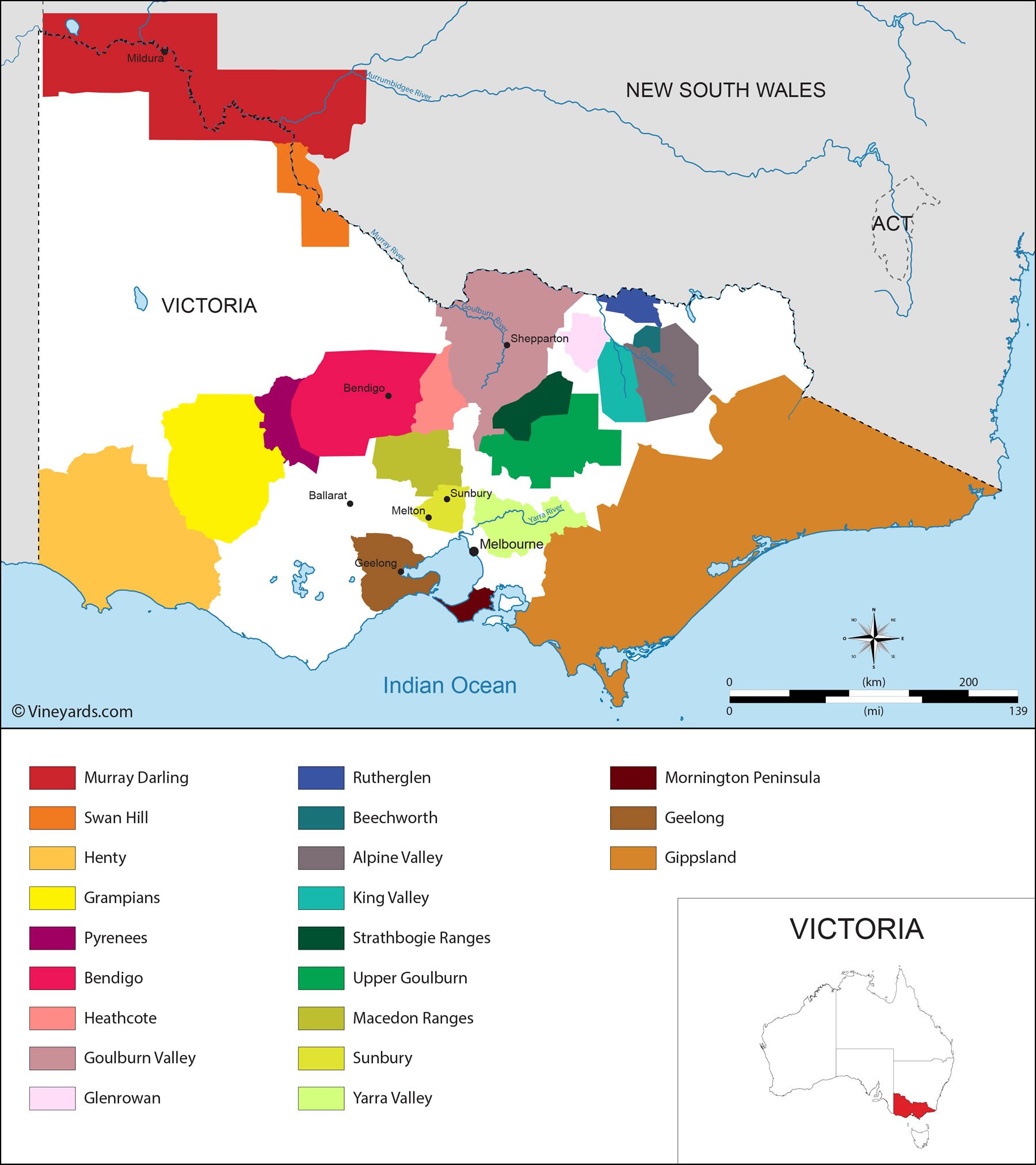
Place of Changing Winds is in Bullengarook within the Macedon Ranges, one of Victoria’s cool climate wine regions. Look to the north and a little west of Melbourne.

Where in the world does the magic happen?
Bullengarook VIC, Australia
You must be logged in to post a comment.