Size & Type
Other

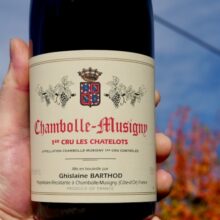
Pinot Noir from France, Côte-de-Nuits, Chambolle-Musigny, Burgundy
$480
Exuberantly fresh aromas of essence of various red berries with a broader array of spice notes leads to detailed, even chiseled, lighter weight flavors that exude both energy and minerality on the understated, firm and moderately austere finale.
Allen Meadows, Burghound 89-92 Points
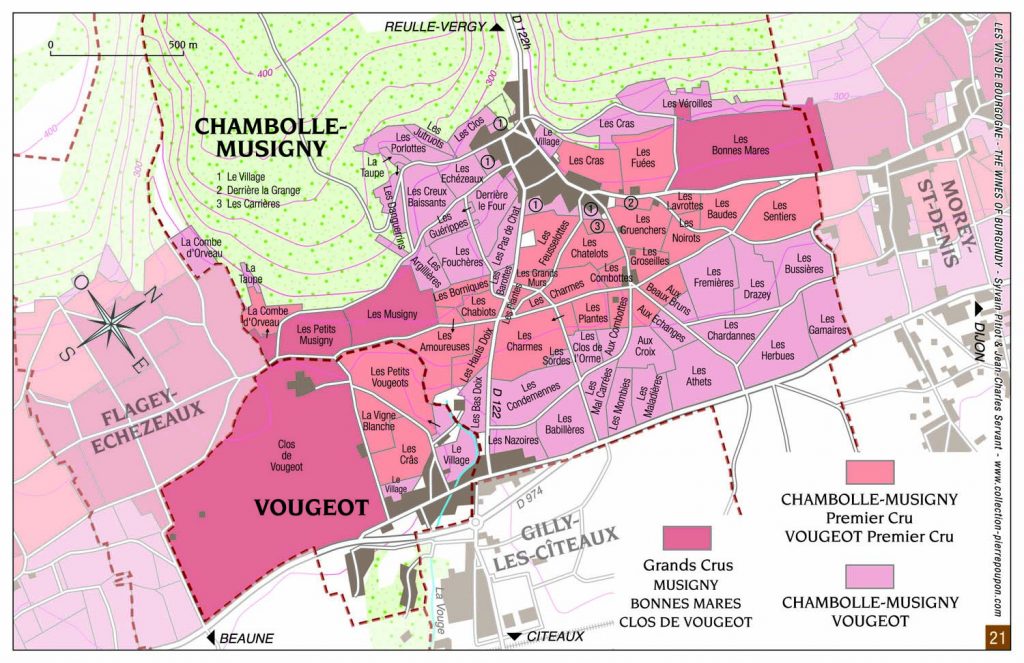
The Chatelots vineyard (2.96 hectares) is also close to the town and partly adjoins Les Charmes. The topsoil is deeper and more alluvial, with plenty of small stones. This cuvée is always energetic and bright, bristling with energy. Only the ancient, 80-year-old vines are used for this cuvée. The younger vine material is declassified into the Chambolle villages. Vinified with 20% new oak.
Only 2 left in stock
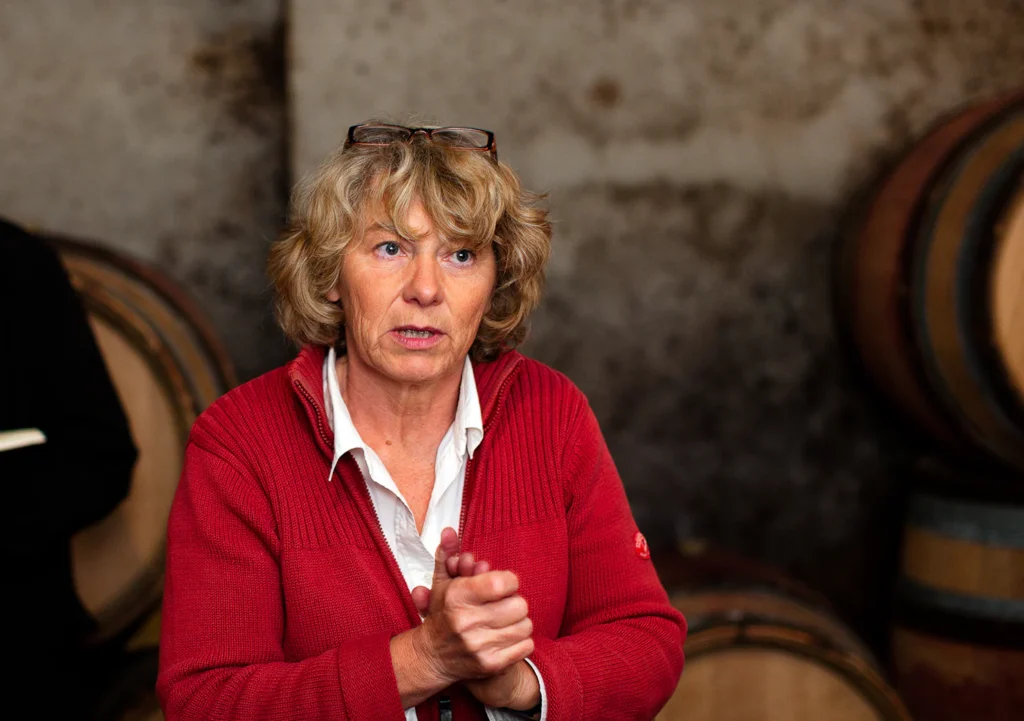
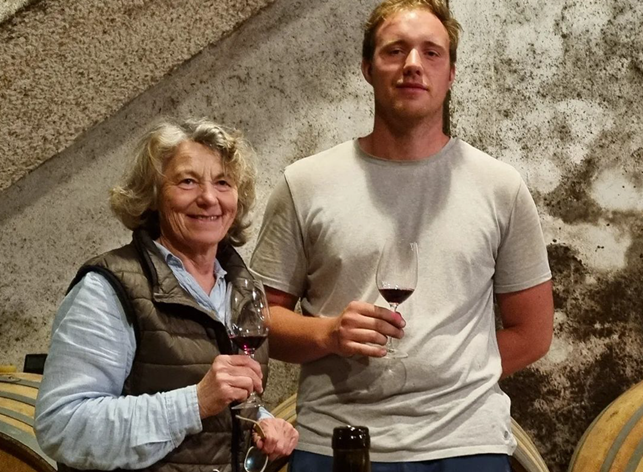
Ghislaine Barthod’s domaine originates back to the 1920s when it was owned by Marcel Noëllat. His daughter married Gaston Barthod, a soldier stationed in Dijon who visited the winery to buy some wine and consequently fell in love with the girl who sold it to him.
Gaston gave up military life for a new life amongst the vineyards in 1960. His daughter, Ghislaine, and her partner Louis Boillot bought their current premises overlooking Premier Cru Les Feusselottes in 1986. Though they share the team who work the vineyards for both, the vinification and commercial aspects of each business is kept completely separate. Ghislaine’s father Gaston died in 1999, yet effectively Ghislaine had been making his wine for a decade prior to his passing.

Since 1999, the high quality produced by Ghislaine Barthod has ensured a powerful following amongst Burgundy enthusiasts in the know. The style is unashamedly intense, with both the perfume and sensuality that has made Chambolle such an iconic commune but also the density and structure to age (an attribute that Ghislaine strives for).
Ghislaine Barthod’s wines balance the natural elegance of Chambolle with sensual depth, structure and longevity. Many, if not all the wines at this address manage to blur the hierarchy.
The overall effect of tasting at the domaine is to come away with a palate coated in sensual Chambolle fruit. Ghislaine Barthod’s wines are always supremely elegant and harmonious and display admirable concentration and length. The best examples can age gracefully for up to 20 years.
Anyone who doubts the reality of terroir need only taste their way through the range of Ghislaine Barthod wines each year to be converted. While the Domaine is small with just under six hectares of vineyards (one of the reasons it flies under the radar) it includes a remarkable nine Chambolle-Musigny Premier Crus. These are all made exactly the same way, and yet, they all have very different personalities from each other: personalities that express themselves year in and year out, irrespective of the climatic conditions. That said, these Burgundies are not simply subjects for terroir voyeurism—they are just far too delicious for that. To quote Terry Theise, “…that would be like ignoring the rainbow so you can balance your chequebook.”

Ghislaine’s son, Clément Boillot is now heavily involved in the running of the Domaine, along with his father’s Domaine Louis Boillot and their operations in Beaujolais, Louis Boillot-Barthod. They say the apple never falls far from the tree, and from what we have seen—even by this Domaine’s lofty standards—the quality of Clément’s first releases has been astonishing. In the cellar, Clément is running trials with amphora and foudre and is in the early stages of introducing biodynamic viticulture. We know from discussions with Clément (and from what his mother has told us about him) that he is likely to be a wonderful manager of this Domaine in the future. He has the drive of the true vigneron: emphasising the vineyard over the cellar. What a legacy he is inheriting!
I have now tasted more wines from Clement, and it seems like there are two tendencies. Firstly, the style has been lightened a bit … not much … but enough to increase the delicacy and the transparency of the wines. In times of increasing global warming its always welcome to make lighter and more transparent wine.
The second tendency is that the Boillot wines are slowly but surely getting integrated into Clement’s style of wine, hence also the Ghislaine Barthod style. Actually, there is not really a big difference anymore… and I think it’s safe to say you should consider to buy some Louis Boillot wines also …
The estate is made up of just under 6 hectares (15 acres) of vineyards. Over half of this is split between eight well-sited plots in Chambolle-Musigny premier cru vineyards, with the remaining land in Villages-level and AOC Bourgogne parcels.
Restricted crop and meticulous attention to élevage are the ‘simple’ keys to Ghislaine’s success. Her straightforward, no-nonsense approach helped introduce a sorting table to discard any grapes that were not up to scratch. Along with this; a gentle cool pre-maceration before fermentation is used to extract all the fruit’s freshness and flavours; only natural yeasts are used; the grapes are destemmed, allowed a brief cool soak before being fermented naturally in open-top wooden cuvees with more punching down than pumping over. The wines are then matured in barriques (roughly a quarter of which are new). The wines are usually bottled after 18 months, after one racking.
I again met with the young Clément Boillot, who is the son of Ghislaine Barthod and Louis Boillot (see below). Clément is slowly taking over both domaines and while his parents remain very much involved, it’s clear he is the future. The younger Boillot, commenting for both domaines, noted that 2022 had a “much easier-to-manage growing season compared to 2021 though we did have some excitement in our Gevrey vines due to the massive end-of-June storm. We picked from the 27th of August to the 15th of September. Yields were good at around 45 hl/ha except in Gevrey where they were more in the 35 hl/ha range. Potential alcohols were perfectly good though not high at between 12 and 12.5% and we chaptalized about half a degree, which is to say from 12.5 to 13%. The Côte de Beaune fruit definitely came in riper than that from the Côte de Nuits though that didn’t necessarily translate into better wines in my view. We did a soft but relatively long cuvaison of around 4 weeks that had no problems properly finishing. As to the wines, I frankly expect them to be tannic, soft and lacking in energy yet they are the exactly opposite! Despite the fact that technically speaking, the acidities on the low side and the pHs are on the high side at between 3.6 and 3.8, they drink like they have bright acidities and much lower pHs.” As long-time readers know, the Barthod wines are almost always first-rate and the family has again produced superb examples in 2022.
Allen Meadows, Burghound
Clément Barthod-Boillot, who has formally taken the reins at this Chambolle-Musigny reference point, was preoccupied by recent fatherhood during my visit, so it was his father, Louis Boillot, who guided me through another persuasive tasting at this benchmark address. The 2021 vintage must have been disconcerting for Clément, but now that the wines are safely in bottle, I’m sure he’s as satisfied as his parents with this exquisitely balanced, concentrated and vibrant set of wines that will delight Burgundy purists.
William Kelley, The Wine Advocate
Domaine Ghislaine Barthod is based in Chambolle-Musigny, Côte-de-Nuits, Burgundy, France

The film below explores the geology and geography of Chambolle-Musigny
Exuberantly fresh aromas of essence of various red berries with a broader array of spice notes leads to detailed, even chiseled, lighter weight flavors that exude both energy and minerality on the understated, firm and moderately austere finale.
Where in the world does the magic happen?
Domaine Ghislaine Barthod, Ruelle du Lavoir, Chambolle-Musigny, France
You must be logged in to post a comment.