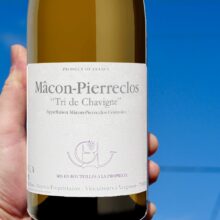
Domaine Guffens-Heynen Mâcon-Pierreclos 'Tris de Chavigne' 2024

Product information

Domaine Guffens-Heynen Mâcon-Pierreclos ‘Tris de Chavigne’ 2024

Chardonnay from Pouilly-Fuisse, Mâcon, France, Burgundy

$238

$228ea in any 3+
$218ea in any 6+
Closure: Cork

Description

The 2024 Mâcon-Pierreclos Tris de Chavigne blossoms in the glass with aromas of pear, white currant and freshly baked bread, mingled with a subtle exotic note of passion fruit. Medium-bodied and fleshy yet vibrant, it reveals a texture rarely encountered in this vintage, framed by structuring extract and a cool, marine profile, concluding with a long, saline finish. It incorporates some of the fruit that would typically inform his Juliette et Les Vieilles de Chavigne cuvée.

Kristaps Karklins, The Wine Advocate 91-94 Points


“The 2024 Mâcon-Pierreclos Tri de Chavigne has turned out beautifully, offering up aromas of pear, clear honey, white flowers and freshly baked bread. Medium-bodied, satiny and seamless, it’s ample and fleshy for the vintage, with lively acids and a saline finish. This contains the wine produced from the parcels that are sometimes bottled separately as Juliette et Les Vieilles—though Guffens admits that he did bottle one hectoliter of the latter for his personal consumption.”

William Kelly, The Wine Advocate 91-94 Points

In stock
Check out all of the wines by Domaine Guffens-Heynen

Why is this Wine so Yummy?

About Domaine Guffens-Heynen

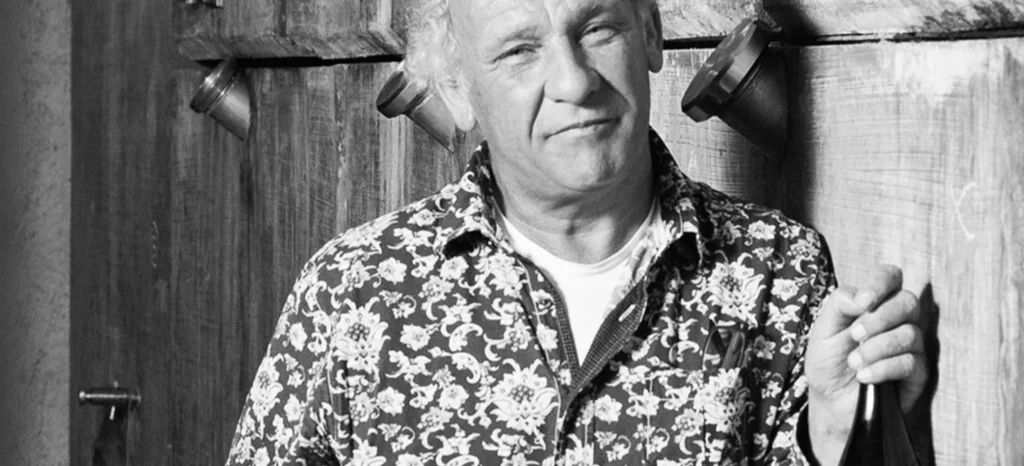
Over the decades Jean-Marie Guffen’s predisposition for ruffling feathers may have, at times, overshadowed the significance of his many triumphs. Today I think people simply accept that Guffen’s straight-shooting style simply comes with the territory. Indeed, the bullshit-free universe that Guffens inhabits may in fact be one of the key reasons why he has become such an important and influential grower in Burgundy. Trying to make better-than-Grand Cru whites in the Mâconnais? What kind of personality would try such a thing? Only an iconoclast, able to see through the cultural straight jacket of his times and recognise things as they might be in an alternative universe.

Jean-Marie Guffens and his wife Maine established the estate in the late 1970s and run it with trusted winemaker Julien Desplans.

“Domaine Guffens-Heynen is one of the great domaines of Burgundy. Ample but incisive, concentrated but weightless, Guffens’s wines represent the apotheosis of a grape and a place. To say they are the equal of the wines of Puligny-Montrachet or Meursault would be to do them a disservice, because they’re all too frequently better.”

William Kelley, The Wine Advocate

“He has the magic touch that you cannot learn from a book. The one constant throughout [Guffens’ career] has been the quality of his wines. However much you might disagree with his views or smart at his opinions, you cannot argue when you take that first sip.”

Neal Martin, Vinous

There is still a great deal of poor viticulture in the Cote d’Or and there are many great and historic terroirs in them Mâcon. If you work to the highest possible standards in these latter terroirs, there is no reason why you shouldn’t be able to achieve greatness. Guffens saw this and he was right. Now others are following his lead. There’s no doubt that when the stars align, as they so often do here, Domaine Guffens-Heynen is nigh on untouchable.

Domaine Guffens-Heynen is Jean-Marie Guffens’ folly. He pulls out all stops to make the greatest wines possible from the Mâcon, and the results are in the bottle for all to taste.

The Guffens-Heynen wines are very different in style to those of Verget – much more powerful, opulent, and layered. Meticulously produced from tiny yields of only flawless berries, these wines are made in minuscule quantities and allocated strictly. The fruit is harvested via multiple runs through the vineyard over a period of days. Only the perfect fruit makes it to the press. In the winery, Guffens’ favourite toy is a small hydraulic Champagne press made by Coquard in 1930, which he had rebuilt by hand in time for the 2001 harvest. This tool gives him the flexibility of being able to press multiple tiny batches of grapes each day, rather than having to wait longer to fill a larger press. While he can press extremely gently overnight, he can also drain off the free-run juice and capture 85% of the volume of the grapes in half an hour.

Grown and crafted by one of the wine world’s true freethinkers, these are wines of rare intensity and complexity, not just for Mâcon but for Burgundy as a whole. They twist and turn with every sip, evolving in surprising ways, and will gain finesse and minerality with bottle age while others simply gain weight. You don’t come here looking for lean, crunchy, reductive whites. You come knocking at the door of Guffens for power, expansiveness, waves of fruit and rocky minerality. As Andrew Jefford has written in The New France “Before Guffens, no one knew that Mâcon Peirreclos or even Pouilly-Fuissé could rival Corton-Charlemagne or Bâtard Montrachet. Now they do.”

In the Vineyard

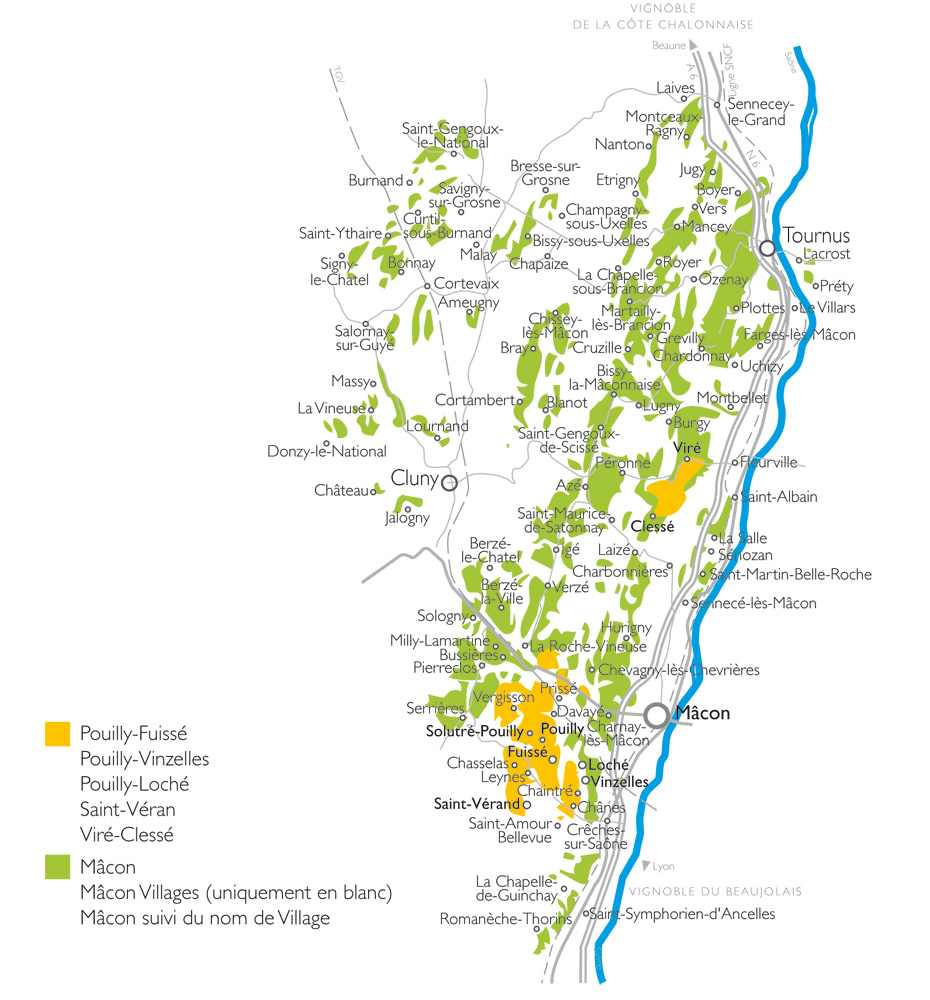
The estate covers just under six hectares of vines in Mâcon-Pierreclos, Saint-Véran and Pouilly-Fuissé, with soils ranging from clay-limestone to more calcareous and stony profiles.

Farming is organic in practice, with no use of sulphur, copper or synthetic sprays.

Guffens believes in making honest wines, and is propelled by the belief that his region of Macon can create wines of legendary quality; judging by some of the remarks of critics over the last few decades, few disagree with Guffens at all. Through his varied trials in the vineyards, Jean-Marie’s methodologies were firmly in the camp of “less is more” – in fact, he coined the term “non-cultivation” to describe his approach. Whereas many a vigneron would have manicured the vine rows and ploughed regularly, Guffens would instead only plow once and very shallow, and continue to mow the cover crop throughout the year while allowing the vine to be “guided, not restrained.” His argument is that maintaining the grass through the year, rather than ploughing it in will both reduce soil compaction and limit nitrogen; the resulting grapes are higher in acidity, smaller (leading to more concentration), and in conjunction with not de-leafing or hedging (which stimulates growth), promotes the vine churning all of its energy into the fruit.

The result? Guffens’ clusters are wildly small with tiny grapes; yields are routinely around 37-38 hectoliters per hectare, and the small grapes lend a higher ratio of solids-to-juice; this means more dry extract, or, in more everyday terms, a less dilute and more concentrated flavor. Ripeness is always desired, and so there will be repeated “tries” through the vineyard over multiple weeks to ensure the clusters are picked at ideal times.

In the Winery

As important as picking ripe grapes is in the vineyard, pressing may be one of the most crucial parts of winemaking to Jean-Marie. The grapes are lightly crushed before being pressed. In the winery a modified Coquard press is used; this is also uncommon in Burgundy but more common in Champagne where delicacy is the name of the game. Much like Champagne, where the press cycles are intended to be separated by the regional laws, Jean-Marie will separate his free-run juice – the juice provided only by the weight of the grapes themselves – and the different cycles of the press; by doing so, he will be able to create his wild array of wines that are kaleidoscopic in flavors by virtue of varying levels of density via the pressure under which the grapes were squeezed.

For the most prized vineyards, the free-run and first-press juice is of utmost importance as it is both delicate and low in pH – meaning high-acidity which is hugely important for wines of such ripeness as the Guffens wines are. In short, sorting, fermenting and blending are performed intuitively, which is mirrored by the creative labeling that knows no bounds. Certain vineyards and wines are routinely repeated – Croux et Petits Croux, Juliette et les Vieilles de Chavigne, etc. – but there are no limits to what Guffens and his winemaker, Julien, can create in any given vintage. The top wines routinely are fermented in barrel, while the young-vine plots will be fermented in concrete. A varying amount of new oak is used, while batonnage is performed multiple times throughout to stimulate a healthy culture in the wine. Ultimately, as Guffens says, each wine “began with an idea.” To translate that, no wine is formulaic; the signature here is that of vibrancy, feeling and a true sense of spirit, if not place.

The 2024 Vintage at Domaine Guffens-Heynen

Jean-Marie Guffens excelled in the cool-season 2024 vintage, producing wines of aromatic plenitude and concentration rarely encountered in this year in Burgundy, challenging preconceived notions of what the Mâconnais is capable of.

“The harvests were very small at all three estates. At Domaine Guffens-Heynen, Julien has been in charge of the day-to-day management for the past year and assists me during the winemaking process. Our collaboration couldn’t have been better, as the vintage was very complicated. Thanks to the improvements he proposed and organized in harvest reception, we were able to harvest each plot on the right day. This allowed us to double the daily harvest while reducing the workload, all without changing our philosophy. The result is astounding. The few people who have tasted these wines have all been dazzled by the precision on the nose, the fruity attack, and the length on the palate. I thought we could do as well as in 2014, but I’m sure we’ll surpass it.”

Jean-Marie Guffens

Where in the World is Domaine Guffens-Heynen?

The estate covers just under six hectares of vines in Mâcon-Pierreclos, Saint-Véran and Pouilly-Fuissé, Mâcon, Burgundy, France with soils ranging from clay-limestone to more calcareous and stony profiles.

91-94 Points

"The 2024 Mâcon-Pierreclos Tri de Chavigne has turned out beautifully, offering up aromas of pear, clear honey, white flowers and freshly baked bread. Medium-bodied, satiny and seamless, it's ample and fleshy for the vintage, with lively acids and a saline finish. This contains the wine produced from the parcels that are sometimes bottled separately as Juliette et Les Vieilles—though Guffens admits that he did bottle one hectoliter of the latter for his personal consumption."

WIlliam Kelly, The Wine Advocate

94 Points

The 2024 Mâcon-Pierreclos Tris de Chavigne blossoms in the glass with aromas of pear, white currant and freshly baked bread, mingled with a subtle exotic note of passion fruit. Medium-bodied and fleshy yet vibrant, it reveals a texture rarely encountered in this vintage, framed by structuring extract and a cool, marine profile, concluding with a long, saline finish. It incorporates some of the fruit that would typically inform his Juliette et Les Vieilles de Chavigne cuvée.

Kristaps Karklins, The Wine Advocate

Where in the world does the magic happen?

VERGET SAS, 1, Montée du Couvent - 71960 Sologny

Pouilly-Fuisse
Mâcon
Burgundy
France