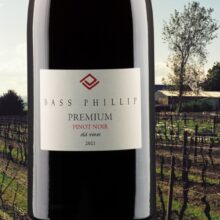
Size & Type
Other

Pinot Noir from Gippsland, Victoria, Australia
$285
“This 2024 Premium Pinot Noir has a strong whole bunchy feel with beautifully composed layers of dark cherry and woody herbs with a lining of Szechuan pepper and licorice. Complex and a little wild showing strong meaty, earthy and cola tones. Most notable is the firm structure thanks to chewy tannins and vibrant, balanced acidity which builds to a strong finish. A wine built with cellaring in mind. 2030-2040.”
Angus Hughson, Wine Pilot 94 Points HH 97
In stock

The three wines at the top of the Bass Phillip hierarchy — the Estate, Premium and Reserve Pinot Noirs — have always come from the same original 1979 main vineyard in Leongatha: a 3.5-hectare block, known as the Estate vineyard. Within this vineyard the same rows of vines and sub-plots are used for each of these wines every year, purely because those vines give the best grapes, year after year.
Founded by Phillip Jones in 1979 at the age of 32, having spent an early career in telecommunications and IT research.
Phillip initially planted Cabernet inspired by the wines of Ducru-Beaucaillou at his home vineyard in Leongatha. After many years he realised his choice was in vain and replanted to Pinot and Chardonnay at vine density similar to those in Burgundy at 9,000 vines per hectare.
He was captured by the great wines of Burgundy (eg. Charles Rousseau and Henri Jayer) in the early eighties, which set him on the path of finding an appropriate region and appropriately organic techniques to develop pinot noir wines with depth and fine texture. He laboured for years without results and finally entered the Australian market in 1991. Since then, his Bass Phillip pinots have often achieved the highest ratings in the land, including the nomination of his 2010 Reserve pinot noir as the Australian Wine of the Year. The Bass Phillip vineyards have grown to 14 hectares over the past 25 years, much like a small Burgundy Domaine.
As of April 2020, Bass Phillip wines has welcomed the entry of – Jean-Marie Fourrier (of Domaine Fourrier) and associates. In this new phase of growth moving forward, Jean-Marie Fourrier will begin to take an active and primary role in the management of the vineyards and the wine production process as Chief Winemaker of Bass Phillip wines.
Jean-Marie carries on the development of fine wines with texture and complexity.
As a perfectionist, we crop our fruit at incredibly low levels to achieve the objectives in flavour development.
South Gippsland is not only renowned for dairy and beef, but also the giant Gippsland earthworm, which play an active role in the fertilization and airing of the deep mineral-rich soil of the vineyards. The region is blessed with approx.1,000 millimetres of rainfall per annum and a deep, silty loam soil filled with volcanic minerals. High temperatures (mid 30 Celsius degrees) in the summer months are balanced by humidity and late afternoon, cool air from Bass Straight. All these factors contribute to the intense flavours, aromatics and exceptional length in the finish, which are trademarks of Bass Phillip’s vibrant, yet graceful wines.
Following on from the initial plantings three additional sites: Belrose, Issan and Village were planted.
This is basically a story of “quality overrides quantity”
High density planting is one of the approaches taken by Bass Phillip to prove that Australia can produce a jaw-dropping pinot that is comparable with the best from the Pinot Monarch – Burgundy, France.
Bass Phillip achieves a cropping level of 1.0 -1.3 tonnes per acre (compared to from 2 to 4 tons per acre average in Australia). We believe this contributes to intensity and length of flavour which is not always prominent in Aussie pinots. Many question the economics of this low level of yield, but when the wine-making is driven by an obsession for perfection and instinctive flair, production costs become secondary.
Although a single vine at Bass Phillip barely makes half a bottle of wine, the highly perfumed nose, robust flavors, exquisite textures, profound complexity and minerality contained in each bottle provide a justification for this practice.
We believe strongly in a gentle hand. Racking is kept to a minimum and no pumps are used in the winery. “The difference between good and great Pinot Noir is texture. We try to minimise the bruising effects that pumping can have on this texture.” Ultimately our priority is to produce a wine that is completely natural and which expresses vineyard site. This sounds simple, but such a high standard does require a relentless pursuit of perfection – and a degree of madness.
The Biodynamic practice at Bass Phillip is planned according to the lunar cycles. Adopting these practices means that each vintage of Bass Phillip wines exhibits the characteristics of “mother nature’s” temperament, expressing the harmony of earth, moon and sun. Displaying the natural influences of nature’s power and elegance.
Wines at Bass Phillip are handcrafted with strict scientific analysis and monitored with rigorous quality control. However the story doesn’t end there, the real essence of Bass Phillip’s wine production is to allow the forces of nature to maintain control. Minimal human intervention is practiced wherever possible – no irrigation/pesticides/fertilizers, minimal pumping/ filtration, natural yeast, no fining agents.
The 2024 growing season at Bass Phillip has delivered a vintage defined by exceptional quality and structural intensity. In the cool, maritime climate of South Gippsland, we often face the vagaries of nature during flowering; this year, a cold and windy spell resulted in a slightly reduced total yield of 32.3 tons. However, for the dedicated collector, this smaller crop is a harbinger of excellence. The reduced yield has produced fruit with a high skin-to-juice ratio, translating into wines of profound concentration, vibrant natural acidity, and beautifully integrated tannins.
While the 2023 season was characterized by a swifter ripening process, 2024 was a year of patience. The cooler temperatures allowed for an extended “hang time,” with harvest concluding on March 27th. This gradual, even ripening has endowed the 2024 wines with a level of flavour complexity and aromatic precision that is truly distinctive. Our Chardonnays show a modest and welcome increase in volume and focus, while the Pinot Noirs possess the deep concentration and structural “spine” that ensure they will evolve magnificently in the cellar for years to come. In summary, 2024 is a vintage of balance and power—a testament to the slow, cool ripening that makes Bass Phillip one of the world’s most unique sites for Pinot Noir and Chardonnay.
Where in the world does the magic happen?
Bass Phillip, Leongatha VIC, Australia