Size & Type
Other

Winery
Winemaking is a gamble, every year you roll the dice and use knowledge gleaned over time to harness what nature has presented you in the form of grapes. Ben’s always has lovely touch and it’s showed from day 1 in the Côtes du Beaune.
Over the last couple of years Ben’s touch has extended from the Côtes du Beaune to the Côtes du Nuits.
Each year I find the pleasure derived from both Côtes getting closer & closer to one and other.
Benjamin Leroux is widely considered to be one of the most gifted and knowledgeable wine growers in all the Côte d’Or. Born and bred in Beaune, Leroux has always been considered a prodigy, studying at the Lycée Viticole in Beaune from age 15 and taking the reins at the esteemed Domaine Comte Armand when he was just 24. Leroux would stay at Comte Armand for fifteen vintages, while simultaneously launching his eponymous négociant operation in 2007.
In 2014 Leroux left Comte Armand—in great shape, we might add—to concentrate on his young venture. The first stage of his evolution allowed him to establish the winery (in the old Jaboulet-Vercherre premises off the Beaune périphérique) and refine his ideas and understanding of the terroirs with which he wanted to work. The way Leroux structured this side of his business was highly innovative. His aim was to create the same quality standards of the finest domaines, despite not owning most of the vineyards. He has long-term relationships with the growers he works with, some of which he pays by land area rather than the quantity of fruit harvested. This allows him to dictate lower yields, ripeness, date of harvest, and so on. He only works with high-quality growers who plough or do not use herbicides or pesticides. Most are organic or biodynamic. For those that are not, there is an understanding that they will move to organics over five years.
Leroux’s knowledge of the Côte is encyclopaedic, and he has unearthed some very exciting, previously less well-known terroirs for his portfolio. It’s important not to underestimate how close Leroux works with these growers, as that is one of the keys to his ability to coax the finest fruit quality from the vineyards. He never buys juice or finished wine, only fruit; he nominates the harvest dates and will pick himself if necessary.
“He certainly has the gift of touch that seems to elevate everything from village crus to grand crus.”
Neal Martin, Vinous
In tandem with his excelling négociant business, Leroux has quietly been building up his family’s impressive domaine holdings, which now run to eight hectares. Though he worked these vineyards organically and biodynamically from the beginning, it took him several years to apply for organic certification, which came in 2016. Ben’s first vineyard purchase was a 0.16-hectare slice of Batard-Montrachet in 2009, though most of Leroux’s white vineyards lie in Meursault and include crown jewel parcels in Genevrières-Dessus and Charmes-Dessus. For the reds he farms his beloved Blagny 1er Cru La Pièce Sous le Bois, in Volnay Santenots and there are a number of small parcels in Vosne-Romanée.
For coming on 20 years, this has been one of the most dynamic cellars on the Côte in terms of winemaking. Leroux works with some 50 appellations and every wine has its own bespoke treatment according to the conditions of each vintage. This makes it difficult—and sometimes misleading—to try and generalise about the winemaking. We can say that the cellar is using more and more 600-litre, 1200-litre, and even larger casks for the whites, and more and more 450-litre to 600-litre barrels for the reds. It is also becoming moot to talk of new oak, of which so little is now used (especially for the whites). Likewise, to generalise about Leroux’s winemaking decisions, such as using whole bunches, is like trying to hit a moving target: in any given year, Leroux works with between 0% and 70-80%!
Since 2018, Leroux has used a cold room to preserve bunches overnight, at under 13°C, resulting in a cool, slow start to fermentation.
Every year this thoughtful and precise grower keeps hitting a higher bar, continually adapting to each vintage and the ever-changing climate. He remains one of the most talented and learned winegrowers in Burgundy, and although he can release as many as fifty different wines in any given year, they are all at an astonishingly high standard. Indeed, don’t be misled by the number of wines he offers. His smallest parcel is 0.06 hectares, and many of his sites are not much bigger: most wines are produced in the one-to-five-barrel range
One rule reigns supreme it’s all judged by taste, what’s in the glass. Whether it’s use of large wood, stalks, or whole berries he’s constantly experimenting to find ways to evolve.
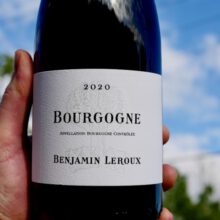
Showing of wines
Pinot Noir from Beaune, Côte du Beaune
This year's blend includes Bourgogne-level fruit from Leroux’s key sources: the excellent Maison Dieu in Pommard, Mon Poulain in Volnay and Les Belles Côtes in Meursault. In 2022, these sites are complemented by village wines from Monthélie. Leroux opted to use whole-bunch fermentation only on the homegrown components. Maturation took place in 2,200-litre Grenier oak casks. As always, this punches way above its weight division. So crunchy and pure, yet with depth, it’s loaded with gr
Pinot Noir from Savigny-lès-Beaune, Côte du Beaune
The lion’s share of this release comes from the outstanding Aux Fourneaux lieu-dit in the north of the village. Leroux works with lots of Pinot Fin here (a high-quality, low-yielding Pinot Noir cultivar), giving low yields and great concentration. The fruit from these vines fermented with 15% bunches. A fully destemmed parcel of Les Conardises was also included this year. The wine, half of which was raised without sulphur, matured exclusively in large cask—half in foudre and half in 600-litr
Pinot Noir from Savigny-lès-Beaune, Côte du Beaune
The vines here are owned by one of Leroux’s close friends and are sited in the heart of the 1er Cru, on the east-facing, Beaune side of Savigny. This is the area from where the most elegant Savigny wines tend to derive—so perfect for powerful years. Like most of the terrain in the Côte d’Or, the soils here are clay/limestone, but the clay here is light and sandy. So, although there’s more flesh here than in the villages cuvée—there is also greater finesse. The 2020 was fermented with
Pinot Noir from Savigny-lès-Beaune, Côte du Beaune
One of Leroux’s close friends owns these vines in the heart of the 1er Cru on the east-facing Beaune side of Savigny. The most elegant Savigny wines tend to come from this area, so it is perfect for powerful years. Like most Côte d’Or terrain, the soils are clay/limestone, but the clay is light and sandy. So, although there’s more flesh than in the village cuvée, there is also greater finesse. All the fruit was destemmed this year, and again, it is a wonderfully bright and juicy renditio
Pinot Noir from Pommard, Côte du Beaune
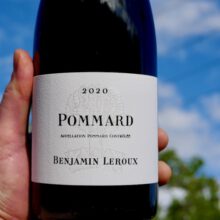
Given his experience in Pommard, home turf, if he'll have handle on any fruit this will be it! As with last year, this is a blend of Les Vaumuriens (high on the slope) and Les Cras (on the lower slope), both vineyards lying on the Volnay side of the village. Leroux notes the cooler, hillside fruit from Les Vaumuriens brings freshness and balance to the blend. This was crafted from 100% de-stemmed berries and raised with roughly 20% new oak. We have very little.“The village Pommard is a suc
Pinot Noir from Nuits-Saint-Georges, Côte-de-Nuits
This blend of Nuits-Saint-Georges climats includes the village lieu-dit Les Allots and three Premiers Crus: Les Cailles, Aux Thorey and Les Boudots. The lion’s share, however, is drawn from Aux Herbues on the Vosne border and a parcel in the northern part of Fleurières, just south of the town. This year, Les Tuyaux, a stony terroir at the very northern end of the appellation, has joined the party. The 2022 was entirely destemmed. My notes read “Very Ben Leroux” in that it’s a
Pinot Noir from Pommard, Côte du Beaune
Given his experience in Pommard, home turf, if he'll have handle on any fruit this will be it! A lovely perfume, as expected still very youthful. Building in weight with tannins and fruit beautifully balanced. This seems to be very well dialed in and just in need of time. With excellent length and flow. It's looking incredibly complete. I'd be hiding it away for at least 7 years to really show you its potential. Having been the manager of Comte Armand for 15 years, Benjamin Leroux knows a
Pinot Noir from Volnay, Côte du Beaune
‘Mitans’ derives from the old French for centre, and this is likely the source of the name as this Cru lies at the heart of the appellation (on the slopes beneath the village). This 0.65-hectare parcel is close to the Volnay 1er Cru Clos de la Barre and encroaches into the Mitans l’Ormeau lieu-dit. The soil here is fine clay shot through with limestone, and the vines are, on average, 50 years old. Just a pinch of whole bunch this year. Les Mitans is considered one of the most elegan
Pinot Noir from Volnay, Côte du Beaune
Les Santenots is one of the top 1er Cru sites of Volnay. Here, the clay-rich soils gift wines of perfumed depth and silken structure. To give you some idea of the site’s quality, many years ago we asked Benjamin Leroux if there was one vineyard in Volnay he would like to work with, and he replied Santenots without hesitation, mentioning that he buys the wine of this vineyard from his friend Dominique Lafon each year. Of course, he then went on to speak about Rugiens and Caillerets (the most re
Pinot Noir from Pommard, Côte du Beaune
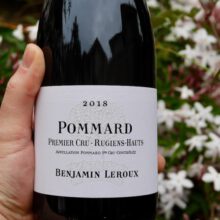
Ben does such a great job in the Côtes-de-Beaune. There's a certain harmony that comes across in the reds he makes here. It makes sense given his familiarity with the region following his time at Comte-Armand. He talks of his efforts to shift the styles of the Pommards from rustic and super tannic to more perfumed and supple. He's succeeded in achieving that with the Pommards not only at Comte-Armand, but, at his own Domaine too!The 1er Cru Rugiens-Hauts is an impeccable site
Pinot Noir from Pommard, Côte du Beaune
Ben does such a great job in the Côtes-de-Beaune. There's a certain harmony that comes across in the reds he makes here. It makes sense given his familiarity with the region following his time at Comte-Armand. He talks of his efforts to shift the styles of the Pommards from rustic and super tannic to more perfumed and supple. He's succeeded in achieving that with the Pommards not only at Comte-Armand, but, at his own Domaine too!The 1er Cru Rugiens-Hauts is an impeccable site
Pinot Noir from Pommard, Côte du Beaune
Notwithstanding the Clos des Epeneaux, Leroux has always said that if there was one 1er Cru that would tempt him back to Pommard it would be Les Rugiens. A new long-term contract with the same owner as the Volnay Caillerets brought Leroux back to his old stomping ground in 2017 and so, once again he is working with the same iron-rich red clay soils that he did, so famously, at Comte Armand..“A brooding and reticent nose features liqueur-like aromas of poached plum, cassis and cool eart
No wines match your filters
Try removing a filter or broadening your selection.
We couldn't load the wines just now.
You've seen all wines
wines