Size & Type
Other

White Wine
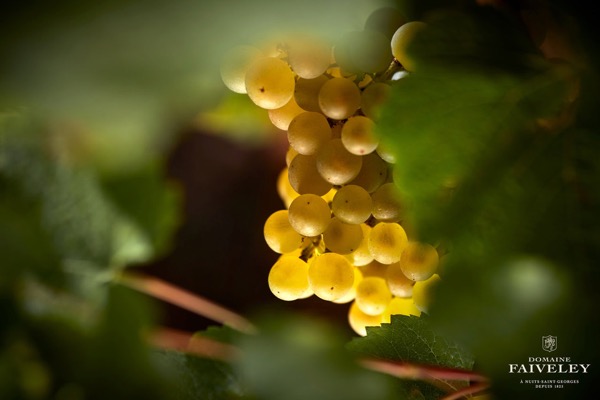
The variety takes its name from the village of Chardonnay near Uchizy in the Mâconnais, in southern Burgundy. A region gaining in reputation for the production of delicious Chardonnay. Thought to have originated from Sâone-et-Loire between Lyon and Dijon.
Burgundy is the mythical home of Chardonnay. From there it spreads far and wide across the world. One of the three main varieties of Champagne production, we also see massive plantings in Australia and North America. You’ll find it somewhere in pretty much every wine growing country.
In Australia 340,000 tonnes of Chardonnay grapes are harvested each year over four times more than the No.2 white grape in Australia, Sauvignon Blanc!
There are a vast array of flavours, aromas, and, textures that Chardonnay can offer from the fruit alone, add in use of solid, fermentation vessels like oak, eggs, and tanks, and, malolactic fermentation, the sky is the limit.
Chardonnay has incredible versatility and can be picked over quite a wide range of sugar levels and flavour ripeness. The same vineyard can be picked with enough sugar to make a wine of 10-11% alcohol for sparkling production and then 14% for table wine with anything in between possible. Picked earlier it tends to have more citrus and green apple characters. Picked ripper the natural acidity drops and the flavours progress through stone fruit, to pineapple, fig and melon.
The hand of the winemaker has been particularly evident in Australia over the last 20 years. Starting with big, broad, alcoholic full malo styles in the 1980’s and 1990’s, the pendulum swung to the lean, acid driven styles in Australia in the mid-00’s, with some down right mean wines produced in the cooler climates like the Yarra Valley, Adelaide Hills, Mornington, and, Tasmania. Currently, styles have found balance with generosity and elegance. Australian Chardonnay is the best it has ever been. Restrained oak use is thankfully the norm, and, globally we are seeing greater use of larger oak barrels, reducing the influence of any new oak.
Use of wild fermentation, malolactic fermentation and grape solids in ferments can add an array of secondary aromas and flavours, nuttiness, creaminess, bakery notes, butteriness, funk.
Some makers have played heavily with reduction in Chardonnay often resulting in flinty, burnt match characters.
In Burgundy, climate change, just as in Australia (along with mature vineyards) has seen picking times bought forward with sugar levels maintaining. The degree of chaptalisation in Burgundy is reducing and is often not required at all.
Check out all the articles in the Wine Bites Mag exploring Chardonnay.
Showing of wines
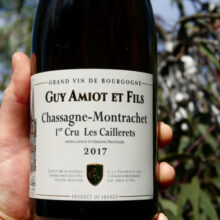
Chardonnay from Chassagne-Montrachet, Côte du Beaune
Lovers of flavourful Chardonnay will be happy here! Excellent gear. A step up in acid levels from 'Les Vergers'. Lovely flavour profile here. From Meadow's notes the flavour profiles is much the same. What clearly has changed over a couple of years in the bottle is the expression. No longer the shy, reticent teenager. Now a vivacious creature with a certain delicacy and that full flavoured profile I've come to expect from Amiot. The flow and texture across palate is excellent with a fine finish.
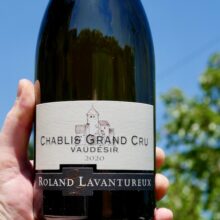
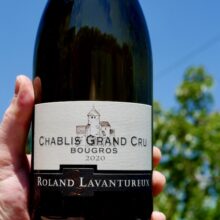
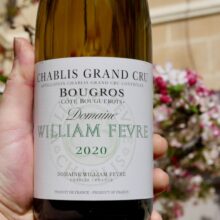
Chardonnay from Chablis, Burgundy
Bougros sits on a very steep slope, with a gradient of more than 30%, facing due south at the foot of the hill. The shallow soil, a mixture of clay and gravel, prevents excessive yields resulting in complex, robust wines.Note: from a 2.2 ha parcel at the bottom section of the vineyard; even so, the vineyard is so steep here that it must be worked entirely by hand as tractors would be dangerous to use.In a sense, the 2020 Chablis Grand Cru Bougros Côte Bouguerots offers a resumé of
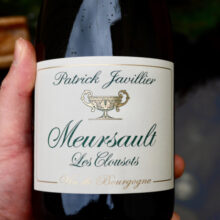
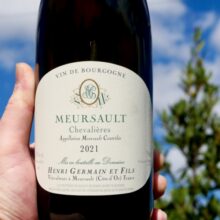
Chardonnay from Meursault, Côte du Beaune
“Another wine that has only partially completed its malolactic fermentation is the 2022 Meursault Le Limozin, a medium to full-bodied, satiny and fleshy wine that's broader and more voluminous than the taut Chevalières. Offering up reductive aromas of pear, hazelnuts and iodine, it concludes with a long, mouthwatering finish.” William Kelly, The Wine Advocate 91-93 Points
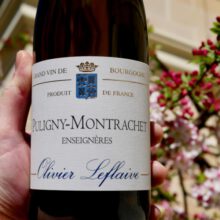
Chardonnay from Puligny-Montrachet, Côte du Beaune
Slightly more apparent wood surrounds the overtly floral aromas of white and yellow peach and fennel. There is excellent intensity to the concentrated and unusually powerful flavors that culminate in a clean, very dry and impressively long finale. This too is a very fine villages level wine and one that will age. Outstanding ♥Allen Meadows, Burghound
Chardonnay from Meursault, Côte du Beaune
The 2023 Meursault Les Chevalières wafts from the glass with notes of buttery citrus fruit, white flowers, green apple and hazelnuts, followed by a medium to full-bodied, satiny and saline palate that's bright and mineral. The racy style of this site works well with the inherent generosity of the vintage. William Kelly, The Wine Advocate 90-92 PointsThe 2023 Meursault Les Chevalières (not Premier Cru as I mistakenly wrote last year!) has a very cohesive bouquet with light white flower
Chardonnay from Meursault, Côte du Beaune
From lower down the slope, the 2023 Meursault Le Limozin is more exotic, bursting with aromas of honeyed orchard fruit, orange oil and musky peach, followed by a medium to full-bodied, satiny and layered palate that's pure and enveloping, concluding with a saline finish. William Kelly, The Wine Advocate 90-92 PointsNaturally exotic aromas are comprised by notes of jasmine tea, acacia and freshly sliced pear. There is more volume, if less minerality, to the generously proportioned and be
Chardonnay from Chassagne-Montrachet, Côte du Beaune
Where the Bourgogne is immediately approachable the village Chassagne Blanc needs a little more time. 1/3 from Les Masures next to Morgeot 2/3 Puligny side of Chassagne. Again this shows a wonderful progression through the quality standards in Burgundy. Jumping a rung in the ladder, the energy and precision is showing here. Whilst a full percentage lower in alcohol than the Bourgogne, it has greater depth and length. Current tightly wound, beautiful linear acid is supported nicely by a little te
Chardonnay from Chassagne-Montrachet, Côte du Beaune
Where the Bourgogne is immediately approachable the village Chassagne Blanc needs a little more time. The 2023 Chassagne-Montrachet Blanc opens in the glass with aromas of pear, hazelnut and nutmeg, followed by a medium-bodied, ample and lively palate that's quite generous and fruit-driven this year, though I suspect it will tighten up with a second winter on the lees. 1/3 from Les Masures next to Morgeot 2/3 Puligny side of Chassagne. William Kelley, The Wine Advocate 89-91 Points
Chardonnay from Chassagne-Montrachet, Côte du Beaune
Where the Bourgogne is immediately approachable the village Chassagne Blanc needs a little more time. 1/3 from Les Masures next to Morgeot 2/3 Puligny side of Chassagne. Again this shows a wonderful progression through the quality standards in Burgundy. Jumping a rung in the ladder, the energy and precision is showing here. Whilst a full percentage lower in alcohol than the Bourgogne, it has greater depth and length. Current tightly wound, beautiful linear acid is supported nicely by a little te
Chardonnay from Meursault, Côte du Beaune
About Faiveley Based in Nuits-St-Georges, the famous Domaine Faiveley was founded in 1825 and in more recent times, the domaine has greatly expanded its vineyards across the entire Côte d’Or. The grapes are entirely destemmed and fermented in a mix of new wooden vats for the top end wines and stainless steel for the lesser […]
Chardonnay from Chassagne-Montrachet, Côte du Beaune
The Chassagne comprises six parcels Benoît inherited from Domaine Bernard Moreau. The most northerly of these sites is En Journoblot, which borders Criots-Bâtard. The core of the bottling comes from three more centrally located vineyards: Voillenot Dessus and Les Chambres under the 1er Cru Maltroie, and Les Masures under the 1er Cru Champ Gains. The most southerly parcel is La Platière, which sits below the Abbaye de Morgeot climat. Altogether, these plots cover a surface of 1.4 h
Chardonnay from Puligny-Montrachet, Côte du Beaune
“It has a lifted nose with green apple, a touch of petrichor and just a small reduction. The palate is well balanced with lovely poise. Touches of noisettes and orange rind build through the harmonious and persistent finish. Excellent.” Neal Martin, Vinous 90-92 Points JM 89-92
No wines match your filters
Try removing a filter or broadening your selection.
We couldn't load the wines just now.
You've seen all wines
wines
You must be logged in to post a comment.