Size & Type
Other

White Blend from Southern Rhône, Rhône Valley, Châteauneuf du Pape
$281
Crafted from six different grape varieties in equal proportions, the 2024 Chateauneuf du Pape Blanc is exquisite, wafting from the glass with aromas of flowers, herbs, almonds, pear and peach. Medium- to full-bodied, round and sappy, it’s fleshy with a lively core of fruit, terrific mid-palate plenitude and a long, ethereal, somewhat chalky finish lifted by a beautiful bitterness and a saline aftertaste.
Yohan Castaing, The Wine Advocate 96 Points
White wine, historically overlooked, is now increasingly appreciated. All six permitted white varieties are co-fermented in stainless steel at low temperatures without malolactic fermentation, then aged five to six months on the fine lees without bâtonnage. It combines texture with tension, marked by fennel, citrus blossom, stone fruit and chalky salinity and ages well for 5–10 years.
Grenache Blanc, Bourboulenc, Clairette, Roussanne, Picpoul, and Picardin.
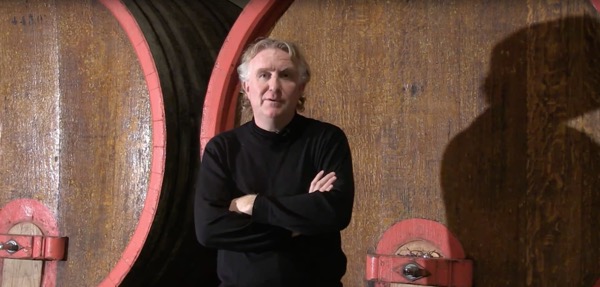
The Clos des Papes white 2024 is quite floral but, as is often the case, presents some aniseed notes. In the mouth we find a grapefruit side, minerality but also a very saline side. It’s a wine that you can enjoy young on these aromas or age in the same way as the reds, knowing that it will go through different stages of evolution. Namely, minerality, dried fruits, honey, and toasted almonds. As you know, there is always a year’s difference between the reds and the whites, because the whites are not aged in wood, because we want to maintain a certain freshness and minerality. They are aged on fine lees until February before being bottled. We remind you that it is recommended to consume the whites at 12°C, not to put them in ice, you can also decant them.
Paul-Vincent Avril – Clos du Papes
Clos des Papes is one of the great established names of Châteauneuf-du-Pape alongside Beaucastel, Vieux Télégraphe, Charvin, and, the epic Rayas. In recent years has produced a succession of remarkable wines made by Paul-Vincent Avril.
Clos des Papes covers 40 hectares divided into 24 distinct plots. This division enables control of grape maturity during harvest and to mix several grape varieties (65% Grenache, 20% Mourvedre, 10% Syrah, 5% Counoise, Vaccarese and Muscardin for the reds) and different terroirs. Clos des Papes is one of the few estates to use all permitted varieties for both red and white Chateauneuf.
The yields are about 28 hl per hectare, sometimes falling below 15 hl as in 2013! To put this into context Romanée-Conti is permitted to yield around 35 hl per hectare in most years, although they typically yield around 25 hl per hectare. On top of that they undertake a severe sorting of the harvest. Aged in oak casks for 12 to 15 months depending on the vintage, the wines are traditionally fined with egg white but not filtered.

The Avril family has been settled in Chateauneuf du Pape since 1600, with the first vintage of Clos des Papes in 1896, made by the great-grandfather of the current owner, Paul Avril. He contributed greatly to the creation of the Chateauneuf du Pape appellation: he gathered a commission at the town hall of the village in 1911 to establish the AOC which was launched in 1936. His son Regis Avril continued the export of the Clos des Papes (75% of the production is exported to 25 countries!). It was served in particular at the Elysee to General de Gaulle.
His son, Paul, who joined at age 26, has perpetuated the tradition of quality, gradually transfer the estate to his own son, Paul Vincent from 1988. For more than 20 years, Paul Vincent has maintained the estate’s philosophy. Traditional elaboration, maturation, of fine wines made for ageing, and irreproachable quality. He kept ignoring the temptations to produce some “garage wines”, offering only one quality of reds (90% of the production of Clos des Papes, the remaining 10% being white). Clos des Papes is unique, coming from an exceptional and harmonious blending of grape varieties and complementary terroirs.
Clos des Papes are well-known for producing one of the most authentic and long-lived examples of the appellation.
Clos des Papes stands as a benchmark estate in Châteauneuf-du-Pape. It was founded under its current name in 1896 by Paul Avril and is today directed by Paul-Vincent Avril. Rather than pursuing innovation for its own sake, the domaine has refined traditional practices with quiet rigor and unwavering fidelity to terroir.
The estate farms around 40 hectares—including three hectares of white varieties—divided into more than 30 parcels across diverse soils (sand, clay-limestone, galets roulés). All 13 permitted grape varieties are cultivated organically, with minimal treatments. Yields are kept deliberately low (around 25 hectoliters per hectare) to preserve concentration and balance in warm vintages. Harvest is entirely manual, with parcel-specific timing; whites are picked early for freshness, while reds are picked at full maturity but never overripe. Grapes arrive intact, without mechanical intervention.
In the cellar, fermentations rely exclusively on indigenous yeasts. Reds are 100% destemmed—a practice established fully in 1991—and vinified by parcel or co-fermented, depending on the year. No enzymes, acidification or aggressive extractions are employed; macerations are long and gentle, with restrained remontage and pigeage. Élevage lasts 15–18 months in large, neutral foudres, some over a century old, with no new oak and minimal fining or filtration. The reds emphasize aromatic clarity, ripe but fine tannins, vivid fruit and long aging potential.
White wine, historically overlooked, is now increasingly appreciated. All six permitted white varieties are co-fermented in stainless steel at low temperatures without malolactic fermentation, then aged five to six months on the fine lees without bâtonnage. It combines texture with tension, marked by fennel, citrus blossom, stone fruit and chalky salinity and ages well for 5–10 years.
Production focuses on two wines only—a red and a white Châteauneuf-du-Pape—with no special cuvées. The red typically blends 65% Grenache, 20% Mourvèdre, 10% Syrah and 5% other varieties; Mourvèdre’s role has grown, especially in warm vintages, for its acidity retention and structural freshness.
Clos des Papes embodies traditionalism adapted to modern challenges: adjustments in picking dates, variety proportions and selection practices address climate change, but there is no new oak, over-ripeness or extraction excess. Paul-Vincent Avril’s methodical approach aims not to reinvent the appellation but to render its nuances with precision and consistency year after year.
Yohan Castaing, The Wine Advocate
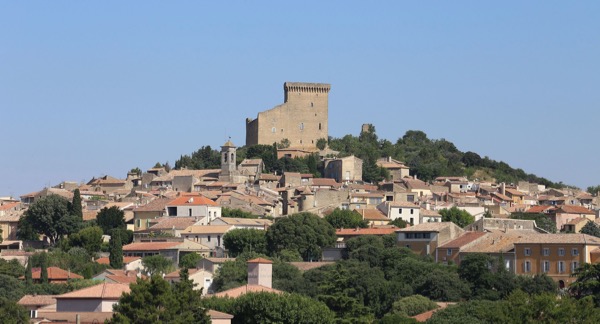
Châteauneuf-du-Pape literally translates to “The Pope’s new castle” and, indeed, the history of this appellation is firmly entwined with papal history. In 1308, Pope Clement V, former Archbishop of Bordeaux, relocated the papacy to the town of Avignon. Clement V and subsequent “Avignon Popes” were said to be great lovers of Burgundy wines and did much to promote it during the seventy-year duration of the Avignon Papacy. At the time, wine-growing around the town of Avignon was anything but illustrious. While the Avignon Papacy did much to advance the reputation of Burgundy wines, they were also promoting viticulture of the surrounding area, more specifically the area 5–10 km (3–6 mi) north of Avignon close to the banks of the Rhône. Prior to the Avignon Papacy, viticulture of that area had been initiated and maintained by the Bishops of Avignon, largely for local consumption.
Clement V was succeeded by John XXII who, as well as Burgundy wine, regularly drank the wines from the vineyards to the north and did much to improve viticultural practices there. Under John XXII, the wines of this area came to be known as “Vin du Pape”, this term later to become Châteauneuf-du-Pape. John XXII is also responsible for erecting the famous castle which stands as a symbol for the appellation.

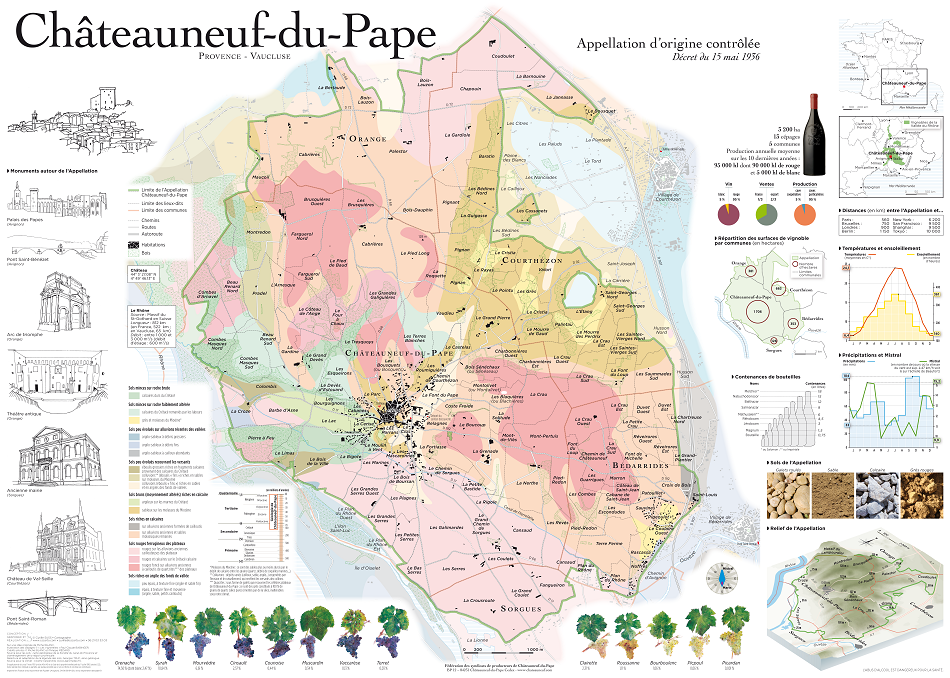
Click to enlarge 🔎

Châteauneuf-du-Pape is traditionally cited as allowing thirteen grape varieties to be used, but the 2009 version of the AOC rules in fact list eighteen varieties, since blanc (white), rose (pink) and noir (black) versions of some grapes are now explicitly listed as separate varieties. Also in the previous version of the appellation rules, Grenache and Picpoul were associated with different pruning regulations in their noir and blanc versions, bringing the number of varieties previously mentioned from thirteen to fifteen.
Red varieties allowed are Cinsaut, Counoise, Grenache noir, Mourvèdre, Muscardin, Piquepoul noir, Syrah, Terret noir, and Vaccarèse (Brun Argenté). White and pink varieties are Bourboulenc, Clairette blanche, Clairette rose, Grenache blanc, Grenache gris, Picardan, Piquepoul blanc, Piquepoul gris, and Roussanne. (The varieties not specifically mentioned before 2009 are Clairette rose, Grenache gris and Piquepoul gris.)
Both red and white varieties are allowed in both red and white Châteauneuf-du-Pape. There are no restrictions as to the proportion of grape varieties to be used, and unlike the case with other appellations, the allowed grape varieties are not differentiated into principal varieties and accessory varieties. Thus, it is theoretically possible to produce varietal Châteauneuf-du-Pape from any of the eighteen allowed varieties. In reality, most Châteauneuf-du-Pape wines are blends dominated by Grenache. Only one of every 16 bottles produced in the region is white wine.
"A blend of 55% Grenache, 35% Mourvèdre and 10% Syrah and other permitted varieties, the 2020 Chateauneuf du Pape looked exceptional on this day, offering up scents of framboise and kirsch alongside dried flowers and Asian spices. Full-bodied yet weightless, silky and long, this is special stuff, complex and balanced. "The phenolic maturity is there, the sugars are there," Avril said. "No, it won't be like 2019, but I think we will come in around 14.5–15 degrees [of alcohol]. I think, I don't like to say before the vintage is finished." Of the vintages reviewed here, Avril calls the 2020 "really elegant."
Where in the world does the magic happen?
av Pierre de Luxembourg, 84230 Châteauneuf-du-Pape, France
You must be logged in to post a comment.