Size & Type
Other

Location
One thing is certain, you’ll never run short of choice!
First Records of Wine Production – Go back millennia!
Founding Figures – The Greek colonisation marked a shift from vine grown in the wild to planned viticulture around 800 BC the Romans dramatically expanded production around 200 BC. The Italians never looked back!
Area Planted – Around 700,000 hectares making around 19% of the world’s wine!
Number of Wineries – Soave alone is made by 3,500 producers. That’s around the same number of wineries as in all of Australia! From gargistes to industrial scale conglomerates every Italian has a winemaker in the family.
Established Regions – Every region in Italy produces wine! The most prestigious region Piedmont is home to the stunning Nebbiolos of Barolo & Barbaresco. The Chianti and Brunello of Tuscany following hot on Piedmont’s heals. These are just a drop in the ocean!
In typical Italian style the classification systems of each region vary and are often skewed by influential persons with much to gain over the quality of the industry. As always we need to rely on our taste buds as the ultimate decider of quality!
Most Common Varieties – In his book ‘Native Wine Grapes of Italy’ Ian D’Agata documents around 500 Italian grape varieties, by no means the complete set! Around 350 of these have been granted authorized status. There’s plenty to try! We’ve seen a push to save some of the notable, rare varietals like the white Nascetta and Arneis from Piedmont.
Whilst we have seen an ingress of French Varietals, the most notable being the Cabernet Varietals + Syrah used to make the Super Tuscans, the Italians have, by and large stayed true to their roots.
White – Whites of note: Arneis (Piedmont), Cataratto (Sicily), Fiano (southwest coast), Friulano (Friuli), Gargenaga (Veneto – the Soave grape), Greco di Tufo (southwest coast), Malvasia Bianca (throughout Italy), Moscato Blanc (Piedmont), Pecorino (Abruzzo), Pinot Grigo (Why?), Ribolla Gialla (Friulli), Trebbiano (Abruzzo), Verdicchio (Marche) and Vermentino (Sardinia, Tuscany and Liguria).
Red – Aglianico (Campania), Barbera (Piedmont), Corvina blended with Rondinella to make Amarone, Dolcetto (Piedmont), Malvasia Nera (Puglia), Montepuliciano (Tuscany), Nebbiolo (Piedmont), Negaromaro (Puglia), Nero d’Avola (Sicily), Primitivo (Puglia), Sagrantino (Umbria) and Sangiovese (Tuscany).
Up and Coming Regions – Beyond Barolo and Barbaresco, around the world we have seen Amarone, Chianti, Soave, Prosecco, Verdicchio and the wines of Puglia gain strong recognition. In recent times the increasing cost of Barolo in particular has seen exploration of Nebbiolo from Alto Piedmonte and Valtellina. At the opposite end of the country, in part due to the investment of heavy hitters like ‘Barolo Boy’ Marco di Grazie (Terre Nere) and Andrea Franchetti (Passopisciaro) the Nerello Mascelese (red) and Carricante (white) wines of Etna, Sicily have become world recognised. Nerello Mascelese being described as some as the Barolo of the South or a cross between Nebbiolo and Pinot. I prefer to call it delicious!
Showing of wines
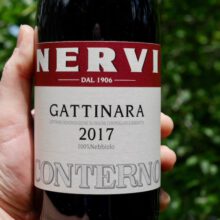
Nebbiolo from Gattinara, Alto Piemonte
Amazing transparency, sophistication shining though. The 2017 Gattinara is terrific. It will also give readers something to drink without waiting decades. In 2017, the Gattinara is a bit richer than it often is - the result of the warm dry year – but its profile is super-classic. Sweet pipe tobacco, mint, dried herbs, licorice, dried cherry and Alpine herbs fill out its ample frame effortlessly. I would give the 2017 a few years in bottle, but it won’t need more than that to start drinking w
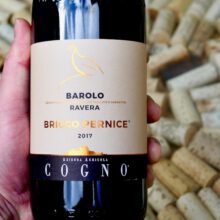
"This is a medium-bodied Nebbiolo from a hot vintage with a ruby-tinged appearance. The 2017 Barolo Ravera Bricco Pernice shows generous inner fiber and richness with dried cherry, blackberry, plum and dark spice. Fruit for this wine comes from a beautiful amphitheater of vines with the perched town of Novello high up on the skyline. I love the especially smooth and soft quality to what is a powerful and lasting wine. "Monica Larner, The Wine Advocate 95 Points
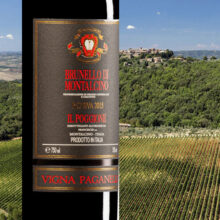
Sangiovese from Montalcino, Tuscany
Brooding and balsamic, the 2019 Brunello di Montalcino Riserva Vigna Paganelli is a dark stallion of a wine with a bouquet to meditate to, wafting up exotic spices, flint, incense, dried roses, black cherries and hints of ashen stone. It's racy yet complex and sensual, with silken textures and masses of mineral-inflected red berry fruits, all guided by a core of zesty acidity as a tinge of sour citrus adds tension throughout. Pleasantly chewy yet still mouthwatering, the 2019 leaves a web of fin
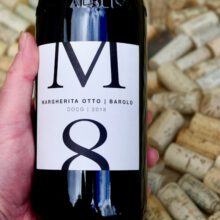
Nebbiolo from Castiglione Falletto, Barolo
This one's another argument for blending sites! From a disciple of Maria Theresa Mascarello! Manly worked with Sandrone, Cavallotto and Altare before an extended stint with Maria-Therese Mascarello. When you look at these wineries the diversity of practices they employ, it makes for an exception foundation of experience to launch your own label as Alan did in 2015. From what I've tasted thus far it's only a matter of time before these wines reach the cult status of his peers.
Nebbiolo from Castiglione Falletto, Barolo
This one's another argument for blending sites! From a disciple of Maria Theresa Mascarello! I've now had a chance to taste through a good wedge of 2020 Barolos. It reads as an interesting vintage. There are many tightly coiled wines at this point that will need time to build generosity. Manley's M8 is one of the highlights of my tasting thus far. It's a complete wine with a caressing shape and flow of fruit underpinned by long, even, layered, serious tannins. Complex with immediate generosity,
Nebbiolo from Serralunga d'Alba, Barolo
The 2008 Riserva we see the parallels with the 2015. The long structure is there, the complexity has built further, the wine is now fully comfortable wearing it's own skin, having resolved and built generosity. Of the 2015 it was clear that there was no chance to mistake the Gabutti, with its abundance of darker things; stock, porcini, graphite, smoke and black cherry. Under this very typical Serralunga ‘tarry/earthy’ mantle though, are other complexities of dried roses, orange and spices. T
Nebbiolo from Castiglione Falletto, Barolo
Sordo's Parussi always sits on the bolder side for the Cru, which it turns out has split soil types. Theirs being on soils more similar to those of Serralunga. The resulting structure shows in the wine. The 2008 is drinking beautifully, showing darker fruits and like the other 2008 Sordos seamless, with exceptional harmony and balance.This is such a great opportunity to look at different Crus in a horizontal from one producer!Matured Barolo straight from the cellars of Sordo ... Bring It
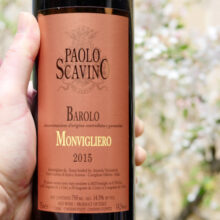
It's fascinating the from one of Barolos Northern most Crus in Monvigliero, moving to one of the Southern most in Ravera from Novello we see two Crus that are more playful and expressive in their youth. Here we typically see supple tannins, oppulent red fruits with front to mid-palate attack. Again the metamorphosis only time can offer us really is something special.Here's a chance to see a Ravera with a decade+ of bottle age on it and find out just how it transforms!This is such a great
Nebbiolo from Monforte d'Alba, Barolo
Perno, always the darkest and most structured on release, is perhaps the wine in the Sordo Cru lineup that goes through the most dramatic metamorphosis with time. Monforte is the least defined of the Barolo Communes, the end result is a diversity of styles. Barolo from Monforte can have incredible power, darknesss and earthiness, less reliant on fruit than other communes, in recent times we have soon producers making finer, elegant, perfumed iterations. Sordo's Perno sits in the middle, perhaps
Sangiovese from Montalcino, Tuscany
Like the ‘Ignaccio’ Rosso di Montalcino ‘Iacopo’ Il Marroneto is a baby Brunello in that was grown with the intention of becoming so. A pure Sangiovese that was aged for a few months in large oak barrels this wine is an exciting new project that cements and displays Iacopo’s understanding of the vineyards and is exciting now and for years to come. Declassified fruit parcels from the Madonna delle Grazie vineyard.Deeply complex, the 2022 Rosso di Montalcino Iacopo waf
Nebbiolo from Barbaresco, Piedmont
In my view the Barbaresco Masseria is the most under-the-radar wine at Vietti....The 2018 marks an important transition for the Masseria which is a trademarked brand, not a vineyard, named for one of the hamlets within the Cottá sub-zone where Alfredo Currado first sourced fruit for this wine in the 1960s. Over the years vineyard sources for the Barbaresco have varied.... Beginning in 2018, the Masseria is made exclusively from a sizeable parcel in Roncaglie Vietti acquired from Socré. Vinous
No wines match your filters
Try removing a filter or broadening your selection.
We couldn't load the wines just now.
You've seen all wines
wines