Size & Type
Other

Location
Without doubt the two greatest drivers of the French wine industry have been the concept of Terroir and the establishment of the Appellation d’origine contrôlée.
Combined these have defined a philosophical approach to growing and making wine and enforced strict controls of grape varieties that can be planted in each region and winemaking practices that can be employed.
Frances has come through with flying colours, successive generations have been better trained, spent time in the New World exposing them to different techniques for growing vines and making wine, and, have been able to push the boundaries to achieve excellence.
First Records of Wine Production – Go back millennia to the 6th century BC. The Greeks kicked things off with the Romans ramping things up. Those Romans got around and took their vines and wines with them! Over time the wealth of the Monastries took over much of the production. Nobility took their turn until the guillotine fell!
Founding Figures – In ‘recent times’, technical advancement in the industry were driven by Minister of the Interior, Jean-Antoine Chaptal following the French revolution, work done by Louis Pasteur in the 19th century, and, the Emperor Napoleon III commissioning of the 1855 classification of Bordeaux.
Area Planted – with around 630,000 hectares of vines France produces 17% of the World’s wine
Established Regions – When we think French wine, the regions that immediately come to mind are Champagne with its fizz, Bordeaux’s Cabernet blends and Sauternes, Burgundy’s Pinot and Chardonnay, the Rhône Valley’s Shiraz, Grenache, Marsanne & Roussane, and, Alsatian Riesling.
Most Common Varieties
White – From greatest area planted down the top red varieties are Ugni Blanc, Chardonnay, Sauvignon Blanc, Melon de Bourgogne, Sémillon, Chennin Blanc, Colombard, Muscat Blanc à Petits Grains, Grenache Blanc, Viognier, and, Riesling.
Red – The list doesn’t surprise the order they come in does from greatest area planted down the top red varieties are Merlot, Grenache, Syrah, Carignan, Cabernet Sauvignon, Cabernet Franc, Gamay, Pinot Noir, Cinsaut, Pinot Meunier and Mourvèdre.
Up and Coming Regions – In recent times we’ve seen the Rosé of Provence, the hidden gems from the Languedoc, Jura and Loire Valley increasing in popularity.
Showing of wines
Chardonnay from Chablis, Burgundy
Here the airy and expressive nose is even more floral in character with its notes of acacia, rose petal and even a suggestion of gardenia on the aromas of ocean breeze, wet stone and shellfish. The more refined and highly energetic if less concentrated medium-bodied flavors tighten up noticeably on the focused, moderately austere and overtly stony finale. This seductive yet serious effort is going to require at least a few years of patience and should repay up to a decade of keeping if you wis
Chardonnay from Chablis, Burgundy
There is ample citrus influence suffusing the nose that could be from nowhere else but Chablis with its array of seashore, algae and oyster shell scents. The caressing but notably denser and more powerful larger-bodied flavors coat the palate while retaining an attractive texture on the strikingly persistent finish that is shaped by bright acidity. This can't match the MdT for refinement but it is presently more complex and should age just as well. Drink 2032+Allen Meadows, Burghound 89-92 P
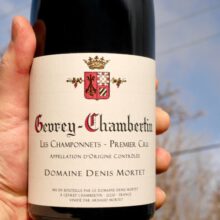
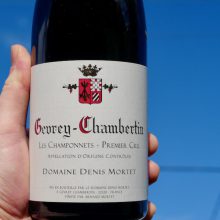
Pinot Noir from Gevrey-Chambertin, Côte-de-Nuits
Moderate wood frames the ripe and fresh aromas of plum and dark cherry that are laced with earth and sauvage wisps. There is both good verve and richness to the lightly mineral-inflected middleweight plus flavors that possess a seductive mid-palate mouthfeel thanks to the relatively fine-grained tannins shaping the powerful, serious and compact if slightly warm finish. From a texture standpoint, this excellent and highly complex effort walks a fine line as it's not an elegant wine though it's no
Pinot Noir from Gevrey-Chambertin, Côte-de-Nuits
The 2022 Gevrey-Chambertin 1er Cru Petite Chapelle is more mineral but also more concentrated than the En Ergot bottling. Bursting with notes of rose petals, raspberries and baking chocolate, it's medium to full-bodied, supple and refined, with an intense core of fruit, lively acids and polished tannins, concluding with a saline finish.William Kelley, The Wine Advocate 92-94 PointsA more perfumed and more elegant nose consists mostly of cool red berries and a plethora of spice and fl
Pinot Noir from Aloxe-Corton, Côte du Beaune
A completely different aromatic profile is proffered by the nose of intensely sauvage, smoky dark currant and plum. The delicious and tension-filled medium-bodied flavors possess good power on the serious and lingering finish that is borderline rustic. Excellent development potential here. (from .84 ha holding of ~75+ year old vines; 40% whole clusters) 2034+Allen Meadows, Burghound (92-95) Points
Rhône Blend from Châteauneuf du Pape, Southern Rhône
"A blend of 55% Grenache, 35% Mourvèdre and 10% Syrah and other permitted varieties, the 2020 Chateauneuf du Pape looked exceptional on this day, offering up scents of framboise and kirsch alongside dried flowers and Asian spices. Full-bodied yet weightless, silky and long, this is special stuff, complex and balanced. "The phenolic maturity is there, the sugars are there," Avril said. "No, it won't be like 2019, but I think we will come in around 14.5–15 degrees [of alcohol]. I think, I don'
Blend from Ambonnay, Montagne de Reims
It's like the Beatles have Got Back Together! Fruit from Lahaye, Laval, Leclapart & of course Marguet! Champagne Sapience, vinified totally with natural methods. Sapience is collaboration between 4 great biodynamic Champagne growers: Benoît Marguet, Benoît Lahaye, Vincent Laval and David Leclapart. The concept is to craft Champagne using extreme biodynamic methods. The blend comprises Chardonnay from David Leclapart, Pinot Meunier from Vincent Laval and Pinot Noir from Benoit Lahaye. The wine
Chardonnay from Avize, Côte des Blancs
This is a very special wine from a very special plot of dirt. Treat it like a great white wine, served at the table with proper wine glasses, and you will be greatly rewarded. Disgorged July 2021. This is a very special wine from a very special plot of dirt. It comes from one-third of a hectare of vines in the renowned Avize vineyard called La Fosse aux Pourceaux. This 0.3-hectare section of La Fosse lies on the very chalkiest portion of the slope near the village (contrasting with the more
Chardonnay from Aloxe-Corton, Côte du Beaune
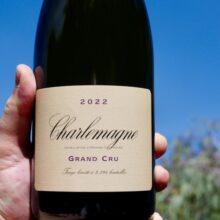
A distinctly cooler nose is comprised by notes of Granny Smith, spice, white flower and plenty of wet stone character. The rich and impressively scaled and concentrated big-bodied flavors exude an almost aggressive minerality on the clean, dry and markedly powerful finish. This beautifully long effort could use better depth but it has so much underlying material that more should almost certainly develop over time. Excellent. (from parcels of .28 ha in En Charlemagne and .22 ha in Le Charlemagne;
Chardonnay from Chablis, Burgundy
This is the largest and most famous Grand Cru; its fame based on its history as one of Chablis’ first vineyards. The appellation enjoys a southerly aspect with very white, dense and deep clay soil, resting on a limestone bed 80 cm below the ground, which brings to the wine those spicy notes so typical of this terroir.Note: from 4 separate parcels totaling 4.11 ha, 3 of which are all at the top of the slope.A cool, restrained and airy nose grudgingly divulges its combination of lem
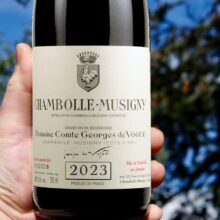
Pinot Noir from Chambolle-Musigny, Côte-de-Nuits
Note: from <2 ha of vines in the upper southwest portion of the commune that includes some declassified 1ers from Les Baudes and FuéesA fresh and ripe nose speaks primarily of cool red berries, spice and a pretty floral top note. There is a lovely sense of volume and punch to the supple and delicious flavors that flash surprisingly good power on the impressively long bitter pit fruit-inflected finish where the only nit is a touch of warmth. Tasted Jan 2026 ♥ OutstandingAllen Meado
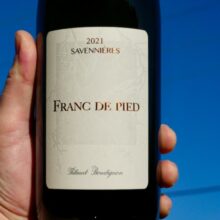
Chenin Blanc from Savennières, D'Anjou-Saumur
Hailing from ungrafted vines on the Clos de la Hutte vineyard, the 2022 Savennières Franc de Pied blossoms and expands in the mouth. Massive concentration sits within its delicate core. There's a bright line of citrusy acidity that carries this wine from start to finish with a residual saltiness, leaving you licking the inside of your mouth. It is restrained aromatically, focusing quietly on texture, essence and substance. Drink 2025-2037Rebecca Gibb MW, Vinous 97 Points
No wines match your filters
Try removing a filter or broadening your selection.
We couldn't load the wines just now.
You've seen all wines