Size & Type
Other

Location
Without doubt the two greatest drivers of the French wine industry have been the concept of Terroir and the establishment of the Appellation d’origine contrôlée.
Combined these have defined a philosophical approach to growing and making wine and enforced strict controls of grape varieties that can be planted in each region and winemaking practices that can be employed.
Frances has come through with flying colours, successive generations have been better trained, spent time in the New World exposing them to different techniques for growing vines and making wine, and, have been able to push the boundaries to achieve excellence.
First Records of Wine Production – Go back millennia to the 6th century BC. The Greeks kicked things off with the Romans ramping things up. Those Romans got around and took their vines and wines with them! Over time the wealth of the Monastries took over much of the production. Nobility took their turn until the guillotine fell!
Founding Figures – In ‘recent times’, technical advancement in the industry were driven by Minister of the Interior, Jean-Antoine Chaptal following the French revolution, work done by Louis Pasteur in the 19th century, and, the Emperor Napoleon III commissioning of the 1855 classification of Bordeaux.
Area Planted – with around 630,000 hectares of vines France produces 17% of the World’s wine
Established Regions – When we think French wine, the regions that immediately come to mind are Champagne with its fizz, Bordeaux’s Cabernet blends and Sauternes, Burgundy’s Pinot and Chardonnay, the Rhône Valley’s Shiraz, Grenache, Marsanne & Roussane, and, Alsatian Riesling.
Most Common Varieties
White – From greatest area planted down the top red varieties are Ugni Blanc, Chardonnay, Sauvignon Blanc, Melon de Bourgogne, Sémillon, Chennin Blanc, Colombard, Muscat Blanc à Petits Grains, Grenache Blanc, Viognier, and, Riesling.
Red – The list doesn’t surprise the order they come in does from greatest area planted down the top red varieties are Merlot, Grenache, Syrah, Carignan, Cabernet Sauvignon, Cabernet Franc, Gamay, Pinot Noir, Cinsaut, Pinot Meunier and Mourvèdre.
Up and Coming Regions – In recent times we’ve seen the Rosé of Provence, the hidden gems from the Languedoc, Jura and Loire Valley increasing in popularity.
Showing of wines
Chardonnay from Ambonnay, Montagne de Reims
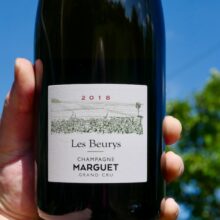
Le Parc sits right on the other side of the wall of Clos du Mesnil! 100% Chardonnay from domaine vines planted in 1982. Le Parc is prime territory. The vineyard borders Krug’s uber-famous Clos d’Ambonnay and Selosse’s Le Bout du Clos. There is a thick (nearly 2 meter) clay and sandy loam layer of ‘tufa’ limestone on top of the chalky bedrock in Le Parc, which would suggest a powerful broad and round wine. Yet, Marguet’s version is sleek and saline with a strong chalk influence on the
Pinot Noir from Ambonnay, Montagne de Reims
La Grande Ruelle Grand Cru is sourced from estate grapes planted in 1967 in the village of Ambonnay.
Chardonnay from Ambonnay, Montagne de Reims
The haunting flinty nose pulls you into this beautifully eccentric chardonnay that some lovers of this grape will find revolutionary. We say, vive la revolution! With aeration the citrusy aromas and energy expand. Then comes the incredibly racy palate which extends and extends in ways that seems to bend space-time with its elegance. SP 96 Points
Pinot Noir from Ambonnay, Montagne de Reims
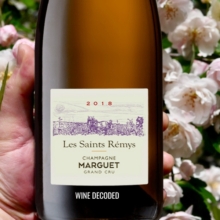
The lieux dit Saint Remys comes from estate vines planted in 1975 and 1992 and sits on the west side of Ambonnay near the border of Bouzy.
Chardonnay from Ambonnay, Montagne de Reims
Intensely smoky and flinty, also almost blindingly fresh, this is a dangerously chalky Champagne. The bergamot aroma expands dramatically as it aerates in the glass. Extremely concentrated Amalfi lemon character on the super-focused palate, building and building at the driving chalky finish that doesn't want to let go of you. July 2023SP 98 Points
Chardonnay from Avize, Côte des Blancs
If you think it's good now (hot tip 🔥IT IS) give it another 1-5 years in bottle and you'll see a 🦋emerge! The 2014 Extra Brut Blanc de Blancs Grand Cru Minéral is a powerful, intense Champagne that captures all of the natural power of these old vines in Avize and Cramant. Aptly named, the Minéral is infused with tremendous mineral and soil inflections that give a real feeling of gravitas. Crushed rocks, slate, chalk and citrus accents are some of the many nuances that emerge with a bit o
Chardonnay from Avize, Côte des Blancs
If you think it's good now (hot tip 🔥IT IS) give it another 1-5 years in bottle and you'll see a 🦋emerge! This is typically the saltiest, most mineral wine in the Agrapart range. Like all the Agrapart wines the quality is remarkably consistent, with the only variation due to vintage. The 2016 spent just over five years on lees and was dosed at three grams per litre.“From Les Bionnes in Cramant (vinified in barrel) and Champbouton in Avize (vinified in tank), two parcels that shar
Chardonnay from Chablis, Burgundy
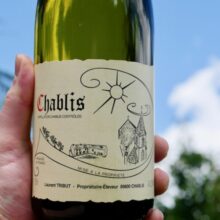
Ripe aromas of poached pear and apple compote are laced with hints of iodine, lemon rind and a whiff of brine. The succulent, round and sappy middle weight flavors display notably better than average persistence on the citrusy, clean and nicely dry finale. This punches above its weight and is worth a look. Drink 2028+ ♥ Outstanding Top ValueAllen Meadows, Burghound 89-91 Points
Chardonnay from Chassagne-Montrachet, Côte du Beaune
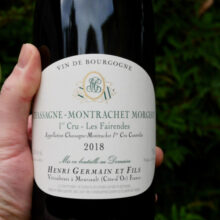
'Pungent notes of petrol and resin add breadth to the very ripe aromas of both yellow and white orchard fruit citrus and floral-suffused nose that is also trimmed in just enough wood to merit mentioning. There is impressive volume to the muscular, powerful and tension-filled middle weight plus flavors that possess a highly textured, even mildly creamy, mouthfeel where the citrus-tinged acid spine maintains the balance.'Allen Meadows, Burghound
Pinot Noir from Chambolle-Musigny, Côte-de-Nuits
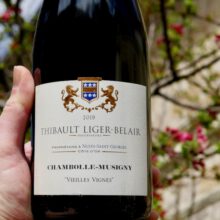
Initially there is a touch of reduction though aggressive swirling slowly reveals overtly floral-suffused nose that is comprised mostly by attractively spicy red and dark berries aromas. There is excellent volume to the rich but appealingly delineated medium-bodied flavors that also exude a subtle minerality on the mildly austere, firm and sneaky long finish. A sophisticated Chambolle villages. Drink: 2026+Allen Meadows, Burghound
Chardonnay from Chablis, Burgundy
This is the largest and most famous Grand Cru; its fame based on its history as one of Chablis’ first vineyards. The appellation enjoys a southerly aspect with very white, dense and deep clay soil, resting on a limestone bed 80 cm below the ground, which brings to the wine those spicy notes so typical of this terroir.Note: from 4 separate parcels totaling 4.11 ha, 3 of which are all at the top of the slope. If Kimmeridgian could be distilled, it would likely smell exactly like the nos
Pinot Noir from Savigny-lès-Beaune, Côte du Beaune
"As it usually is, this is at once more elegant and a bit more aromatically complex with its agreeably spicy mix of red and dark cherry, warm earth and floral top note. Here too there is excellent volume to the delicious medium weight flavors that possess both fine verve and minerality, both of which carry over to the balanced and beautifully persistent finale. This isn't as powerful as the Corton but it's notably finer. A qualitative choice." Drink: 2034+ Sweet spotAllen Meadows, Burghound
No wines match your filters
Try removing a filter or broadening your selection.
We couldn't load the wines just now.
You've seen all wines
wines