Winery
Nervi-Conterno
About Nervi-Conterno
Nervi-Conterno & the great Antoniolo sit at the very top of Gattinara’s wine heirachy.
Roberto Conterno’s admiration of the Nebbiolo wines from the tiny Gattinara appellation was given dramatic illustration by his purchase of the original Gattinara producer, Nervi in 2018. Having spent a great deal of time in this north-western Piedmont region over recent years, Roberto has become very familiar with the lay of the land and its lean, minerally soils.
Roberto Conterno visited the Nervi estate in Gattinara for many years due to a close association with the previous owners, the Astrup family. Roberto encouraged his friend to purchase these vineyards in 2011, once great but left in disrepair with the quote ‘no one could make bad wine here’. Once the scale of the job became apparent though, Roberto, at the Astrup’s request became more involved, advising his friends and becoming more connected to the estate itself. The Astrup family encouraged Roberto to take ownership, and he did so officially from April 2018.
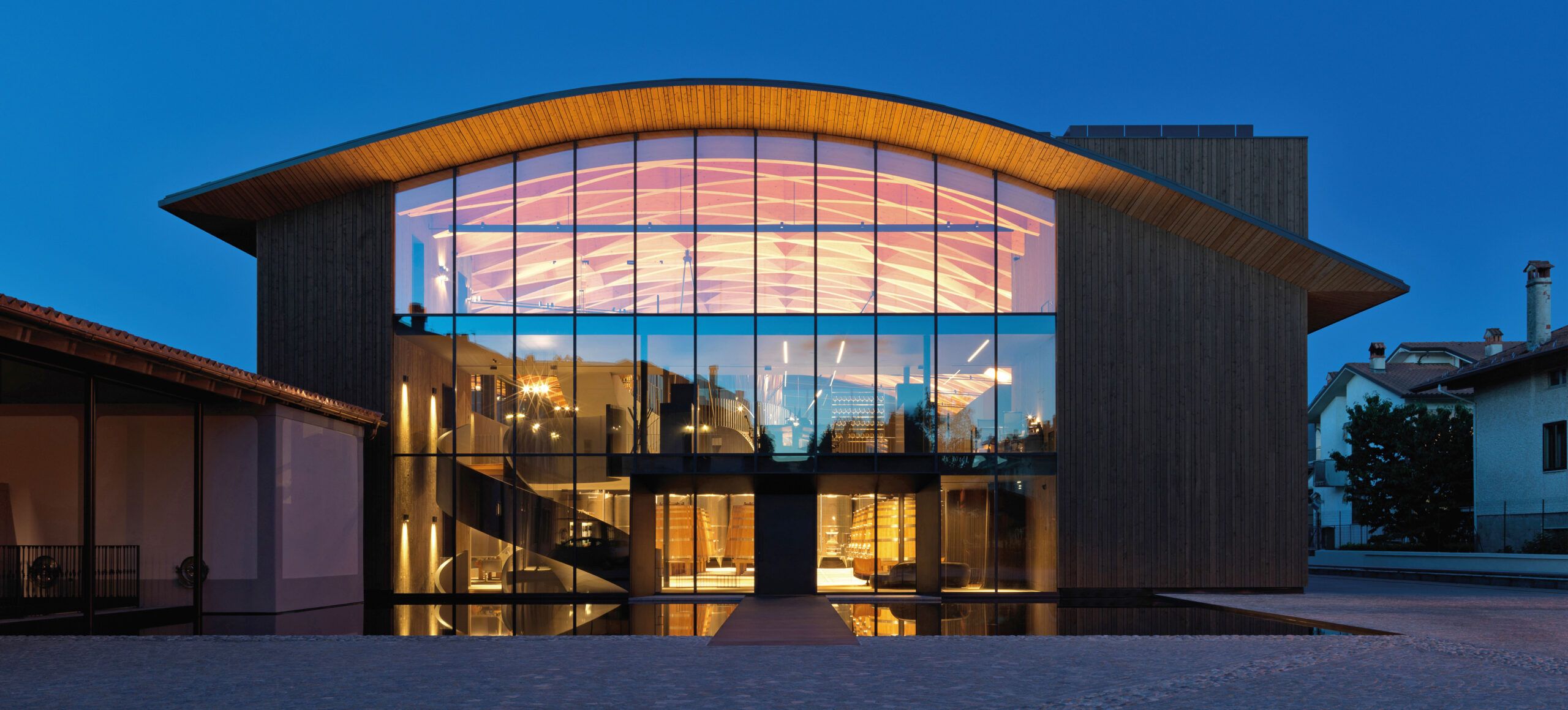
Following the acquisition, Roberto’s aim, working closely with his son Gabriele, was to apply the same fastidious attention to detail and quality to the wines of Nervi-Conterno as he does to those of the Giacomo Conterno estate. As soon as the ink was dry on the purchase, Roberto set about building a beautiful and state-of-the-art winery, which can be seen in the pictures above. They began to dig the new cellar in December 2018, and in the summer of 2019, the operative part of the winery was already completed. The three new projects were all completed by January of 2022. They included the winery with the exact equipment used in Monforte d’Alba at Giacomo Conterno, an extensive wine cellar under the parking lot, and a beautiful restaurant called Cucine Nervi, which offers refined cuisine and a stellar wine list. For this large-scale project, they took ideas that Roberto had developed and refined over decades in the Langhe.
Nestled in the foothills of Monterosa, Gattinara was established as a DOC in 1967, and gained DOCG status in 1990, although Gattinara has mainly been a wine for those in the know. If you’ve tried a Nervi or Antoniolo Gattinara from superior vintages, like 1961, ’64, ’78, ’96 or ’97, for example – and they have occasionally been seen here – you will know they clearly rival Langhe Nebbiolo. Roberto Conterno certainly thinks so.
Nervi is a historic, benchmark Gattinara producer, possessing some of the most prized vineyard holdings in all of the appellation. The winery was founded in 1906 by Italo Nervi and is the oldest Cantina in Gattinara. However, many of the vineyards had already been in the family dating back as far as 1679. The estate comprises 28.5 hectares of vineyards, including their top crus of Molsino and Valferana as well as Garavoglie and Casacce. These are historic crus in Gattinara and mentions of Molsino in town records date as far back as 1471, and those of Valferana date back to 1231!
In the 1800s, Gattinara was one of the most important wine-growing areas in Italy, with a reputation for quality. At the end of the 19th century, there were around 4,000 hectares under vine. By the 1960s, that number shrank to around 800 hectares, as people from the area left the instability of agriculture and industrialization took hold. Factories for textiles and faucet manufacturing became big industries, drawing the workforce away from vineyards. Today, only 100 hectares are planted in Gattinara.
In the Vineayrd
Four plots, totalling nearly 29 hectares, or getting towards a third of the DOCG’s total area, make the three main Nervi-Conterno wines.
While the DOCG allows up to 10% of Uva Rara or Vespolina in the blend, only the odd vine of these would still be mixed amongst older plantings, and most of Gattinara’s vines are now Nebbiolo. These, an array of up to 13 different Spanna clones, chosen to ensure vine health and diversity, and to maintain local identity, are grown at 300-420 metres. Soils are a mineral-rich gravel, with a stony mixture of red volcanic porphyry and granite, with a lot of clay underlay, making it somewhat similar to the Serralunga profile, but with better drainage due to the high portion of volcanic gravel.
In the Winery
Nervi’s production of Gattinara started in the first few years following 1900, and it is regarded as the oldest cantina in the area. Over the years, Nervi learnt how to tame the typically high-acid, high-tannin grapes of the region’s clone of Nebbiolo, Spanna. Historically, long-term ageing was the key, with maturation (often much longer than the mandatary DOCG regulations) in large format Slavonian botti.
Robert has taken control and the winemaking continues to evolve. Following completion of the new winery the winemaking is now more closely aligned to the approach taken with the wines of Giacomo Conterno.
The layout and space of the winery are slightly different from the winery in Barolo, but the concepts for production are the same. Roberto and Gabriele use the same vats for fermentation, the same aging vessels, the same space-age de-stemmers and cork sorters (to essentially remove any trace of cork taint!), and of course, his unique and incredibly precise bottling line.
Gabriele Conterno, Roberto’s eldest son, works closely with his father in all aspects. They also work closely with an impressive team of support they have in each cellar and winery. While they live near the winery in Monforte, they both spend a great deal of time back and forth between there and Gattinara. Gattinara’s proximity to Barolo was, again, one of the key reasons Roberto chose to purchase the Nervi winery.
For the winemaking, the process is very much the same at both estates, with 3-4 week macerations using pump-overs, occasional delestage and submerged cap. Malolactic tends to go slightly quicker in Gattinara than in Monforte, but bottling is the same for both Barolo and Gattinara, between 30-34 months. The cru Gattinara spends an extra year in bottle, whereas the Gattinara classico is released on the 1st of October, the same year it is bottled. Gattinara cannot be released until a minimum of 3 years after the harvest.
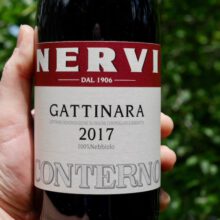
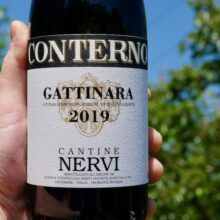
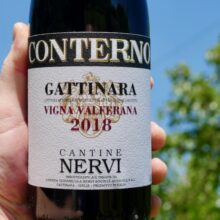
The vintage Gattinara, effectively the normale, is comprised of the four plots, Casacce, Garavoglie, Molsino and Valferana.
A Word on Vintages in Gattinara
As with all wines from any vintage, the ultimate truth comes from what’s in the glass. The best vignerons optimise each year and offer us a high base standard each year.
It’s important to recognise that the distance between Barbaresco and Barolo is enough result in a difference between the general vintage environment, indeed, even the distance of a few rows can result in dramatic differences in fruit quality.
The wines from Barolo and Gattinara must be considered independently of one and other given the 150km distance from Barolo to Gattinara, combined with hundreds factors that differ between the two regions and their individual vineyards.
Readers often ask if the Nervi wines are of comparable quality to the Barolos. I don’t think of wine as a competition. Some vintages may favour one appellation over another, the most striking example being 2018, when the Nervi wines were quite a bit more complex than the Conterno Barolos. Aside from those cases, the wines from the two estates can absolutely stand side by side. In fact, that is how I taste them every year.
Antonio Galloni, Vinous
Celebrate the difference!
Where in the World is Nervi-Conterno?
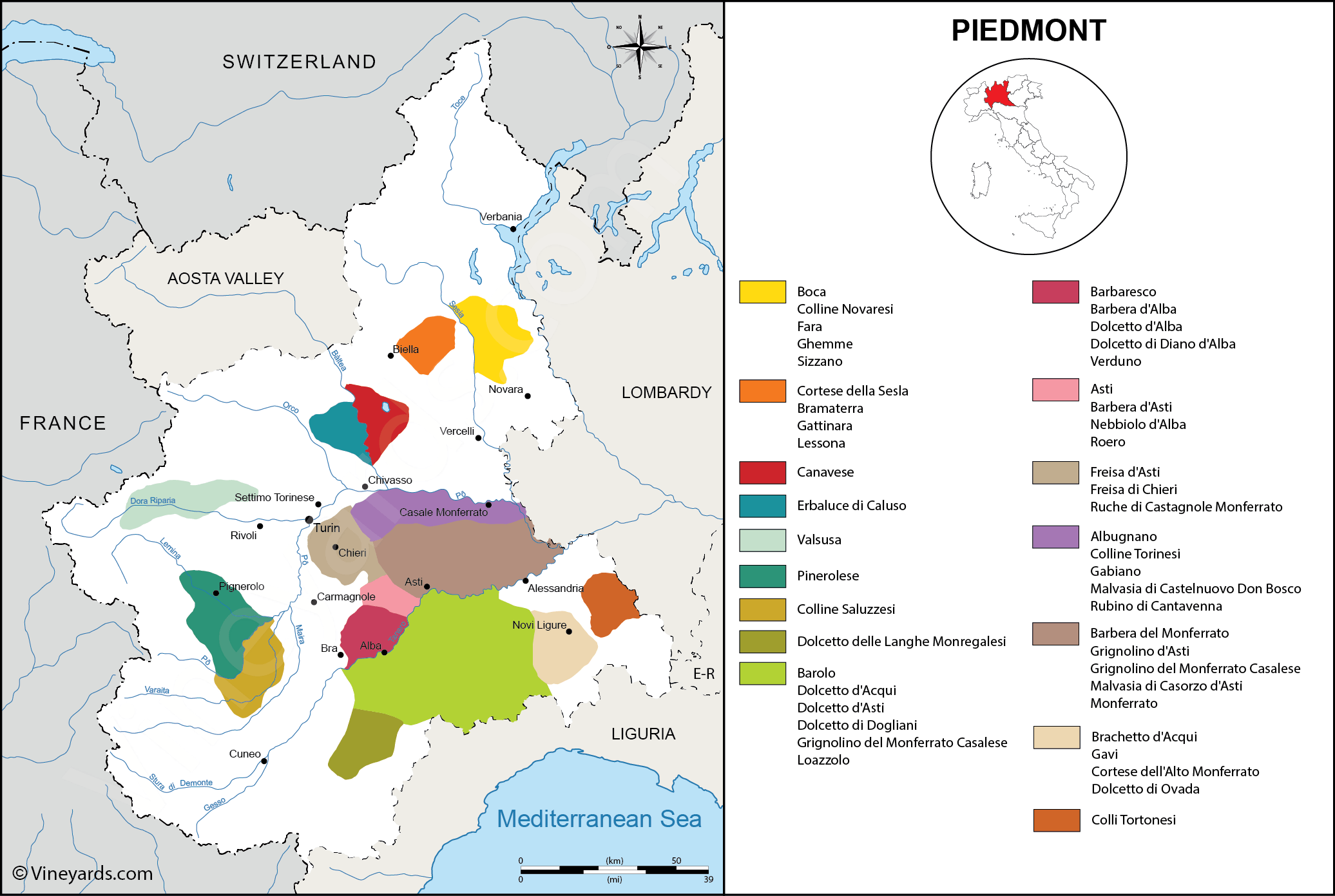
Gattinara in the Province of Vercelli in the northern part of the Piedemont region. 150km north of Barolo and 70km West of Milan.
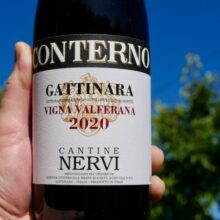
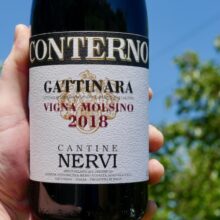
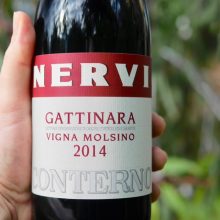
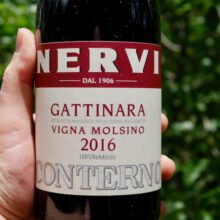
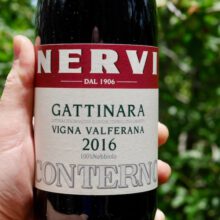
Nervi-Conterno’s holdings are in Casacce, Garavoglie, Molsino and Valferana with single vineyard wines made from the holdings in Molsino and Valfernana.