Size & Type
Other

$280
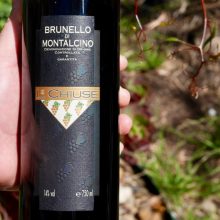
Call it traditional or call it delicious wine, you choose. Poised, harmonious, layered Brunello is what ends up in your glass. Le Chiuse’s Brunellos have the legs to be cellared for a long time, yet they have a drinkability as young wines that is just so enticing. Following up on the outstanding 2010, 2013, and 2015, 2016 is going to be one to watch!
Carved out of the Biondi-Santi Estate, we get to see fruit that used to go into Biondi’s Riserva! One of the great Brunellos.
Out of stock
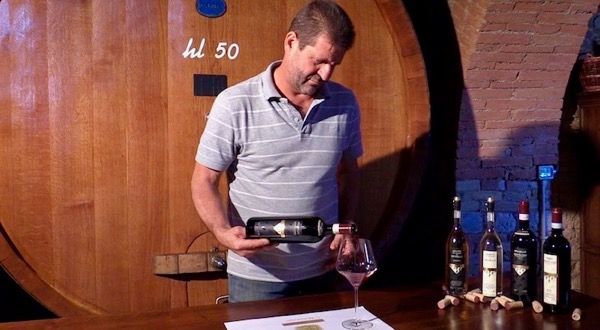
With 3years in large mostly older oak of 2-5,000L the sophistication from careful maturation pre-bottling shows. Crack it and decant it a few hours before devouring it. If you can hold off for a 5 years you’ll be rewarded, wait 10-20 years and you’ll be in a very happy place.
Like Chianti, Sangiovese is at the core of Brunello, specifically the Sangiovese Grosso clone. Brunello has an incredible diversity of styles, the ‘modern style’ tend to be clinical, often oakey, to my mind lacking harmony. The ‘traditional’ employing old large oak show delicacy and restraint, even when blessed with some incredibly powerful fruit.
Le Chiuse is undoubtedly a traditional producer, yet they clearly understand hygiene. There’s no Brett in these babies. The Brunellos I’ve tasted from them to date have been beautiful wines.

The Le Chiuse holdings originate through hereditary title, passed down from ancestors, Jacobo Biondi and Clementina Santi. Wine production starting toward the end of the 19th century.
For most of its life, the fruit of the vineyard was destined, through lease, for Biondi-Santi’s Brunello di Montalcino Riserva. Upon the death of a family Fiorella in 1986, the Le Chiuse holding, right in the heart of Montalcino, passed to her daughter Simonetta Valiani. With her grandfather love for the lands and passion for making wine, Simonetta started to produce wine “Brunello Le Chiuse”. Together with her husband Nicolo’ Magnelli she restored the farm-buildings, the chapel, built a new underground-cellar and planted new vineyards. To maintain the wine typicality the new vineyards are implanted with wild feet all grafted one by one with the old vines stocks (60/70 years old).
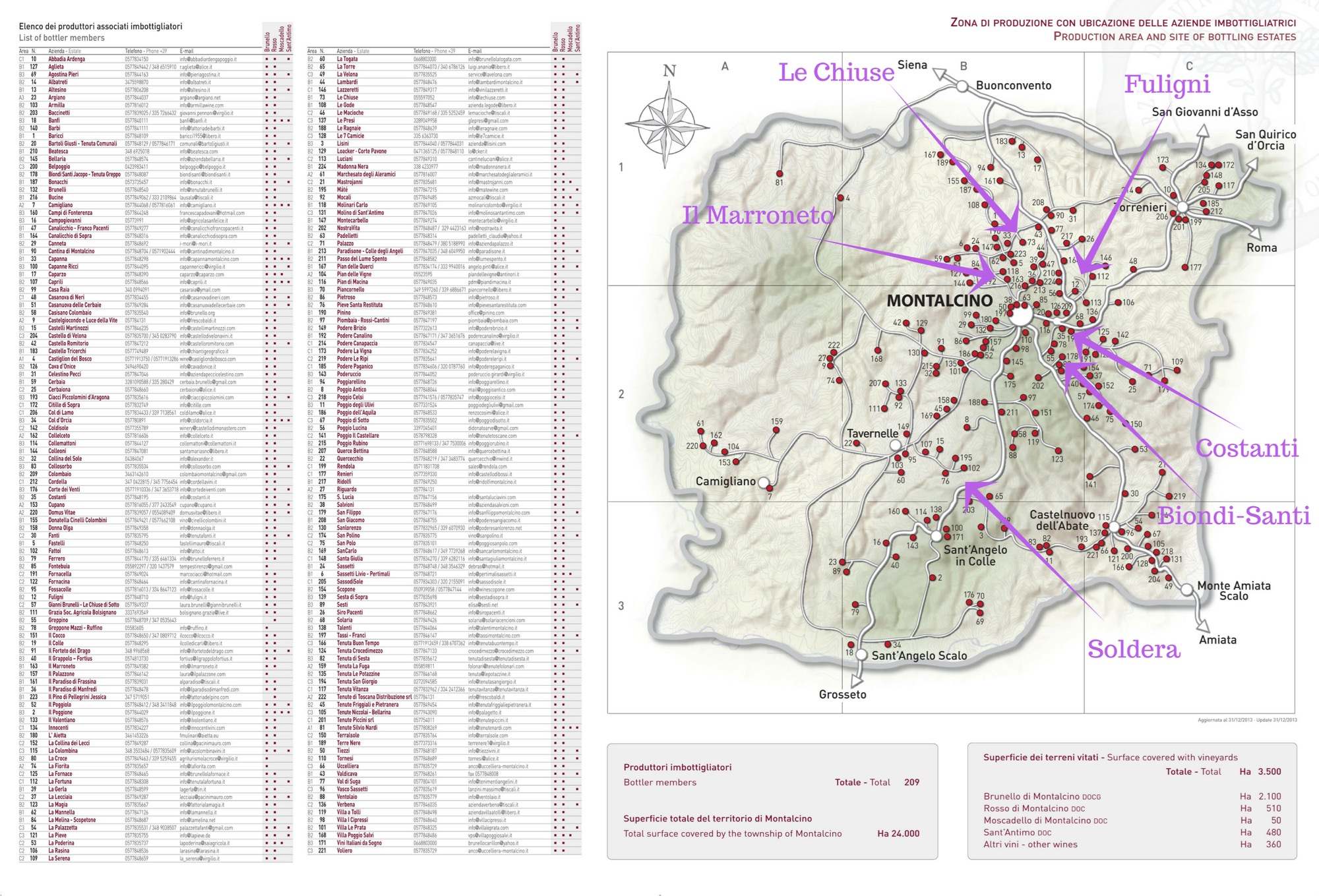
The estate consists of 18 hectares, including vineyards, olive groves and forest situated on the north-northeast side of the Montalcino hill at 300 meters above sea level and on the south-east slope at 500 meters above sea level.
There are five Sangiovese Grosso vineyards on the property with respective ages of 26, 16,14,10 and 2 years old. Together, the vineyards occupy eight hectares and have an average vine density of 4,000 vines per hectare. The spurred cordon trained vines are, for the most part, from a Massal selection of Sangiovese Grosso from Il Greppo.
The terrain is of marine origin and, therefore, rich in fossil material. It is also composed of clay striations, as well as, a good presence of marl and tuff. The result of this composition is the production of a wine characterized by an exaltation of aromas, good body and an alcohol level that is never excessive.
Each year Le Chiuse produces approximately 30,000 bottles of wine between its Rosso di Montalcino, Brunello di Montalcino, Brunello di Montalcino Riserva and a classic method spumante called “Stellare”.
As the new shouts establish they are heavily thinned to control the yield and keep the canopy open.
In August, the green harvest takes place in which a selection of bunches is made. In the course of the green harvest, almost half of the entire production of the vineyards is purged – an average of 40-45 quintals per hectare are removed. This operation is fundamental to obtaining high quality, allowing a better maturation of the remaining bunches and giving a good concentration to the final wine. In addition, the low yields reduce the risk of attack from disease, guaranteeing healthy grapes.
The true harvest begins in the second half of September when the largest bunches are collected by hand for the Rosso di Montalcino and “Stellare”. After a few weeks, it is time for the smallest bunches to be harvested for the Brunello di Montalcino, and in the best years, the Brunello di Montalcino Riserva.
The grapes are selected and picked by hand. Taking advantage of the vicinity of the winery, the grapes make it from the vineyards to the de-stemmer and crusher in less than a half hour. Using a gravitational system, the must falls into steel vats to begin fermentation.
Once de-stemmed and crushed, the grapes are gravitationally fed into steel vats. Fermentation using indigenous yeasts takes place in thermo-controlled tanks that do not exceed 29°C. Throughout fermentation and maceration, the must undergoes remontage and delestage to obtain the best extraction from the skins. After 18 days, the wine is separated and left to rest for approximately three months. During this period, malolactic fermentation takes place.
In January, the wine is racked into large Slovenian oak barrels that hold 20-30 hl. The wine will refine here for 12 months in the case of Rosso di Montalcino, 36 months in the case of Brunello di Montalcino and 48 months in the case of Brunello di Montalcino Riserva. During aging the wine is racked regularly.
Before bottling, the wine goes back into steel tanks while DOC and DOCG certifications are requested.
After light filtering, the wine is bottled and then refines an additional eight months before release.
From Vinous ‘2016 Brunello di Montalcino: Radiance Personified’
Let’s consider how long we’ve all been looking forward to Montalcino’s next great vintage. I’m thinking back to the release of the 2010s, walking the aisles of Benvenuto Brunello and tasting from table to table. Aromatically, the wines made your eyes roll back in your head, followed by an assault on the palate of intense and complex primary fruit, which was quickly clenched and held firm by aggressive tannins. When the reviews finally hit, it was like nothing I had ever seen before. Suddenly, every retailer in the country was pumping out email after email to feed the unquenchable thirst that consumers had for Montalcino’s next great vintage.
However, after the dust settled, and 2011 arrived, people seemed to be satisfied. The 2011s were ripe and juicy, and consumers were happy to allow them to fill restaurant wine lists instead of their cellars. Next was 2012, just as warm as 2011, yet prettier and more balanced; but it still didn’t move the needle. Two thousand thirteen had some potential and quickened our pulses for a time, yet it wasn’t the next 2010. At this point, we all started to feel the hunger – when would Montalcino have its next great vintage? However, it was just around this time that the 2016 Rosso di Montalcinos began to arrive, giving us a peek into what producers were calling a perfect vintage. The wines were dark and effusive in how they excited the senses, full of energy yet also dense in their fruit profiles, and with structure that was unexpected from the Rosso category. Suddenly, there came a glimmer of hope; and since that time, we have all been waiting for 2016 Brunello di Montalcino.
But now the big question is: Do the 2016s live up to our expectations? Oh, yes; they certainly do.
Eric Guido


The 2016 Brunello di Montalcino is an understated beauty of a wine that takes some time to come fully into focus. Patience is rewarded by a dazzling display of roses and violets, giving way to fresh-picked strawberries with a dusting of autumnal spice. This pure expression of Sangiovese fruit continues to impress with undeniable elegance, soothing and soft yet energized by brisk acids, taking on a decidedly salty note while still showing a mix of ripe berries. It’s so gentle yet full of character, tapering off to round tannins, primary fruit and inner florals. The 2016 Le Chiuse is full of potential but also deceivingly delicious today.
Le Chiuse's 2016 Brunello di Montalcino is a wine buzzing with energy and spirit. You sense this in the sheer crunch and snap of the primary fruit that recalls wild berry, cassis and sour cherry. Those lifted red fruit aromas are framed by light smoke, tar, potting soil, blue flower and crushed mineral or limestone. This is an extremely elegant wine that has been shaped by an epic vintage. The wine draws its fruit from an eight-hectare parcel with limestone clay. Le Chiuse's star is rapidly rising, and this new release from 2016 just thrust that shooting star into hyper speed. With 13,576 bottles made, this estate gives us one of the best buys of the vintage.
This is a very finely polished Brunello with cherry, chocolate and walnut, as well as dried flowers on the nose and palate. It’s full-bodied with creamy, polished tannins and a long finish. Drink in 2023.
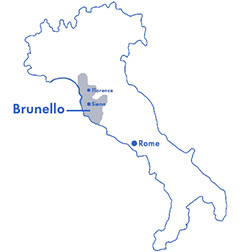
Where in the world does the magic happen?
Le Chiuse di Simonetta Valiani, Montalcino, Province of Siena, Italy
You must be logged in to post a comment.