Size & Type
Other

$495
The 2010 Leoville Barton is cut from a very different cloth to the Langoa this year with more amplitude on the nose and more red fruit. It is very well delineated, very intense with almost honey-like aromas emerging with time. The palate is medium-bodied with succulent, ripe tannins. This is a multi-dimensional Leoville-Barton with tobacco-infused black fruit gripping the finish and not letting go. (4/2020)
Neal Martin, Vinous
Out of stock
I’ve had a soft spot for Léoville-Barton ever since I consumed a fair volume of the Château’s wines in benchmarking exercises at Yarra Yering. Anthony Barton’s own quality reference for wine was purportedly the ability for it to be enjoyed with a lamb chop!
From the 2013 Vintage you can authenticate your bottles direct with the Château here.
The Barton group hold three Château under their umbrella: Léoville-Barton, Langoa-Barton and Mauvesin-Barton.
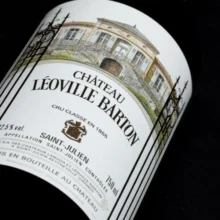
In 1826 Hugh Barton, an Irish already owner of Château Langoa Barton, purchased part of the vineyards of the big Léoville estate which then was renamed Château Léoville Barton.
The property still belongs to the Barton family; it is classified as a second growth and is situated in the heart of the appellation Saint Julien. The current owners believe very much in the importance of “terroir” and consequently produce an authentic Saint Julien wine of great finesse and perfect balance avoiding the trend of excessive extraction and extreme alcohol. Twice in the history of the Bartons, one of the member has been obliged to flee from France: Hugh in 1793 during the French Revolution returned to Ireland after a short stay in prison in Bordeaux. Then Ronald Barton also had to abandon the property in 1940. He returned in 1945 to produce a mythical vintage. Today, Lilian Barton-Sartorius represents the 9th generation and the most ancient family still owner of their property since the classification of 1855.
The work carried out in the vineyards consists of several stages of manual labour throughout the year and in all weather conditions. Pruning in winter is a very complex process that requires precision, experience, knowledge and agility. After tying the vines using a local wicker, the next stage is raising the wires in spring to ensure that the vigorous young vines are well supported and guided in their growth.
The vines have an average age of 40 years and the oldest plot dates back to 1953. Complantation (the process of replacing missing or defective vine stocks) is carried out every year to maintain a high planting density of 9100 vines per hectare.
The protection of the vines and the surrounding environment is of key concern at Chateau Léoville Barton. Since 2012 over 12% of the surface under vine at the domaine has been cultivated using organic methods, without the use of synthetic products. This percentage is increasing every year.
A variety of environmentally respectful practices are used at the domaine. Château Léoville Barton has opted for a sustainable approach to vine growing involving limiting input of external influences, using organic fertilisers (natural and plant-based products), ploughing all the vineyards, no phytosanitary emissions, sorting waste and the use of biodegradable staples etc.
The harvest is always carried out exclusively by hand to preserve the quality of the clusters and allow us to carry out an initial sorting. We work with a team of almost 120 people every year at this crucial moment for the vintage.
During the harvest at Château Léoville Barton, the grapes are brought to the vat-house where they are de-stemmed before being sorted on an optical sorting table and then transferred to temperature controlled wooden vats. The imposing vat-house is the perfect illustration of the traditional approach to wine making at Château Léoville Barton.
The fermentation process generally lasts a few days during which the juices are pumped over the top of the vat twice a day in order to keep the cap of skins moist and enable the juices to absorb the colours, tannins and aromas from this marc. When the maceration process is complete, the next stage is running off the wine i.e. transferring the wine to French oak barrels in which it will be left to age for 18 months. 60% of the barrels used are new oak and sourced from a range of different coopers.
Several different procedures are carried out during the 18 month ageing process, the first of which is topping up. This involves keeping the barrels full in order to prevent the wine from coming into contact with the air.
The next stage is racking the wines. This process is carried out every three months using the candle method which has remained unchanged for several generations. The aim is to separate the clear wine from the sediment (lees) that form in the bottom of the barrels due to gravity.
The last traditional intervention is the process of fining the wines using egg whites. The Oenologist will choose to use between three and six egg whites per barrel. This technique takes place 14 months through the ageing process and consists of separating the egg white from the yolk by hand and then introducing only the whites into the barrels. The proteins in the egg whites attract the floating particles and clarify the wine. A special post-fining racking is performed after 45 days to remove the egg white and sediment.
The alchemy of blending is usually complete by the end of January. It is at this stage that the tasting profile of the vintage is determined in the tasting room at Château Léoville Barton. The Barton family, the Technical Director and Eric Boissenot, the Consultant Oenologist, taste the different batches and varieties to fine tune the final wine and reflect the very best of each plot.
The bottling takes place at the château in Saint Julien in the month of June using our own facilities.
Léoville-Barton is in the Medoc on the Left Bank of Bordeaux.
A magnificently solid wine, initially severe. At this young stage, the tannins dominate in a wine that also reveals a full fruit salad bowl of black fruits. Very dense, concentrated, this is a wine that’s even better than the legendary 2005. The structure tells of its extraordinary aging potential: don’t even attempt to drink this for 10 years. *Cellar Selection* (RV) (2/2013)
A splendid showing, much stronger from bottle than it was from barrel, the Leoville Barton is one of the spectacular wines of the vintage. Inky purple to the rim, its huge tannin gives this wine real potential for 30-50 years of longevity. It is a classic, powerful Bordeaux made with no compromise. A superstar of the vintage, the wine has notes of pen ink and creme de cassis, good acidity, sweet, subtle oak, and massive extraction and concentration. I thought it was one of the most backward wines of the vintage two years ago, and nothing has changed in the ensuing upbringing of the wine in cask except that the wine now seems even richer, denser and fuller than I previously thought. The beautiful purity, symmetry, and huge finish of nearly a minute make this one of the all-time great classics from Leoville Barton. (RP) 96+ (2/2013)
Takes a modern approach, with dark mocha- and espresso-infused toast leading the way, featuring an extra ganache kicker before dark currant preserves and roasted plum fruit strides in. Dense and extracted through the polished finish, this features a charcoal spine that gives rise to extra blueberry and pastis notes. Should cruise in the cellar. (3/2013)
The 2010 Leoville Barton is cut from a very different cloth to the Langoa this year with more amplitude on the nose and more red fruit. It is very well delineated, very intense with almost honey-like aromas emerging with time. The palate is medium-bodied with succulent, ripe tannins. This is a multi-dimensional Leoville-Barton with tobacco-infused black fruit gripping the finish and not letting go. (4/2020)
Where in the world does the magic happen?
Château Léoville Barton, Chateau Langoa Barton Saint-Julien-Beychevelle, France
You must be logged in to post a comment.