Product information
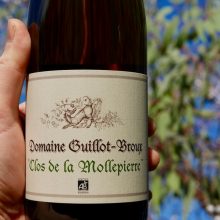
Domaine Guillot-Broux Mâcon-Cruzille Clos de la Mollepierre 2016
$125
$120ea in any 3+
$115ea in any 6+
Out of stock
Size & Type
Other
$125
Out of stock
This vineyard used to belong to our neighbours. Hoping to be able to buy it someday, our father rented it from them for over ten years. He finally bought it in 1992, but at that time couldn’t afford to replant it. He passed away in 2008, before being able realize his dream. We started clearing the land in 2009, planted the first vines in 2011, and produced the first vintage in 2015. This is a wine already packed with history !
During the harvest, the grapes are handpicked, and then sorted in the vines before going to the winery. This allows us to pick only the healthiest grapes, with the right maturity. By controlling the yields, producing between 30 and 55 hectolitres a hectare, we are looking for quality rather than quantity.
The high planting density increases competition among the vines and means that the juice in each grape is more concentrated. The key is to have few grapes per vine naturally, to increase the concentration of flavours and the balance of the wine. The pruning methods we use (Guyot Simple for the whites; Cordon de Royat for the reds) also help reach this goal.
Each terroir is vinified separately, using the methods best adapted to the grape variety, the soil, the vintage and the age of the vines. The best single vineyards are then bottled separately, and only when the vines are at least 10 years old. If the vintage is not exceptional, we blend the single vineyards into the entry-level wines.
We do not add yeasts to our wines, and the use of sulphites and chaptalisation are kept to an absolute minimum.
The white wines, made from Chardonnay grapes, are pressed immediately, in order to avoid any changes in the nature of the wine. The juice goes down to oak barrels in the cellar where both the first (alcoholic) and second (malolactic) fermentations take place. Each barrel contains 228 litres (300 bottles). After the second fermentation, the wines are racked and either put back into barrels, in the case of the single vineyard wines, or into vats for the Mâcon Villages.
The red wines, made either from Pinot Noir or Gamay grapes, may or may not be de-stemmed, depending on the vintage, before being put into vats for the alcoholic fermentation. The fermenting grapes are punched down twice a day until fermentation is finished, which usually takes around three weeks. Then the wine goes down to oak barrels in the cellar where the malolactic fermentation takes place.
Most of the wines are matured for eleven months in barrels. In some vintages, the top cuvees spend a second winter in barrels before being bottled, with no fining or filtering.
Established by Jean-Gérard Guillot in 1978, after he returned from working in the Cote d’Or, most recently at Domaine Michelot, then one of Meursault’s most important producers. Jean Gérard recognised the potential offered by the sloping hills around his native Cruzille, which although once famous in France, had largely remained fallow since the devastation of phylloxera.
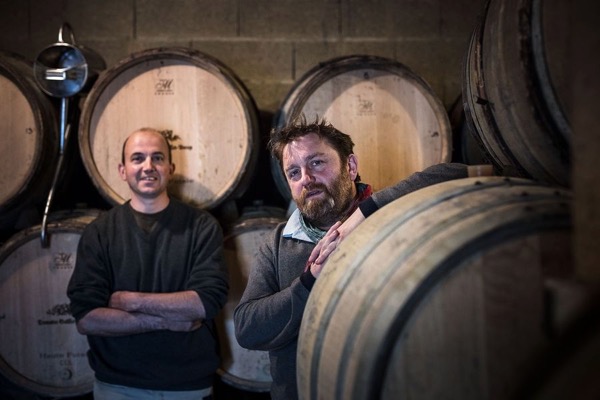
He started with just under a hectare from his father and slowly began to reclaim the old vineyards, planting them to densities of up to 10,000 vines per hectare, with old clones of Chardonnay found locally, and working them organically from the start. Cultivation, green manures, natural pest controls and treatments that do not leave residues in the soil or wine all contribute to the microbial health of the soil promoting better balance in the vine and the resulting wines. The domaine was certified as organic in 1991, when the French government first created the Agriculture Biologique standards.


The Mâconnaise – Is capable of producing some very good wines. It has become a shining light for value with the ever increasing prices of Burgundy. We’ve seen producers like Comte Lafon from Meursault recognise the potential of the region, establishing the joint venture Domaine Héritiers du Comte Lafon.
It is home to the Village of Chardonnay, the geographic home of the grape! Cruzille, the Domaine’s home is just to the west of the town of Chardonnay in the north half of the Mâcon.


Medium yellow. Rather elegant scents of yellow fruits and smoky, flinty limestone, lifted by a floral topnote. Lightly salty wine with a subtle sweetness to its citrus, stone fruit and mineral flavors. Less pliant than the Combettes and Genievrières, perhaps owing to the younger vines, but displays noteworthy precision. Finishes tactile and very long, with firm framing acidity and saline minerality, but avoids coming across as austere owing to its ripeness. Emmanuel Guillot, who shares this site with his cousin Julien (Clos des vignes du Maynes), expressed the opinion that this may be his best vineyard in ten years. From seven-year-old vines on "very strong"--i.e., active--oolitic limestone in a cooler valley, picked a week later than the Combettes.
Where in the world does the magic happen?
Domaine Guillot-Broux, Le Pasquier, Cruzille, France
Riesling | Mosel-Saar-Ruwer, Germany

Riesling | Nahe, Germany

Riesling | Rheinhessen, Germany
Fiano | South Australia, Australia
You must be logged in to post a comment.