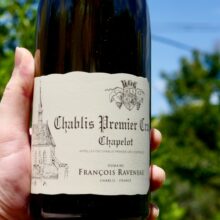
Domaine François Raveneau Chablis 1er Cru 'Chapelot' 2023

Product information

Domaine François Raveneau Chablis 1er Cru ‘Chapelot’ 2023

Chardonnay from France, Chablis, Burgundy

$350

Closure: Cork

Description

A slightly riper nose reflects notes of white peach, apple, lemon confit, quinine and a pretty top note of acacia. The rich, caressing and seductively textured medium-bodied flavors also possess good energy on the impressively long and saliva-inducing finish that is every bit as tightly coiled. While this beauty should be approachable on the younger side, it has the stuffing and balance to repay at least a decade of cellaring. ♥ Outstanding

As an aside, I have always liked the Chapelot from Raveneau (rarely seen as the production is limited to 1,200 to 1,500 bottles annually), and Isabelle confirmed that there will almost certainly be one in 2023. I would note that it’s not always produced, indeed the last one was in 2018.

Allen Meadows, Burghound 93 Points

**Limit 1**

Only 2 left in stock

Check out all of the wines by Domaine François Raveneau

Why is this Wine so Yummy?

About Domaine François Raveneau

The most sublime and the most celebrated estate of Chablis, the wines of Domaine Raveneau are a rare find—exceptional because the vineyard holdings are almost entirely made of grand cru and premier cru fruit, painfully finite as so few are produced, outstanding because of their tremendous quality and consistency, and unusual given the modesty of the vignerons who create these world-class wines.

Third-generation cousins, Isabelle and Maxime Raveneau are at the helm today with their recently-retired fathers, brothers Bernard and Jean-Marie, supporting by keeping their hands in across the vineyards and cellar. Prior to retirement, the brothers built on founder and father François Raveneau’s implementation of age-old traditional vineyard and winery techniques before passing the baton to their children.

The story of Domaine François Raveneau has its roots in the post-WWII years. Each from wine grower families, in 1948, François Raveneau and his wife Andrée Dauvissat (of the fellow famed Chablis house) merged their vineyard holdings to establish the house. While his father had systematically sold off prime plots over the years, when François took over, he was determined to acquire the best parcels for the domaine.

Throughout the decades from the late 1940s, this is exactly what he did, building a portfolio that represents some of the finest vineyards in Chablis. This activity coincided with a mass exodus from the region following the war, leaving François able to buy up prime parcels during the decades that followed. Another pivotal move by François was implemented soon after he and Andrée combined their holdings: He became the first in his family to make and bottle wine from his harvests, which, prior, had been sold to other producers and grape merchants.

Initially, François undertook viticulture and winemaking in a wider framework of “mixed farming”. This is the practice of combining crops with livestock farming and was typical among wine producers in Chablis to hedge against harsh climates and unpredictable harvests. However, during the 1960s and 70s technical advancements in the vineyards like methods for protection against spring frosts contributed to an explosion of viticultural development. At this time, François made the decision to dedicate himself entirely to viticulture.

Raveneau Family Succession

In 1978, son Jean-Marie completed his studies at the Lycée Viticole in Beaune and joined his father at the domaine. He was followed in 1995 by brother Bernard when he left a career as a Burgundian wine négociant to devote himself to the family business around the time of his father’s retirement. The third-generation Raveneaux have now joined the affair with Bernard’s daughter Isabelle starting work alongside her father in 2010 and Jean-Marie’s son Maxime joining in 2017. Isabelle’s role in the operation has grown steadily marking a departure from her grandfather’s attitude that women did not belong in vineyards or winemaking!

Domaine François Raveneau works to the adage “If it isn’t broken, don’t fix it”. Fundamentally, little has changed in vineyard and winery approaches since François started to concentrate his efforts on winemaking in the 1970s, and the estate’s finessed, complex, terroir-expressive, and in-demand wines are a testament to this.

“The secret is that there is no secret. It starts in the vineyard and then it’s just hard work.”

Isabelle Raveneau

In the Vineyard

Today, the Raveneau domaine encompasses 10 hectares of vine holdings across three Grand Cru and six Premier Cru sites. These include small plots in Blanchot, Les Clos, and Valmur, as well as in the Montée de Tonnerre, Les Vaillons, Butteaux, Chapelot, Montmains, and Forêt. The house also produces a Chablis Villages and Petit Chablis.

The average age of the house’s vines is 40 years with some dating back to the 1930s. Over the decades, the Raveneau domaine has implemented plot-by-plot vine replanting with about two-thirds of plants in the Grand Cru Blanchot vineyard dating to as far back as 1935 while the Petit Chablis site has Chardonnay from as recently as 2010.

Each of the domaine’s plots is treated with the same care, regardless of appellation level. They are traditionally farmed with techniques such as manual plowing the norm to promote soil and vine health. During the growing season, disbudding helps to control yields and, therefore quality, while careful trellising ensures that the fruit is exposed to optimal sunlight. This is especially important considering that, typical of Chablis, across its holdings the domaine’s vines can face south, southeast, southwest, or east so trellising needs to be tailored to each plot. Harvest is by hand to facilitate fruit quality sorting in the vineyard and prevent damage to grapes leading to unwanted oxidation.

The challenge is to mitigate Chablis’ inclement climate and to ensure that ripe grapes display an ideal maturity and acidity ratio for vinification and that the unique features of the region’s signature Kimeridigian and Portlandian soils shine through.

In the Winery

In the winery, the team implements a philosophy of minimal intervention. After harvesting, the grapes undergo pressing right away followed by alcoholic fermentation with indigenous yeast to further allow distinctive terroir expression. This stage takes place in stainless steel so there’s no oak influence and pure fruit flavors can develop unhindered, an important feature of Chablis wines. Afterwards, the wines are removed from their gross lees and start the maturation process with fine lees in barrel. Only a tiny quantity of this oak is new.

Indeed, the domaine makes a point of aging wines in small, used barrels (around seven years old) to add structure while minimizing the presence of oak character in the finished wines. This step takes 15 to 32 months depending on the appellation. The wines are finessed with a further three to six months in stainless steel after barrel maturation and some see additional bottle aging of six months for further balance before release.

The 2023 Vintage at Domaine François Raveneau

Isabelle Raveneau explained that the 2023 growing season “had its share of challenges but overall, was far from the worst we’ve had to manage. We at least avoided much frost damage even though there was some. However, a rainy spring made it though to keep the weeds down so there was a lot of vineyard work. On the plus side, the flowering passed quickly and uniformly, which is always a good thing for both yields and maturities. On the less good side, there was quite a bit of disease pressure, especially mildew and oidium so we again were constantly in the vineyards. The early September conditions were pretty much ideal, which really helped with allowing the vines to bring a relatively big crop to proper maturity. We chose to begin the harvest on the 12th of September and while picking went quickly early, by the end there was frankly a huge amount of sorting necessary. The berries were large with a lot of juice in them and the skins were quite thin and thus easily punctured by insects. This of course raised the very real risk of having problems with acetic acid so it was necessary to sort the later harvested fruit very carefully. Even so, yields were high by our standards, which is to say between 60 and 70 hl/ha compared to, for example, 2022 where they averaged right around 45 hl/ha.

When we began the harvest, potential alcohols were in the 12 to 12.2% area but they progressively increased and by the end, they were more in the 12.5% range. The vinifications were easy because the fruit, at least after the sorting, was so clean. The malos passed quickly as well and by December almost everything had finished. As to the wines, it’s clearly very early days but in speaking with my father (Bernard) and my uncle (Jean-Marie), it’s possible that they will ultimately resemble a vintage like say 2011. If that comparison is apt, then the ’23s should drink well early yet certainly repay mid-term keeping. And anyone that still has 2011 in their cellars will generally say that the wines have aged very well. A great vintage? No. But a good to very good one, yes.” I agree with Raveneau’s take on her ’23s as they indeed should be reasonably approachable young but have the proper stuffing to age well over at least the medium-term. I also revisited the Raveneau 2022s, which were mostly bottled in April 2024. As an aside I have always liked the Chapelot from Raveneau (rarely seen as the production is limited to 1,200 to 1,500 bottles annually) and Isabelle confirmed that there will almost certainly be one in 2023. I would note that it’s not always produced, indeed the last one was in 2018

Bughound

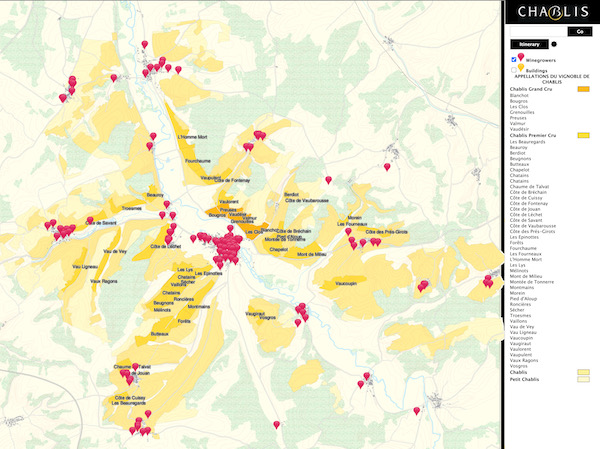
Where in the World is Domaine François Raveneau?

Domaine François Raveneau is based in Chablis, Burgundy, France.

Click on a map to enlarge 🔎

The Chablis governing body has an excellent interactive map that allows you to find producers and vineyards, zoom in and explore.

Where in the world does the magic happen?

Domaine François Raveneau 9 Rue de Chichée, 89800 Chablis, France

Chablis
Burgundy
France