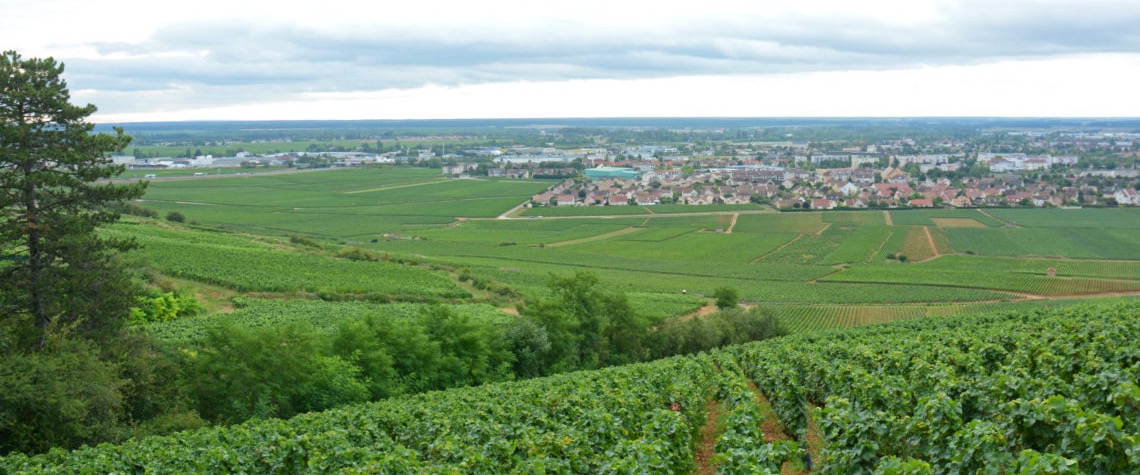

Lieu-dit (plural = lieux-dits) is a French term referring to a specific part of a vineyard or region recognized for its own topographic or historical specificities. Their precise geographical location is not registered by the INAO. You’ll find them in Alsace, Burgundy, the Rhône Valley. They are typically noted on a label as an indicator of quality. They are often a smaller part of a Climat or named vineyard.
In some cases, lieux-dits appear on wine labels, in addition to the AOC name. This is most commonly seen for Alsace wine and Burgundy wine. It may not always be easy for consumers to tell if a name on a wine label is a lieu-dit or a cuvée name created by the producer.
The only case of mandatory mention of a lieu-dit is in Alsace, for Alsace Grand Cru AOC. The Grand Cru designation may only be used if a lieu-dit is indicated. Lieux-dits may also be indicated on regular Alsace AOC wines, but is not mandatory.
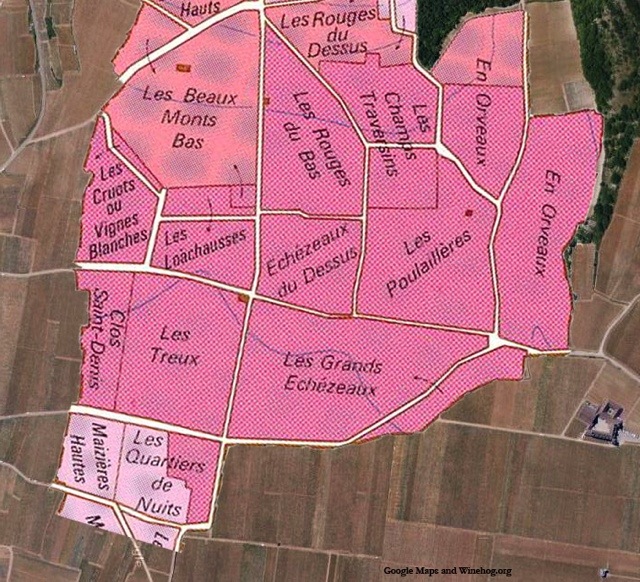
In Burgundy, the term climat is used interchangeably with lieu-dit. The use of the lieu-dit varies with the level of classification of the wine. Although the Grand Cru burgundies are generally considered to be classified on the vineyard level and defined as separate AOCs (with the exception of Chablis Grand Cru), some Burgundy Grand Crus are in fact divided into several lieux-dits. An example is Echézeaux, which includes 10 different lieux-dits in whole or in part (or 11, since one lieu-dit has two alternative names: Les Cruots is also known as Vignes Blanches). It is, by the way, illegal to use the name of lieux-dits on Grand Cru labels, though the law is flouted in Clos de Vougeot and one or two other Grands Crus to consumer-friendly ends.
The map, by Wine Hog, shows the 11 Lieux-Dits of Echezeaux. His article “Echezeaux – Grand cru standard?” explores each of the 11 Lieux-Dits, and, the producers with holdings in each.
The climat of Puligny-Montrachet Premier Cru Les Pucelles, includes the two lieux-dits of Les Pucelles and Clos des Meix. The Pommard Premier Cru climat of Clos des Epeneaux, is formed of part of the lieux-dits of Les Grands Epenots and Les Petits Epenots.
For village level burgundies, the lieu-dit may only be indicated in smaller print than the village name to avoid confusion with Premier Cru burgundies, where the village and vineyard name are indicated in the same size print.
In Rhône, lieux-dits are most commonly seen for some of the top wines of the region. Two examples are the lieu-dit La Landonne or La Chatillonne within Côte-Rôtie. Not all sites have been registered as lieux-dits. For example La Mouline and Les Jumelles are les marques of individual producers.
… a little more detail on the Climats and Lieux Dits in relation to Burgundy
The further exploration of the Climats and Lieux Dits in Burgundy was prompted by Peter M one of Wine Decoded’s community members. Thanks Peter!
The use of Climats and Lieux Dits in Burgundy has been used to great effect, highlighting the potential (I say potential as the vigneron can still stuff up the vineyard and the wine) quality of different vineyards.
We have seen this approach spread across the world with single vineyards wines becoming commonplace. In Australia, there have been attempts to establish distinctions across some of our wine regions. Think Mac Forbes Map of the Yarra Valley and its sub-regions, the Barossa Grounds Project, and, the McLaren Vale Scarce Earth Project. None have yet to reach the level of detail established with the Climats in Burgundy.
Back to Burgundy, the video below is an excellent explanation of Climat.
A definition of Climats from bourgognes-wines.com:
Climats are precisely delineated plots of land that enjoy specific geological and climatic conditions. When combined with human effort and translated through the two great Bourgogne varietals of Pinot Noir for reds and Chardonnay for whites, they give rise to an exceptional range of appellations that are classified according to quality and which enjoy international renown.
The Climats confer their own unique organoleptic qualities onto the wines of Bourgogne, such as their appearance, aromas, flavours and texture.
Some Climats were first referenced as far back as the 7th century, such as Clos de Bèze in Gevrey. For centuries, the reputation of Bourgogne wines was driven by the monks of Cîteaux, and then by the Dukes of Bourgogne. Some wines, such as Clos Vougeot and Montrachet, which bore the name of the Climat where they were grown, acquired a reputation that extended beyond French borders.
In 1935, the National Institute for Origins and Quality (INAO), made official the usage of the word “Climat” and began using it in legal texts applying to all Bourgogne appellations, whatever their level of hierarchy.
The Climats are a sign of excellence and on 4 July 2015, the Climats were included on the UNESCO World Heritage List.
References:
Jancis Robinson, ed. (2006). “Lieu-dit”. Oxford Companion to Wine (Third ed.). Oxford: Oxford University Press. p. 401. ISBN 0-19-860990-6.
Livingstone-Learmonth, John (1992). The Wines of the Rhône (Second ed.). London: Farber and Farbe. p. 11. ISBN 0-571-15111-6.
Jefford Andrew (2018) “Jefford on Monday: Burgundy’s great question” Decanter
 « Back to Wine Words Index

You must be logged in to post a comment.