Size & Type
Other

Chardonnay from Nuits-Saint-Georges, France, Côte-de-Nuits, Burgundy
$460
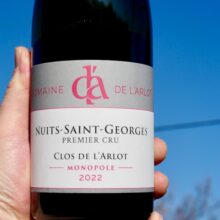
“The 2022 Nuits Saint-Georges Blanc Clos de l’Arlot 1er Cru was taken from tank on the lees before filtration and fining. Aged in 25% new oak, it offers pretty apple blossom, gooseberry and persimmon scents that gradually unfold, though never completely let loose. The palate is well-balanced, with noticeable weight and heft on the entry. This is a concentrated white Burgundy, yet Géraldine Godot manages to retain sufficient tension and poise, elongating the finish. Apparently, this bottle had opened up considerably since being uncorked the previous day. Touch of ginger on the aftertaste. Punchy!”
Neal Martin, Vinous 91-93 Points
Love the elevage very slight hint of toastiness from some oxidative handling remaining fresh with excellent mid-palate weight and chalky mid plate acid and tannins. Pithy, with a slippery, finish & cleansing silvery bitterness. I suspect this will build generosity with time and become quite something specials. Already openning in the glass to reveal just an inkling of its potential.
Paul Kaan, Wine Decoded
Out of stock
Until the 2021 vintage, Clos de l’Arlot Blanc was made from two small parcels of mass-selection vines planted in 1956 and 1984 on this vineyard’s steepest, rockiest section. The soil is white, chalky clay, and the hard limestone bedrock is near the surface. It’s therefore extremely challenging to cultivate and everything here must be done by hand, including weeding and organic and biodynamic spraying. The poor soils and old vines result in low yields, and the site’s exposure gives genuine ripeness, so we can always expect a deep, textural white. The mineral soils bring freshness.
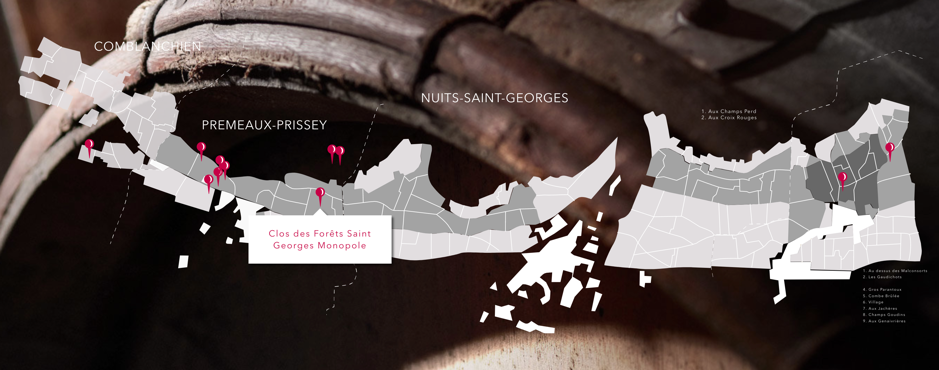
Today, the wine also includes fruit from the cooler La Gerbotte parcel, which was previously bottled separately. It was always in Godot’s plans to combine the two parcels when these vines came of age. La Gerbotte is a small plot of vines in the southernmost part of Clos de l’Arlot. Situated behind the main buildings, the vines border Clos de la Maréchale, where Fred Mugnier has also planted Chardonnay. (Mugnier has been open about the fact that Clos de l’Arlot’s whites inspired him to do this.) La Gerbotte is a slightly cooler site with a different geology from the other Clos de l’Arlot vineyards, with pink Prémeaux limestone rather than the white limestone of the rest of the clos. Planted between 1992 and 2006, the 0.49 hectares of vines include about 2% Pinot Beurot (Pinot Gris). This plot brings even more freshness and perfume to the power and depth of the old-vine parcels on the steep, southeast-facing slopes of the clos.
Domaine de l’Arlot, with its hillside vineyards and 19th century gardens, has what many consider to be the most beautiful estate in Burgundy. Since the late 1980s this producer has also been responsible for some of the prettiest red Burgundies going around. The perfume, silkiness and flickering clarity of these wines is born of the l’Arlot vineyards, and the Prémeaux terroir in general. Prémeaux has always stood apart from the rest of Nuits-Saint-Georges and made wines that are altogether more fine and elegant than those produced further North, around the town itself. L’Arlot brings the finesse of this terroir to the fore with their approach to wine growing and élevage. Biodynamic farming, perfect, well-sorted fruit, gentle extraction and whole bunch use, all play their part. Every step, from vineyard to bottle, is tailored to underline purity and finesse.
2014 was Jacques Devauges’s last year as winemaker, (before he was headhunted by the great Sylvain Pitiot for the role of Clos du Tart’s new régisseur), and Géraldine Godot’s first. The pair worked together at harvest time, with Géraldine assuming control over the élevage prior to bottling. To her credit, Godot refuses to accept any plaudits for the quality of Arlot’s ’14 wines. The plaudits can wait. The energy and dynamism Géraldine Godot is bringing to Domaine de l’Arlot is palpable.
“This was an impressive set of wines, less flamboyant and fruit driven than the previous vintage, more linear and structured with graphite notes often cropping up on the finish. The Clos des Fôrets is among the best within the appellation… Also keep an eye on the excellent whites, especially the La Gerbotte Blanc that should represent great value.” Neal Martin, The Wine Advocate
This year’s harvest will mark Géraldine Godot’s 10th vintage at Domaine de l’Arlot, meaning she has already outlived the combined years of her two predecessors, Olivier Leriche (2007-2011) and Jacques Devauges (2011-2014). Both those winemakers made some outstanding wines during their tenure here, but I think it’s fair to say that neither hit the heights, nor had the galvanising effect, of Godot, under whom Arlot has now become one of the Côte d’Or’s top estates. We need to go back to the great Jean-Pierre de Smet, who ran the domaine for almost two decades, to find a comparable period of consistent greatness. But, of course, the wines (and the climate) were very different back then (de Smet was a staunch 100% whole-buncher). AXA Millésime’s head man, Christian Seely, is certainly hoping that Géraldine has the staying power of de Smet, saying recently: “Géraldine has clearly taken Arlot to higher planes. What she’s brought to Arlot is a precision and fidelity, which allows each wine to express a sense of place.”
In 2022, Géraldine Godot produced another thrilling set of wines. She told us: “2022 has more in common with 2021 than with 2020. You can taste the wines and completely forget that the year was warm. I like this sort of vintage when you forget whether the season was hot or cold.” So do we! It’s a delicious year. Yes, the wines show their terroirs clearly, but they are also wonderfully ripe and textural, with most wines naturally registering 13-13.5%.
The yields were also good in 2022, averaging 38.5 hl/ha, whereas 25 hl/ha would be a 10-year average. This is likely a key to the wines’ superb balance. Godot believes another factor was the partial shutdown of the vines during the warmest days of summer, which slowed the ripening.
Godot destemmed everything in 2022. The 2021 vintage was destemmed out of necessity, and she was so happy with it that she wanted to try it again in a warmer year. The success of 2022 can be judged by the fact that no stems were used in 2023 or ’24. Jasper Morris notes that the change has had little effect on the style, which is aimed toward the ethereal rather than the powerful. The level of new oak was capped at 40%.
When we asked Benjamin Leroux for his favourite village in 2022, he didn’t hesitate to name Nuits-Saint-Georges. So, perhaps we shouldn’t be surprised by the quality on offer at Domaine de l’Arlot. Having said that, Premeaux-Prissey is a very specific part of Nuits (for me, it should have its own appellation!) Regardless, Arlot’s 2022 reds are outstanding: good depth yet long on charm, with a level of finesse and freshness that only the best growers achieved in 2022. “We can almost say classic,” says Géraldine.
Based in Premeaux-Prissey just to the south of Nuits-Saint-Georges, the Domaine also produces two wines from Vosne-Romanée, the 1er Cru Les Suchots and Grand Cru Romanée-Saint-Vivant. This particular wine is a monopole produced only by the Domaine and no other.

“The 2022 Nuits Saint-Georges Blanc Clos de l'Arlot 1er Cru was taken from tank on the lees before filtration and fining. Aged in 25% new oak, it offers pretty apple blossom, gooseberry and persimmon scents that gradually unfold, though never completely let loose. The palate is well-balanced, with noticeable weight and heft on the entry. This is a concentrated white Burgundy, yet Géraldine Godot manages to retain sufficient tension and poise, elongating the finish. Apparently, this bottle had opened up considerably since being uncorked the previous day. Touch of ginger on the aftertaste. Punchy!”
Where in the world does the magic happen?
Domaine de l'Arlot, Premeaux-Prissey, France
You must be logged in to post a comment.