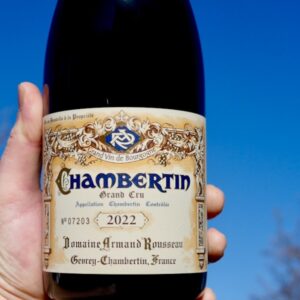
Domaine Armand Rousseau Grand Cru 'Chambertin' 2023

Product information

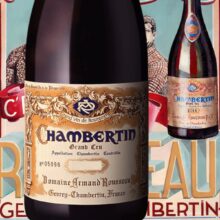
Domaine Armand Rousseau Grand Cru ‘Chambertin’ 2023

Pinot Noir from Gevrey-Chambertin, France, Côte-de-Nuits, Burgundy

Original price was: $3,950.Current price is: $3,650.

Closure: Cork

Description

The 2023 Chambertin Grand Cru has an exquisite, graceful bouquet with pure black cherries, raspberry and violet scents that soar from the glass. It shows exceptional delineation and focus. The palate is medium-bodied with fine tannins and very good weight, more muscular than the Clos Saint-Jacques, with firm grip on the finish This will require time, but there is huge potential.

Neal Martin, Vinous 95-97 Points Tasted Nov 2024 Drink 2030-2060


Rousseau’s 2023 Chambertin Grand Cru is lovely, wafting from the glass with aromas of cassis, plums and sweet berry fruit, mingled with notions of licorice, vine smoke and spices. Full-bodied, ample and fleshy, it’s unctuous and seamless, with sweet, powdery tannins, succulent acids and an expansive finish.

William Kelley, The Wine Advocate 95-97 Points Tasted Jan 2025


A more restrained if even spicier nose is comprised by aromas of dark plum, exotic tea, earth, the sauvage and a lovely array of floral elements. I very much like the texture and minerality of the bigger-bodied but sleek favors that also display focused power on the moderately austere, hugely long and beautifully well-balanced finale. This is slightly less austere and compact than it usually is though with that said, it should have no trouble amply repaying long-term cellaring.

Allen Meadows, Burghound 94-97 Points Tasted Jan 2024 Drink: 2041+

Provenance: Purchased on Release ~ Official Australian Importer ~ Climate Controlled Cellar.

In stock
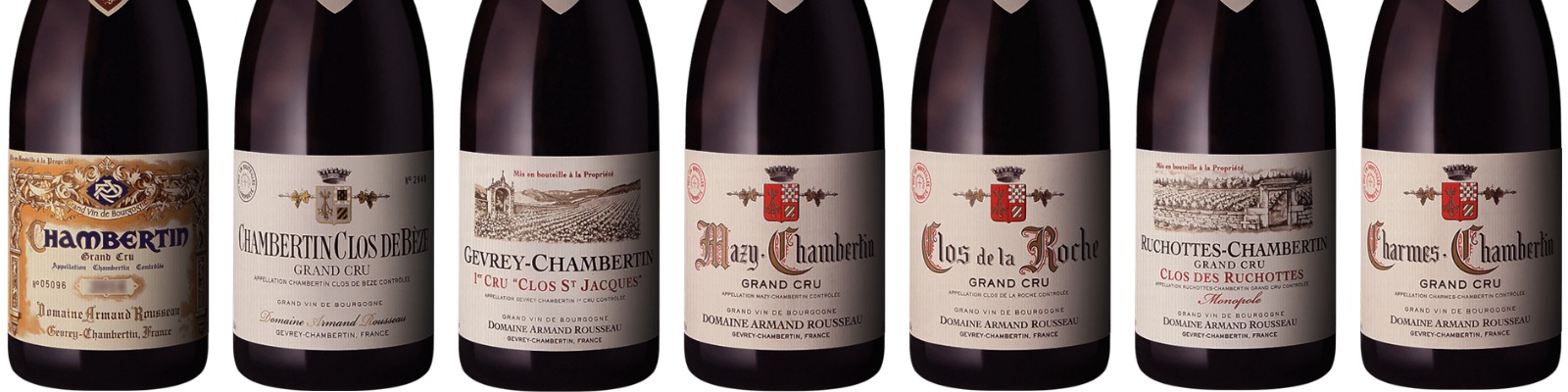
Check out all of the wines by Domaine Armand Rousseau

Why is this Wine so Yummy?

“We did a green harvest where we got rid of half of the bunches,” she tells me. “But there was still a lot of fruit. Everything that seemed a bit shriveled was not picked. The temperatures made sure that the grapes were mature. We started on September 7 and picked over eight days, only picking in the morning. We had a little botrytis in Mazis-Chambertin but that aside, everything was beautiful. Most of the appellation is at the maximum yield with some pickers leaving grapes unpicked. In any case, all the vats were full.”

This is an exquisite set of wines from Rousseau that embody everything that is great about them. Often overlooked is their sheer drinkability. These are not wines to keep as prizes, instead wines that cry out to be drunk. They are built around extremely fine tannins, lighter chassis than in 2022, yet unlike others they deliver just the right amount of concentration combined with terroir expression on the finish. Only the Mazis-Chambertin left me wondering if it reached full potential, perhaps knocked off-balance by that touch of botrytis?

Neal Martin, Vinous

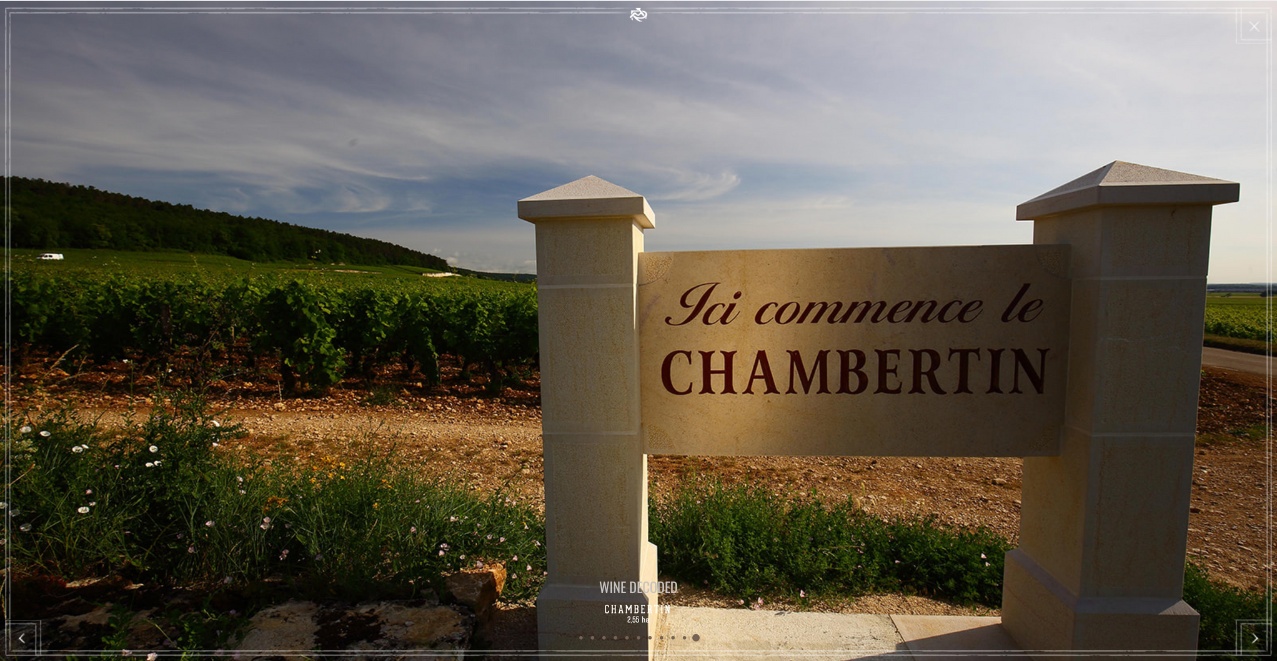
Grand Cru ‘Chambertin’

2HA55/12HA90 – EASTERN EXPOSURE

Long ago, a man named Bertin decided to cultivate the same vines in his field as those of the Bèze monks.

His wine was so exceptional that his vineyard came to be known solely in reference to him: Bertin’s field, or, in French, ‘Champ de Bertin’, which over the years became ‘Chambertin’.

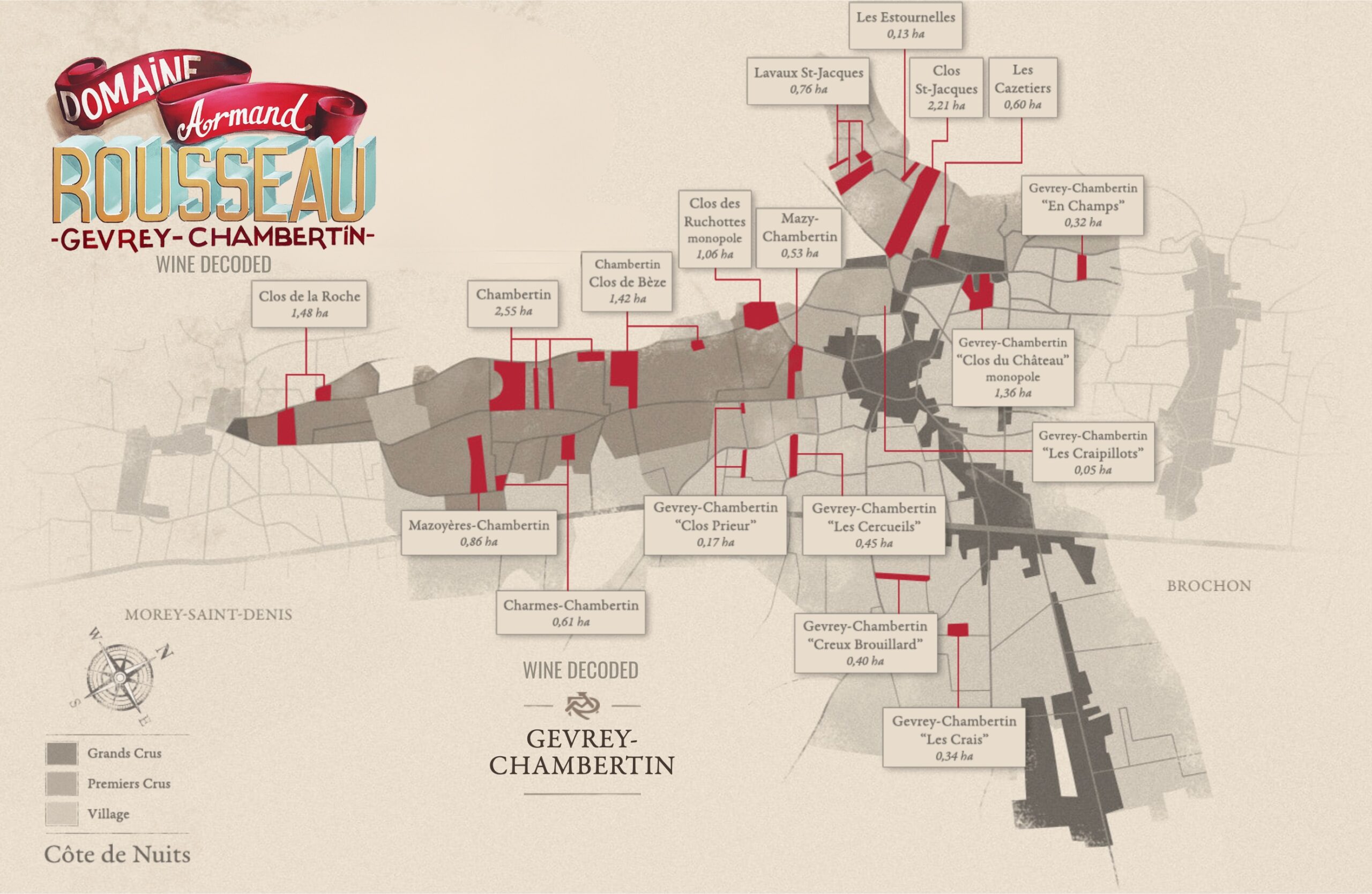
The grapes for this Chambertin Grand Cru come from three vineyards in the east-facing Chambertin appellation, and from a fourth vineyard, ‘Larrey’, a north-south parcel at the edge of the woods. The layout of this vineyard is such that it can only be cultivated using a horse and plough.

The soil has a very high limestone content. At the top of the Clos it lies on Bathonien calcerous clay and halfway down on crinodial limestone and marl from the Bajocian age. The stones are spread out unevenly.

Chambertin is the wine of kings. Powerful, virile, concentrated with good structure. A wonderfully persistent mouthfeel with aromas of chocolate, liquorice and small red fruits.

About Armand Rousseau

For four generations, the Rousseau family has worked tirelessly and passionately on some of the finest terroirs of the Côte de Nuits.

The domain is managed by Eric Rousseau, with the help of his daughter Cyrielle. It has expanded over the years and today covers 15 hectares and 3 ares. They own 3 hectares of Village appellation, 3 hectares 77 of Premier Crus and 8 hectares 52 of Grand Crus, situated in Gevrey Chambertin and Morey-Saint-Denis.

From the moment the domain was established, the family developed an enduring ritual: the elders teach the ways of the vine the next generation. Thus, they maintain the strong bond between man and vine, upholding the family values and strong work ethic through the years. In the Rousseau family, the heartfelt love of the vines is renewed with each generation; a profound respect of the terroir is anchored in the family values.

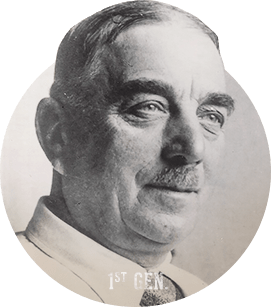
Armand Rousseau

The Domaine was established at the beginning of the twentieth century by Armand Rousseau who, at the age of 18, inherited several plots of vineyards in Gevrey Chambertin. He came from a family of small landowners, composed mainly of winemakers, coopers and local wine merchants.

Armand’s marriage in 1909 provided him with additional vineyards, as well as the current Domaine premises. Situated near a thirteenth-century church in the oldest part of Gevrey Chambertin, the premises include a house, storage space, cellars and the winery.

Armand Rousseau first sold his wines in bulk to local wholesalers. Rapidly, he acquired the prestigious vineyards of Charmes Chambertin, Clos de la Roche, and Chambertin. He decided to start bottling his best wines himself, and with the help of Raymond Badouin, founder of the ‘revue des Vins de France’, he soon developed a clientèle of restaurants and private customers.

Over the years he has continued to expand the domain, notably by purchasing Mazy-Chambertin and Mazoyères Chambertin (sold under the appellation Charmes-Chambertin): Grand Cru appellations, classified as such in 1935 by the ‘Institut des Appellations d’Origine Contrôlée’. The Clos Saint Jacques was purchased his son’s name – Charles Rousseau joined the domain in 1945 after studying Law and Oenology at Dijon University.


Charles Rousseau

In 1959, Armand Rousseau died in a car accident on his way back from hunting. Charles Rousseau found himself at the head of the domain. He continued to develop the family business, adding to the 6 hectares he had inherited by acquiring more vines in the 1990s, especially Grand Crus: several parcels of Chambertin Clos de Bèze, some Chambertin and the entire vineyard of Clos des Ruchottes.

Fluent in English and German, Charles decided to prioritize the export of the domain wines. His father had started selling to the United States right after the end of prohibition, at the end of the 1930s. Charles first exported to the United Kingdom, Germany and Switzerland, then expanded to the whole of Europe, then Canada, Australia, New Zealand, and finally Asia in the 1970s.


Eric Rousseau

In 1982, Charles’ son Eric came on board after completing a degree at the Lycée Agricole et Viticole of Mâcon Davayé, specializing in oenology at Dijon University for a year, and working for a time with wine merchants and négociants in Burgundy.

Eric started in the vineyards, introducing new techniques such as green harvesting, leaf thinning and mechanical work of the soil without the use of insecticides or chemical additives. He steered the Domaine towards a more organic process, and became more involved with the winemaking, encouraging traditional methods and minimal intervention.


Cyrielle Rousseau

Cyrielle Rousseau returned to join her father at the domaine in 2014. After obtaining degrees in Geology and Viticulture and the DTO in Dijon, she left Europe to learn about winemaking abroad. She assisted with harvests and vinifications in Oregon, Australia and New Zealand, and gained experience on the commercial side by working with wine merchants and importers.

Today, she manages the domaine alongside her father, who hands down his knowledge of the work and the vineyards, ensuring that the philosophy of the domain and the values of the family are passed down to yet another generation.


In the Vineyard

Diving into the Heart of Terroir

This in-depth knowledge has led to a better understanding of the trade, which today enables the domain to concentrate on simplifying their approach, deepening their connection with their vineyards, their soils and their climate.

So that the varying needs of each individual vineyard can be tended to with utmost precision, work on the soils is carried out with as much adaptability as possible. Working the equilibrium of prevention and action, the aim is to respect the natural balance of the plant. A mostly organic integrated pest management is used across the vineyard.

Desuckering is systematically carried out, as well as green harvesting in high-yielding years, to optimise the ripeness of the grapes as well as their phenolic concentration. Quality is always placed above quantity at the domain.

The vines are on average fairly old, between 40 and 45 years for the most part, and exclusively of the Pinot Noir variety. They are planted at a density of 11,000 plants per hectare. The clones were selected for their low yield and high concentration.

‘True tradition does not mean reproducing what others have done, but finding the way of thinking behind the great achievements of the past, leading to different decisions as times change.’ — Paul Valéry

The wines are a testament to the simplicity of the Rousseau approach; they will hold their quality consistently throughout their lifespan.


In the Winery

The vinification methods at the domain have for the most part remained true to the very first harvest. The same rigorous monitoring of the stages of fermentation has been maintained.

The 2023 Vintage

Eric Rousseau’s daughter Cyrielle, who is gradually assuming control of day-to-day operations briefly described the 2023 growing season as “much easier to manage than was 2022 given that we weren’t confronted with the massive late June storm that came right down the Combe de Lavaux directly in front of the cuverie! Now that was exciting if for all the wrong reasons! In 2023, we had an excellent fruit set, a relatively easy season as there wasn’t much disease pressure and temperatures, while warm to very warm, weren’t extreme. Really about the only thing that concerned us was controlling yields and to that end we did a huge green harvest. Remarkably, even after having done that we largely made the maximum allowable in two-thirds of our appellations and not far from that in the others. We picked from the 7th of September and there was some sorting necessary but mostly for under ripe bunches or those that had wilted. Potential alcohols were strong at between 13 and 14% with adequate, though certainly not high, acidities. We did our normal vinification and had no trouble with the fermentations finishing their sugars. As to the style of the ’23s, they’re exuberantly fresh with better mid-palate densities than the generous yields would have one believe. No, they’re not super-dense but neither are they dilute, indeed if you didn’t know the vintage it would be easy to assume that the wines were the product of a vintage with normal yields. I like them quite a bit and they should make for good early drinking, which should appeal to those who don’t want to wait.” I agree with that sentiment that the Rousseau ’23s should make for reasonably early drinking but I would still opt for cellaring them over at least the mid-term. I would add that, and as noted previously, the domaine is now using bottles where the bottoms are embossed with the name of the domaine while using corks that have been sensor-scanned and are in concept guaranteed against the presence of TCA. 

Allen Meadows, Burghound

Where in the World is Domaine Armand Rousseau?

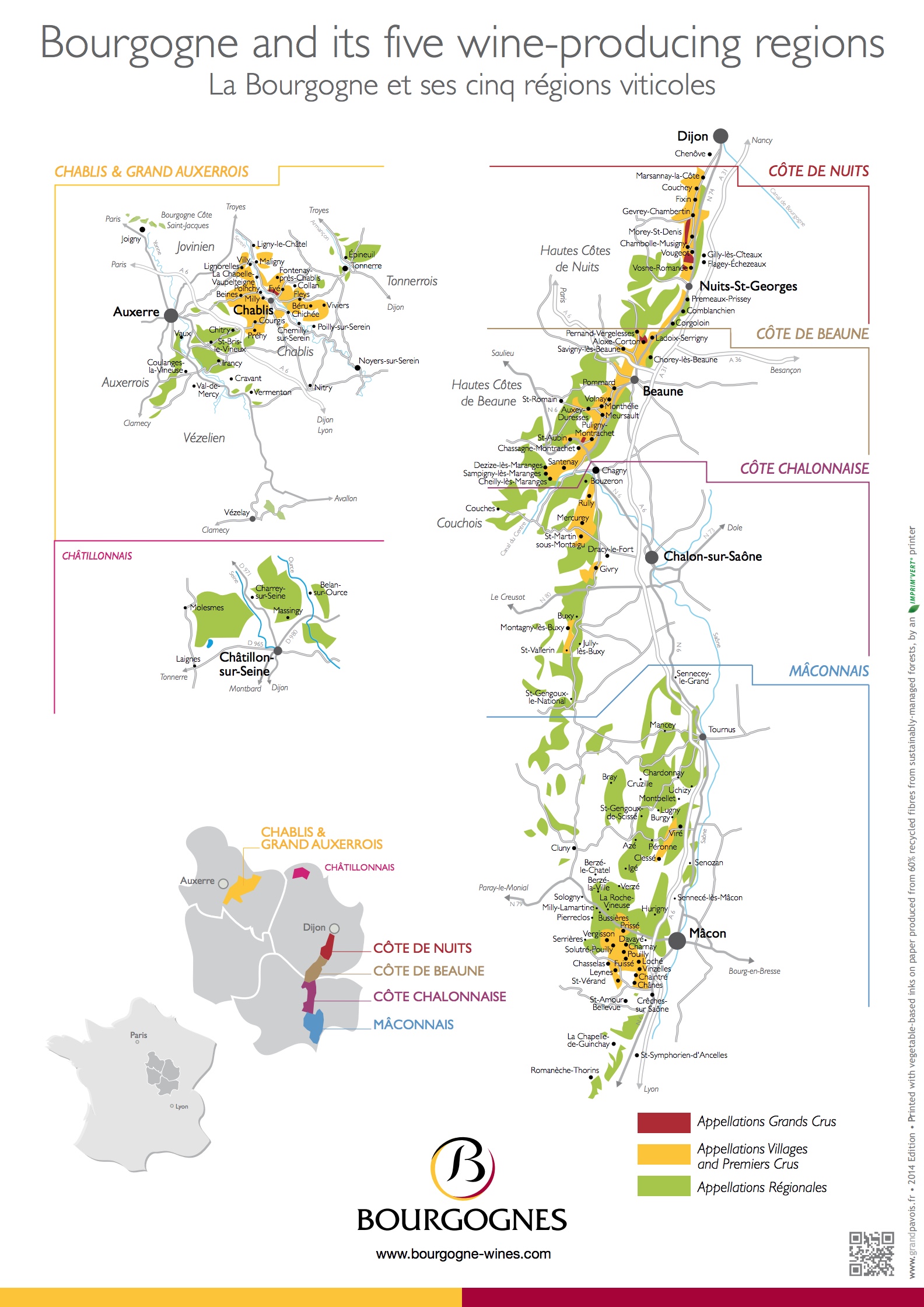
Domaine Armand Rousseau is based in Gevrey-Chambertin in the Côte-de-Nuits, Burgundy, France. Head to the Wine Bites Magazine for a deep dive in the article “Getting Your Head Around Burgundy Part 9.1 – The Village of Gevrey-Chambertin”.

Domaine Armand Rousseau Vineyard Map
Click to enlarge 🔎

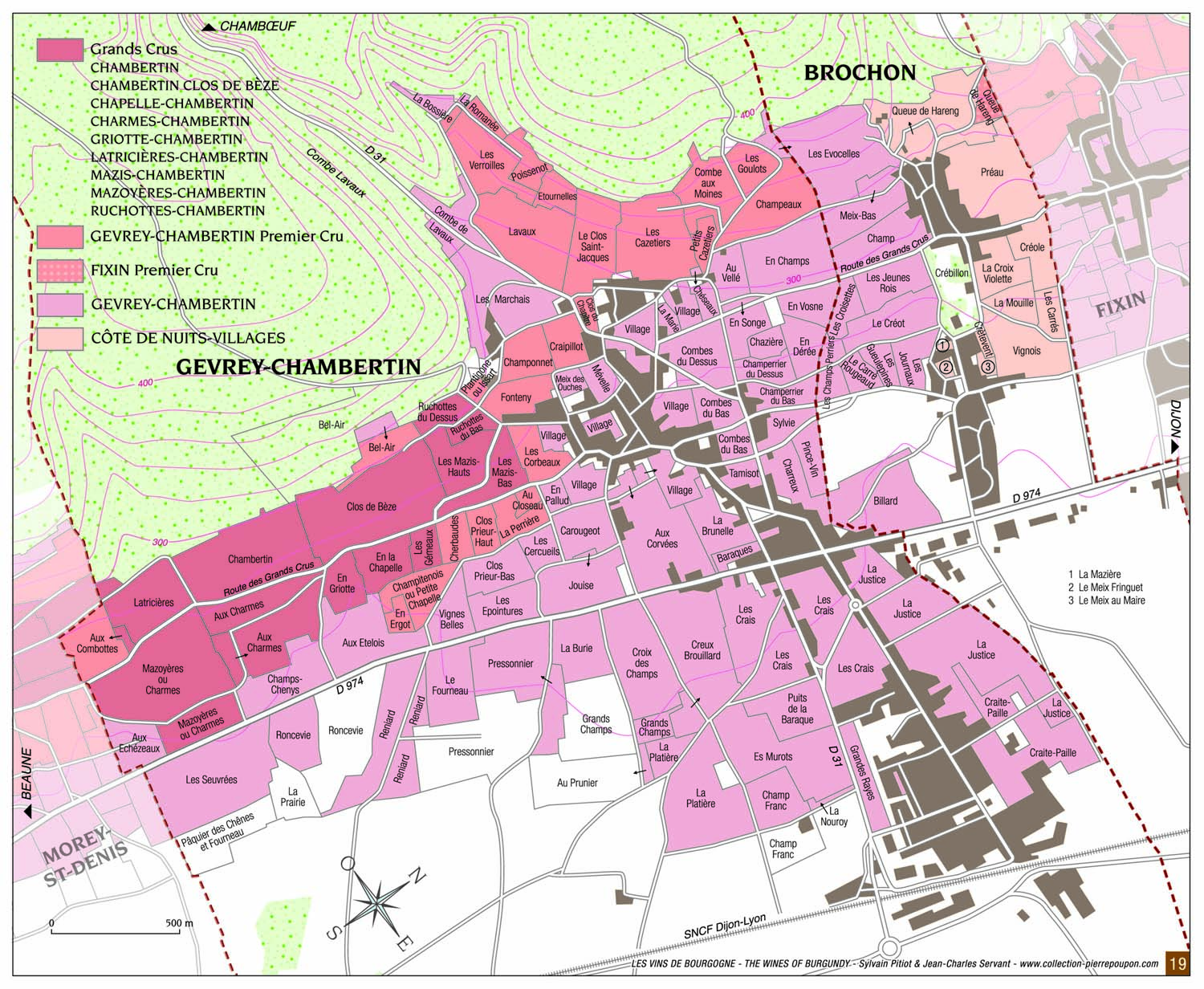
In this video Jean-Pierre Renard takes an in-depth look at the geography, geology and climatic conditions of Gevrey-Chambertin.

Click to enlarge 🔎

Where in the world does the magic happen?

Domaine Armand Rousseau, Rue de l'Aumônerie, Gevrey-Chambertin, France

Gevrey-Chambertin
Côte-de-Nuits
Burgundy
France