
Residual Sugar refers to the amount of sugar left in a wine when the alcoholic fermentation has been completed and any additions made prior to bottling the wine. The amount of residual sugar in a wine will depend on the style being produced. A Dry wine has only non-fermentable sugar left. Typically 2g/L or less. A sparkling wine or off-dry wine might have just a few g/L of sugar left. Then we move all the way up to dessert wines and fortified wines that may contain several hundred grams of sugar per litre.
In the end, it’s all about ensuring the wine is balanced and has a clean finish no matter what amount of sugar it contains. For a high acid low pH Riesling, a few extra grams of Residual Sugar will help to balance potentially searing acidity without giving any apparent sugar sweetness.
Bear in mind fruit flavours and alcohol can also have apparent sweetness.
There are two methods for managing Residual Sugar in a wine:
- Sugar can be added back to achieve the desired balance, for example, Champagne. Sometimes sugar is added to make up for a lack of fruit flavour, giving perceived sweetness. Think low-quality fizz, mega high volume commercial white and even red wines.
- Fermentation can be stopped through the addition of sulphur, refrigeration, and, fortification. For example German and Alsatian whites, Sauternes and many of the fortified wines from around the world.
Different regions around the world have different scales / naming systems to help you understand the possible amount of residual sugar in a wine.
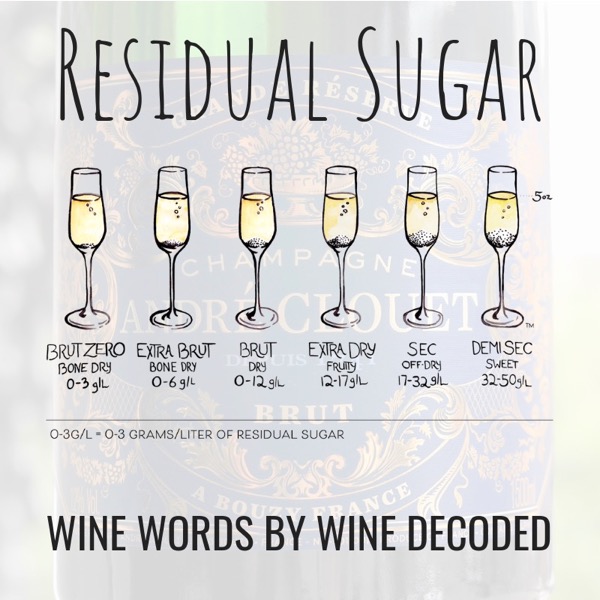
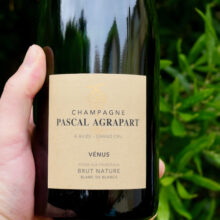
In Champagne Brut refers to dry, but may have up to 12g/L residual sugar, with the residual sugar being added at disgorgement in the liqueur expedition. Brut Nature, Brut Sauvage, and, Brut Zero, are used interchangeably for wines with no added sugar or Zero Dosage and we expected to have less than 2g/L RS.
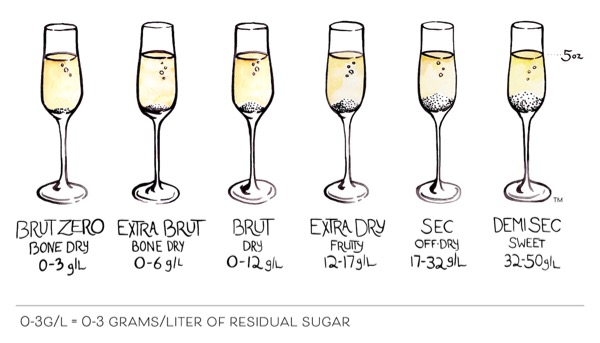
The same principals apply for German Riesling named Trocken (Dry), Kabinett, Spätlese, Auslese, Beerenauslese and Trockenbeerenauslese where the residual sugar levels increase as we go along the scale.
One trick to working out how sweet a German Riesling could be is to look at the Alcohol. If it is high 10% and above the wine will be less sweet. If it is low 6.5-8% the wine will be sweeter.
Fruit for sparkling wine is often picked at between 180g/L and 200g/L sugar. Fruit for a table wine between 200-250g/L. When it comes to sweet wines like Sauternes, Muscats, Topaques, and, German Rieslings like Trockenbeeranauslese we see fruit picked with sugar levels well over 300g/L.
A mini Wine Bite to test your tastebuds
- Grab 3 glasses.
- A bottlle of Dry wine with no Residual sugar in it.
- Pour around 50mls of wine into each glass.
- Do nothing to the first glass.
- Add 1/4 of a teaspoon of white sugar to the second glass. Equivalent to 15-20g/L Residual Sugar.
- Add 1 teaspoon of white sugar to the 3rd glass. Equivalent to 60-80g/L Residual Sugar.
- Stir until the sugar is dissolved.
- Then taste and look for the differences.
The first, unadjusted wine should finish clean and refreshing, the second will appear a little clumsy possibly a little oily, the last will seem way over the top, and, you may feel like you’re trying to swallow a teaspoon of honey.
Let us know how you go. Leave a comment below.
« Back to Wine Words Index
You must be logged in to post a comment.