Baumé [Bé]


Baumé & Brix are unit of measurement for the amount of sugar in grape juice and fermenting wine.

« Back to Wine Words Index

Baumé, pronounced Boh-May, & Brix are units of measurement for the amount of sugar in grape juice and fermenting wine.

1°Bé = 1.8°Brix = 18 grams per litre sugar.

Depending on the efficiency of the yeast in converting sugar to alcohol 1°Bé will produce 1-1.1% alcohol. So fruit picked at 12°Bé will result in a wine with 12-13.5% Alcohol.

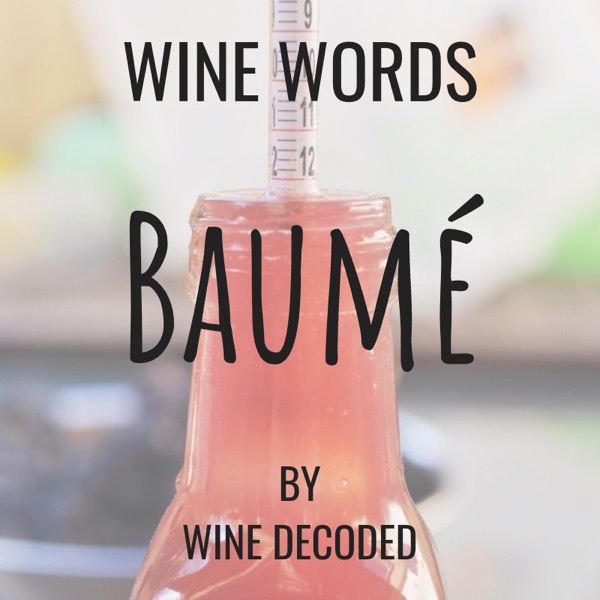
We measure Baumé & Brix using hydrometers that float in juice and wine.

On the left is a hydrometer and thermometer just about to measure the Baumé and temperature of the fermenting wine. On the right a hydrometer measuring the Baumé of a juice sample to check the sugar levels before picking. You can see it is at about 12.4°Bé. Enough sugar to make a wine with somewhere between 12.4-13.5% alcohol.

The Mega Technical Bit

The reading needs to be adjusted for the temperature of the liquid. We’re measuring the density of the liquid which will be more dense at lower temperatures and less dense at higher temperatures. As fermentation progresses alcohol production reduces the density of the liquid. By the end of fermentation, a hydrometer will need to read negative to indicate all the sugar has been consumed.

A hydrometer can not accurately measure very low levels of sugar. Other tests have to be used to determine precisely how many grams per litre of sugar remain in the wine.
 

Synonyms:
Brix
« Back to Wine Words Index

Feeling Thirsty?

White Blend from Swartland, South Africa

Sadie Family Swartland Twiswind 2024

“Twiswind - "to argue with the wind" in Afrikaans - is the maiden release of a brilliant field blend from a 1.4-hectare site planted as recently as 2019. Featuring a medley of Chenin Banc, Cinsault Blanc, Clairette, Grenache Blanc, Grillo, Marsanne, Palomino, Picpoul, Semillon and Vermentino, it's like a who's who of the Mediterranean, with lime, greengage, grapefruit, quinine and juniper flavours, thrilling acidity and a mineral core. 2027-32.” Tim Atkin MW, 95 Points

Vintage 2024
$208
$201ea in any 3+
$194ea in any 6+

Pinot Noir from Chambolle-Musigny, Côte-de-Nuits

Domaine Hudelot-Noëllat Chambolle-Musigny 2019

Aromas of cherries, cassis, sweet spices, rose petals and loamy soil introduce the 2019 Chambolle-Musigny Village, a medium to full-bodied, deep and concentrated wine that's lively and mineral. From the usual eleven parcels, dotted around the appellation, this is a fine success.William Kelley, The Wine Advocate 89-91 Points BH 89-91 NM 88-90

Vintage 2019
$338
$328ea in any 3+
$318ea in any 6+

Chardonnay from Chablis, Burgundy

Domaine William Fèvre Chablis Grand Cru Bougros ‘Cote de Bouguerots’ 2020

Bougros sits on a very steep slope, with a gradient of more than 30%, facing due south at the foot of the hill. The shallow soil, a mixture of clay and gravel, prevents excessive yields resulting in complex, robust wines.Note: from a 2.2 ha parcel at the bottom section of the vineyard; even so, the vineyard is so steep here that it must be worked entirely by hand as tractors would be dangerous to use.In a sense, the 2020 Chablis Grand Cru Bougros Côte Bouguerots offers a resumé of

Vintage 2020
$275
$265ea in any 3+
$255ea in any 6+
Clemens Busch Riesling Vom Blauen Schiefer 2023
Dry

Riesling from Mosel, Mosel-Saar-Ruwer

Clemens Busch Riesling Vom Blauen Schiefer 2023

The 2023er Riesling vom grauen Schiefer, as it is referred to on the main part of the label, comes from blue-slate sectors in the Pündericher Marienburg. It displays a superbly complex and finely aromatic nose of lime, minty herbs, anise, tangerine, candied grapefruit, greengage, lime tree, and apple. The wine starts off on a slightly round side with fruity and light creamy elements dominating at first, before more grip and intensity comes through. The finish is nicely focused, spicy, and l

Vintage 2023
$107
$102ea in any 3+
$97ea in any 6+