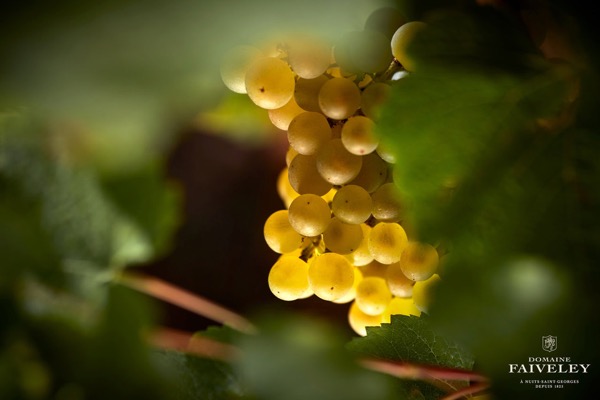
White Wine

Chardonnay

Chardonnay has incredible versatility and can be picked over quite a wide range of sugar levels and flavour ripeness.

The variety takes its name from the village of Chardonnay near Uchizy in the Mâconnais, in southern Burgundy. A region gaining in reputation for the production of delicious Chardonnay. Thought to have originated from Sâone-et-Loire between Lyon and Dijon.

Where is it grown?

Burgundy is the mythical home of Chardonnay. From there it spreads far and wide across the world. One of the three main varieties of Champagne production, we also see massive plantings in Australia and North America. You’ll find it somewhere in pretty much every wine growing country.
In Australia 340,000 tonnes of Chardonnay grapes are harvested each year over four times more than the No.2 white grape in Australia, Sauvignon Blanc!

What does it taste like?

There are a vast array of flavours, aromas, and, textures that Chardonnay can offer from the fruit alone, add in use of solid, fermentation vessels like oak, eggs, and tanks, and, malolactic fermentation, the sky is the limit.

Chardonnay has incredible versatility and can be picked over quite a wide range of sugar levels and flavour ripeness. The same vineyard can be picked with enough sugar to make a wine of 10-11% alcohol for sparkling production and then 14% for table wine with anything in between possible. Picked earlier it tends to have more citrus and green apple characters. Picked ripper the natural acidity drops and the flavours progress through stone fruit, to pineapple, fig and melon.

The hand of the winemaker has been particularly evident in Australia over the last 20 years. Starting with big, broad, alcoholic full malo styles in the 1980’s and 1990’s, the pendulum swung to the lean, acid driven styles in Australia in the mid-00’s, with some down right mean wines produced in the cooler climates like the Yarra Valley, Adelaide Hills, Mornington, and, Tasmania.  Currently, styles have found balance with generosity and elegance. Australian Chardonnay is the best it has ever been. Restrained oak use is thankfully the norm, and, globally we are seeing greater use of larger oak barrels, reducing the influence of any new oak.

Use of wild fermentation, malolactic fermentation and grape solids in ferments can add an array of secondary aromas and flavours, nuttiness, creaminess, bakery notes, butteriness, funk.

Some makers have played heavily with reduction in Chardonnay often resulting in flinty, burnt match characters.

In Burgundy, climate change, just as in Australia (along with mature vineyards) has seen picking times bought forward with sugar levels maintaining. The degree of chaptalisation in Burgundy is reducing and is often not required at all.

Check out all the articles in the Wine Bites Mag exploring Chardonnay.
Filters & Sorting

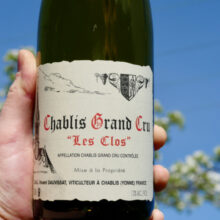
I generally have a slight preference for Dauvissat's Les Preuses, a preference I suspect Vincent Dauvissat shares, but the 2020 Chablis Grand Cru Les Clos, at least at this early stage, gets my nod as the king of the cellar—and the wine of the vintage. Wafting from the glass with aromas of citrus oil, fresh bread, oyster shell, white flowers and wet stones, it's full-bodied, layered and textural, with huge concentration, racy acids and a long, resonant finish.William Kelley, The Wine Advoc

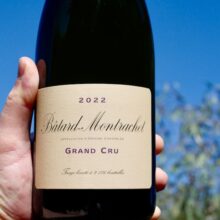
Domaine de la Vougeraie Grand Cru ‘Bâtard-Montrachet’ 2022

Chardonnay | Puligny-Montrachet, Burgundy

Generous but not dominant wood sets off intensely floral-suffused aromas of white peach, spice, acacia and citrus confit. The palate impression of the medium-bodied flavors is not as dense, mineral-driven or powerful but they are still impressive, especially in the context of having even better depth and persistence. This is a stylish and ageworthy Bâtard. (from a .38 ha holding divided into 3 parcels, two of which are on the Chassagne side and the remainder on the Puligny side of the divide) 2
$1,260
$1240ea in any 3+
$1220ea in any 6+
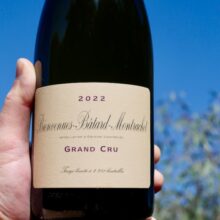
Here the elegant nose is cooler and more restrained with a much more discreet application of wood framing the layered spicy aromas of honeysuckle, white peach and a variety of floral nuances. The notably more refined and beautifully textured flavors possess excellent mid-palate concentration before terminating in a persistent, balanced and markedly dry finale that is unusually powerful. This BBM is terrific and classy, indeed it’s impressively poised for such a young wine. (from a .46 ha holdi
$1,315
$1295ea in any 3+
$1275ea in any 6+
The barest hint of exotic fruit floats in the background of the elegant, pure and layered aromas of orange peel, passion fruit, white peach, acacia blossom and a whiff of jasmine tea. There is outstanding volume and power for such young vines to the medium weight plus flavors that deliver impressive persistence on the agreeably dry and beautifully well-balanced finale. This also needs better depth though again, that should simply be a question of allowing sufficient time. This too is excellent
This singular wine comes from 0.7 hectares in Derrière chez Edouard, planted 20 years ago at a density of roughly 30,000 vines to the hectare (the vines are spaced around 30cm apart in 1m rows). At such a density, Lamy typically gets a maximum of three tiny clusters per vine (sometimes one and sometimes none!) and the entire plot only yields enough juice to fill the contents of a single barrel. Lamy’s trials with higher density have produced completely different wines and he has subsequently

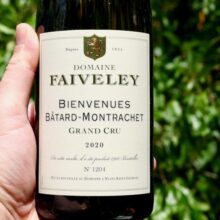
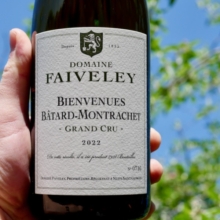
Domaine Faiveley Bienvenues Bâtard Montrachet Grand Cru 2022

Chardonnay | Puligny-Montrachet, Burgundy

Mid lemon yellow. Some delicacy, without disputing the imminent power. A pure bench of fresh white fruit, actually this is more about nuances than power, though it maintains energy all the way through, to a fine long finish. Love the tension, and the finesse, while some other versions may be more intense.94-97 Points, Jasper Morris – Inside Burgundy Drink: 2030-2038The 2022 Bienvenues-Bâtard-Montrachet Grand Cru unwinds in the glass with aromas of peach, ripe citrus fruits, white

Maison Ponsot Grand Cru Corton-Charlemagne 2020

Chardonnay | Côte du Beaune, Aloxe-Corton

First produced in 2009, Ponsot’s Corton-Charlemagne is drawn from two parcels, both in Aloxe: one on the Pernand border in Le Charlemagne and the second in Les Languettes. As you can see from the notes below, this is a deep, fleshy yet energetic and vibrant Charlemagne. A great success!“Split equally between fruit from Les Languettes and Le Charlemagne on the Aloxe side, this was a slow fermenter. It didn't finish its alcoholic fermentation until July 2021! As they say, good things c
This is at once more floral and a bit riper as well with its liqueur-like nose of vaguely exotic scents, especially white peach, passion fruit, crushed fennel and jasmine tea. The mouthfeel of bigbodied yet gorgeously textured broad-shouldered flavors exude evident minerality, indeed this is akin to rolling rocks around the palate, all wrapped in a bone-dry, citrus and hugely long finish. This is an imposingly-scaled and overly powerful Chevalierthat should amply repay 10 to 15 years of keeping.
$1,685
$1665ea in any 3+
$1645ea in any 6+
Lamy already makes a terrific, old-vine cuvée from just under a hectare in Les Tremblots, planted between 1946 and 1970. The HD portion of the parcel has massale selection vines interplanted between a few of these rows, bringing the density up to 22,000 vines per hectare. Although Lamy admits he has created a rod for his own back—his high-density parcels require more than twice the work of his regular parcels—he is obviously thrilled by the class of wine he is achieving. The ripeness, ac
The Lamy family have farmed the vines here for three generations, and the parcel borders the southeast corner of Bâtard right next to Madame Bize-Leroy’s Domaine d’Auvenay plot. Is it worth mentioning that d’Auvenay’s Criots is far more expensive? Olivier Lamy has taken the density here up to 24,000 vines per hectare, and unlike d’Auvenay (and most of its Grand Cru contemporaries), this wine is entirely unfettered by new oak (instead, it is raised in a single 250-litre, six-year-o