
Chianti Classico UGA’s are Here!
Over the last few decades, Barolo and Barbaresco have worked incredibly hard to define their Communes and Cru Vineyards. They are perhaps only second to Burgundy in the level of detail applied in classifying their respective regions.
Whilst these things can never be perfect, and as always, politics and money wield their influence, they are an excellent starting point. I can only imagine the robust conversations that have been had over many a bottle of wine in setting some of these boundaries.
Historically much of the delineation of sites has been based on assessing the quality of the wines from a vineyard that has had it’s boundaries set by markers above ground, aspect, natural boundaries and, sometimes man-made ones.
Increasingly work is being done to include what’s happening below ground. The geology, the soil profiles.
In Italy, no single person or indeed organisation has done more than Alessandro Masnaghetti in researching and exploring the vineyards of Barolo, Barbaesco and now Chianti Classico with the publication of ‘Chianti Classico: The Atlas of the Vineyards and UGAs’. Follow the link if you’d like to grab a copy of this masterpiece.
In Barolo and Barbaresco they have Menzione Geografiche Aggiuntive, MGAs, their Cru Vineyards.
Now Chianti Classico has Unità Geografiche Aggiuntive, UGAs. Also known as Additional Geographic Units.
Where Barolo alone has 170 MGAs, Chianti Classico has just 11 covering a vineyard area 3 ½ times the size with those plantings spread over a much larger area.
The 11 UGAs are listed below. Each is linked to the Consorzio Vino Chianti Classico site that has an incredible visual resource exploring each UGA:
- SAN CASCIANO
- GREVE
- MONTEFIORALLE
- LAMOLE
- PANZANO
- SAN DONATO IN POGGIO
- RADDA
- CASTELLINA
- GAIOLE
- CASTELNUOVO BERARDENGA
- VAGLIAGLI
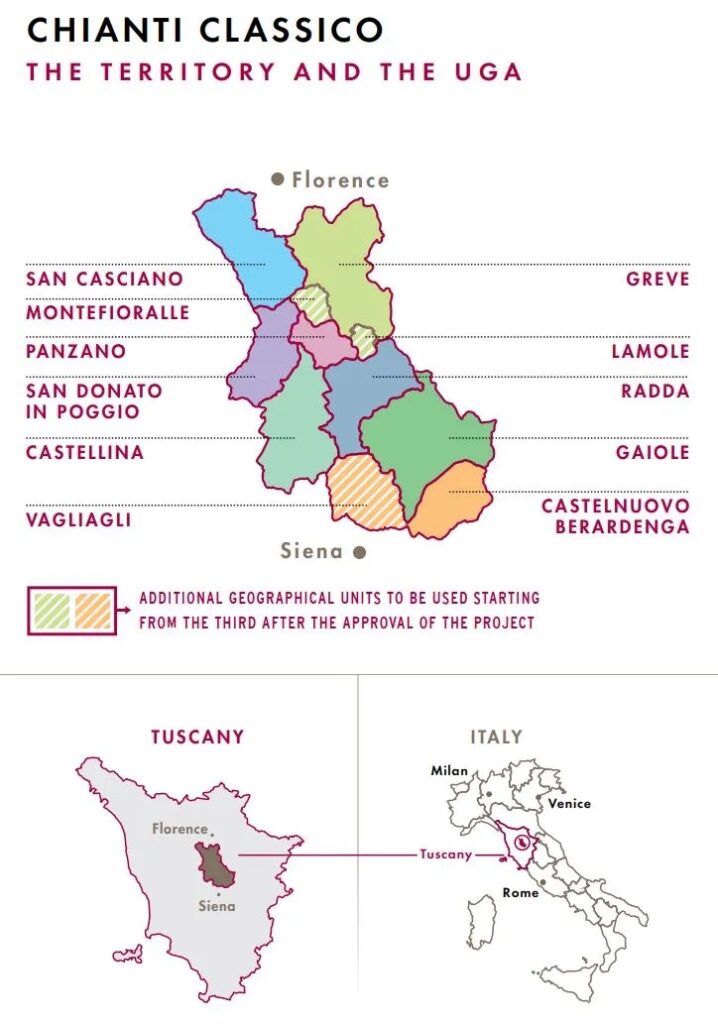
Masnaghetti’s work breaks down each UGA into a number of sub-units
Attempts have been made to summarise the styles of each UGA and highlight significant differences in the sub-units within each UGA based on geography and geology.
Variation in these sub-units within UGA of such size puts us at risk of generalisation diluting the value of the classification even without consideration of differing viticultural and winemaking practices.
These UGA will soon begin appearing on wine labels of Chianti Classico Gran Selezione, hopefully they’ll appear on bottles of Chianti Classico shortly thereafter.
That said it’s one hell of a start!
I think most would agree that we’d all love to see a similar body of work completed for Montalcino!



You must be logged in to post a comment.