
Primer: Montalcino
Rosso, Brunello, Riserva & IGT
Tuscany covers an incredibly large area of Italy. Many kick-off with Chianti and Chianti Classico.
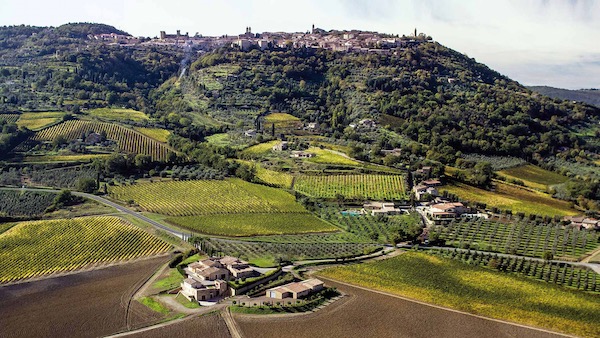
Head a little further South and you’ll discover Montalcino home to Brunello di Montalcino. Around 16 times the size of Barolo it is sparsely planted by comparison.
Ian d’Agata explores Brunello di Montalcino Wine: Terroir, Clones & Aging Potential in this 🎧 podcast on Eat, Sleep Wine Repeat.
Made from Sangiovese, specifically the Sangiovese Grosso Clone, Brunello can reach epic heights.
Rules of the Denomination
The Consorzio di Brunello di Montalcino classifies wines into 3 groups. Further details at the end of this post.
From bottom to top we have:
Rosso di Montalcino
There is great diversity in styles of Rosso di Montalcino. With no aging requirements, Rosso, can be fresh, crisp, crunchy, lighter styles that are made for easy early drinking. These typically come from vineyards not capable of making At the other extreme there are Rosso di Montalcinos made from exceptional sites that can exceed the quality of many Brunellos (think of the Rossos from Cerbaiona, Poggio di Sotto and Il Marroneto) having the quality of fruit to make wines of greater substance, depth, layering and complexity.
Brunello di Montalcino
Just as with the great wines of Barbaresco, Barolo and Burgundy the fourth B, Brunello is made in a great diversity of styles. This is the first level that barrel ageing is mandatory having a significant, positive influence on wines as a whole. With such an incredibly array of geology combined with differing viticultural and winemaking approaches, there are naturally a diverse array of style. Fruit can be anything from delicate and perfumed to dark and brooding, tannins, fine and supple to linear and structured, acid from soft and round to zippy offering great tension. All in all the quality of Brunello from the good makers will show a significant step up from their Rossos making wines of presence and personality. The different styles are discussed further below in the exploration of Brunellos unofficial sub-zones.
Brunello di Montalcino Riserva
See more on these below. The best Riservas have a serious step up in fruit quality, layer of flavours, tannins and complexity. They are built to last and often require a minimum of 10 years of age for the drinking window to open.
Check out our Wines from Montalcino!
Classification is The Choice of the Makers
The determination of Rosso vs Brunello vs Riserva is most unusual. Unlike the extreme opposite, Burgundy where classifications are defined in detail, makers in Montalcino can make their own choices. Often the difference between a Rosso and a Brunello is bunch selection along a row of the same vineyard. From a Brunello to a Brunello Riserva it may simply be a barrel that looked better and was then aged for a further year.
The better producers tend to have specific sites for Rosso vs Brunello vs Brunello Riservas and are more likely to declassify Brunello into Rosso than the other way around.
An incredible proportion of the Montalcino can be classified as Brunello di Montalcino, around 2,100Ha. Unfortunately, this is not simply for reasons of quality. There is an abundance of underperforming vineyards and wineries.
Hopefully, over time a more detailed classification with an emphasis on quality will be established.
Combining these two factors makes it even more important to taste the wines before committing to buy!
Are Riservas Worth It?
The concept of a Riserva that is meant to use the best fruit and is required to have an extend period of aging is counter to the trend of fresher wines with more immediate approachability.
Many suggest that the classification is full of tired, oxidised wines that are not deserved of the tittle nor the price.
- Genuine Riservas or Riservas by name only. As always there is a spectrum from those Brunello Riservas that are taking liberty with the classification to those that truly stand head and shoulders above. They are made from fruit selected from great sites.
- Freshness. Those with a strong understanding of the science behind making wine ensure care is given through the maturation / élévage to ensure the maintain freshness.
- Drinking them at the right time. True Riservas deserve patience in both bottle and glass. As an example Le Chiuse now release their Riserva as a Diecianni, 10 year release (an addition 3+ years beyond the Consorzios requirements) to ensure the wine is at least resolved and at the beginning of the drinking window. Having made wine for decades and consumed wine for much longer it is important to note that wines, those made from exceptional fruit can freshen both in the bottle and after opening in the glass.
Like any wine it comes down to what’s in the glass and drinking it at the right time. Know your producer, know your sites!
Going Their Own Way!
The lack of genuine quality control over the classification has been the reason for some exceptional producers choosing not to maintain membership of the Consorzio, simply classifying their wines as IGT. One of the more basic classification.
Far and away the best example of this is Soldera make of one of the very best Sangiovese’s in Montalcino, in reality, one of the very best wines in the World! One of the most stunning incarnations of Sangiovese on the planet, you would be forgiven for thinking you were drinking an exceptionally good bottle of Grand Cru Burgundy!
To Oak or Not To Oak!
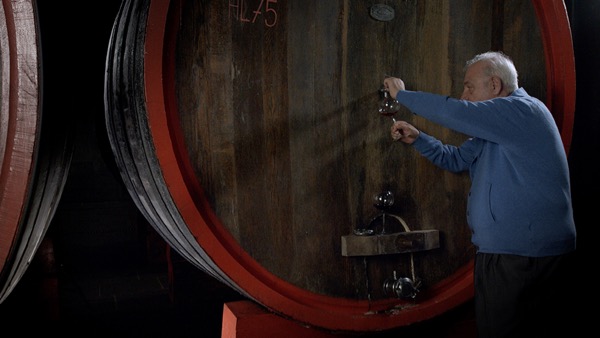
Like many Italian regions use of oak can be a defining factor between success and meh! Those using large, often, older oak typically have a better chance of success.
The lesson here is the same for most regions:
Know your producers and know your sites!
The sub-zones of Montalcino
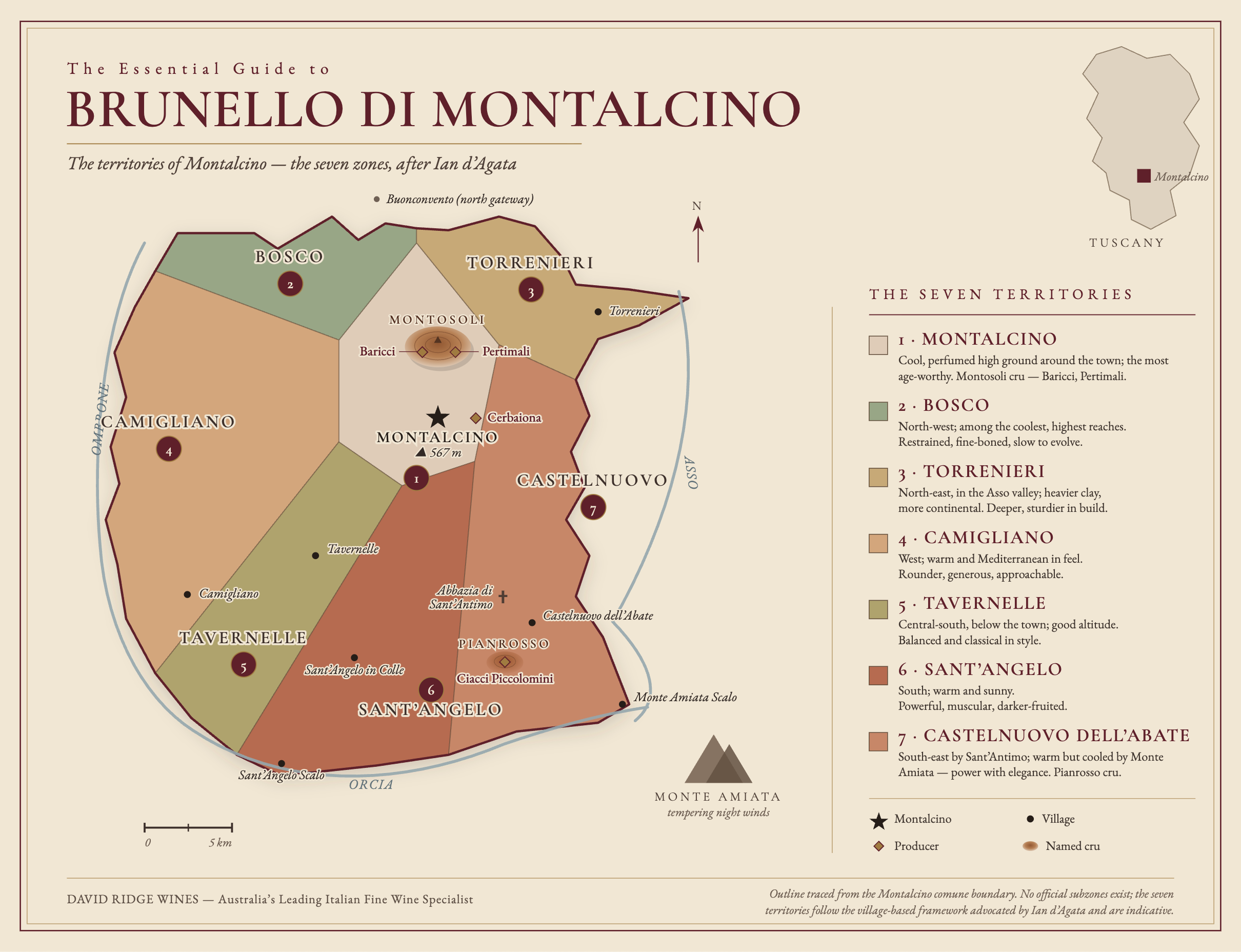
Lovers of Brunello have been pushing for the sub-zones of Montalcino to be official recognised and more work to be done to define key vineyards as has happened over the last few decades in Barolo and Barbaresco. One such Brunello lover, Ian d’Agata has been pushing for the seven zones of Montalcino to be defined as below. Hopefully, in time more detail can be added to this map to help lovers of Brunello celebrate the differences between each zone.
The Seven Zones of Montalcino
Keep in mind the descriptions are generalisations. There is sufficient area, geological, viticultural and winemaking variation across each zone to offer significant diversity of styles and the below a rules of thumb.
Camigliano: Located in the southwestern quadrant, this is a warmer, lower-altitude zone that yields rich, intensely fruity, and lush wines.
Castelnuovo dell’Abate: Situated in the southeast near the Orcia River and Mount Amiata, this warmer area produces some of the most complex, aromatic, and deeply structured wines. Producers of note: Poggio di Sotto, Ciacci Piccolomini d’Aragona, Mastrojanni, Uccelliera, Stella di Campalto, Voliero.
Montalcino: Including the famed Montosoli hill. The area immediately surrounding the historic hilltop town itself. Vineyards here sit at higher elevations, resulting in incredibly elegant, acidic, and long-lived Brunellos. Producers of note (Montosoli): Le Chiuse, Canalicchio di Sopra, Baricci, Il Marroneto, Gorelli Producers of note (Montalcino): Cerbaiona, Biondi-Santi, Fuligni, Conti-Costanti.
Bosco or Nordovest (Northwest): A cooler, higher-altitude sector featuring younger soils. It typically produces fresher, highly aromatic wines.
Sant’Angelo: Located further south near the Orcia and Ombrone rivers. This encompasses both Sant’Angelo in Colle and Sant’Angelo Scalo. It is one of the warmest and driest zones, producing ripe, concentrated, and powerful wines. Producers of note: Il Poggione, Argiano, Talenti.
Tavernelle: Positioned on the southwestern slope between Camigliano and Sant’Angelo. Vineyards here sit at moderate elevations, crafting balanced, harmonious wines that offer both fruit depth and structure. Producers of note: Soldera, Gaja (Pieve Santa Restituta), JG Benda.
Torrenieri: Located to the northeast, this is a slightly flatter area where the soils tend to contain higher percentages of clay (Galestro and Alberese). Wines from this zone are typically less tannic and more approachable in their youth.
The Seven Zones Map from David Ridge based on Ian d’Agata’s work
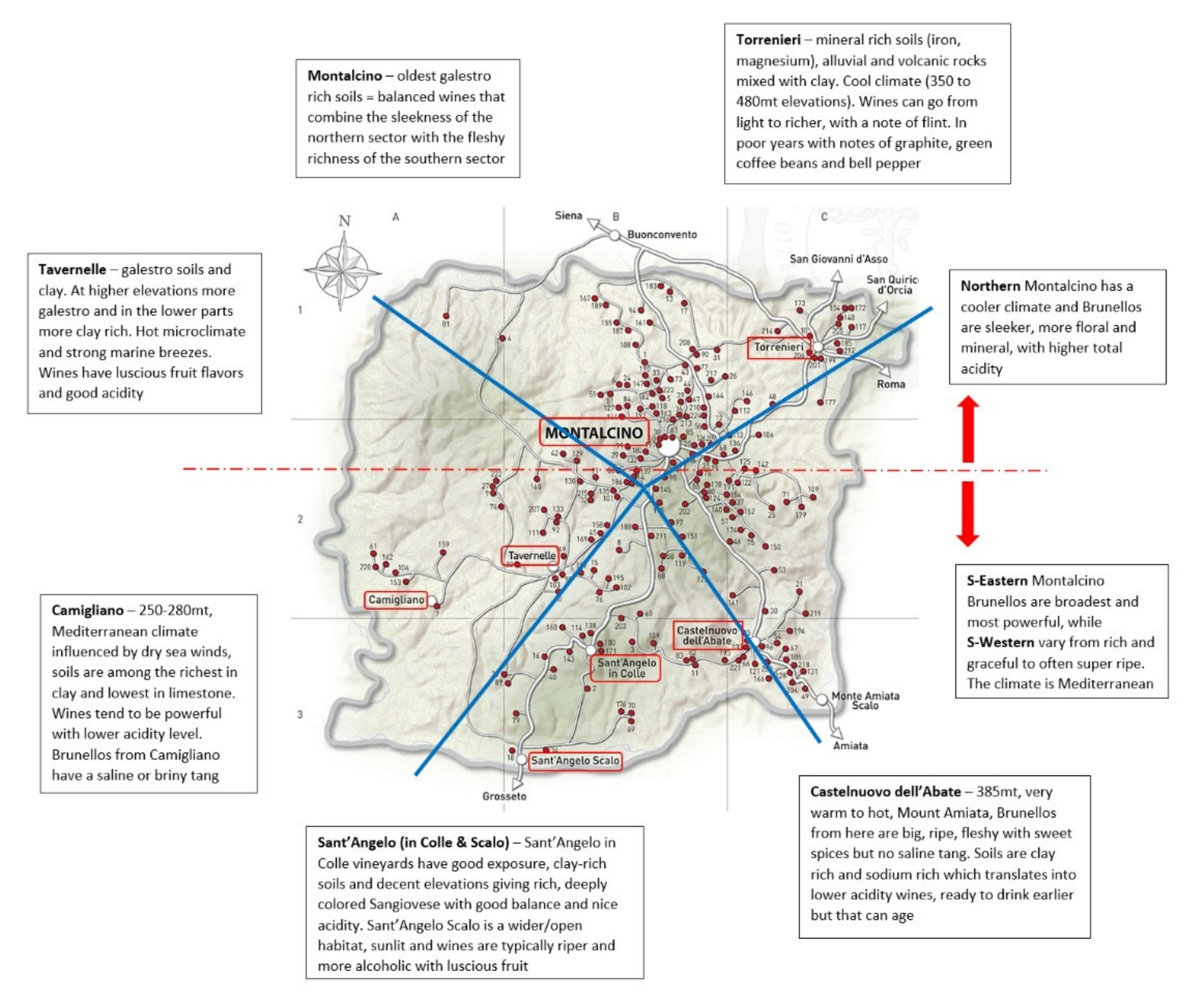
The Seven Zones of Montalcino Interpretation with a north-south divide
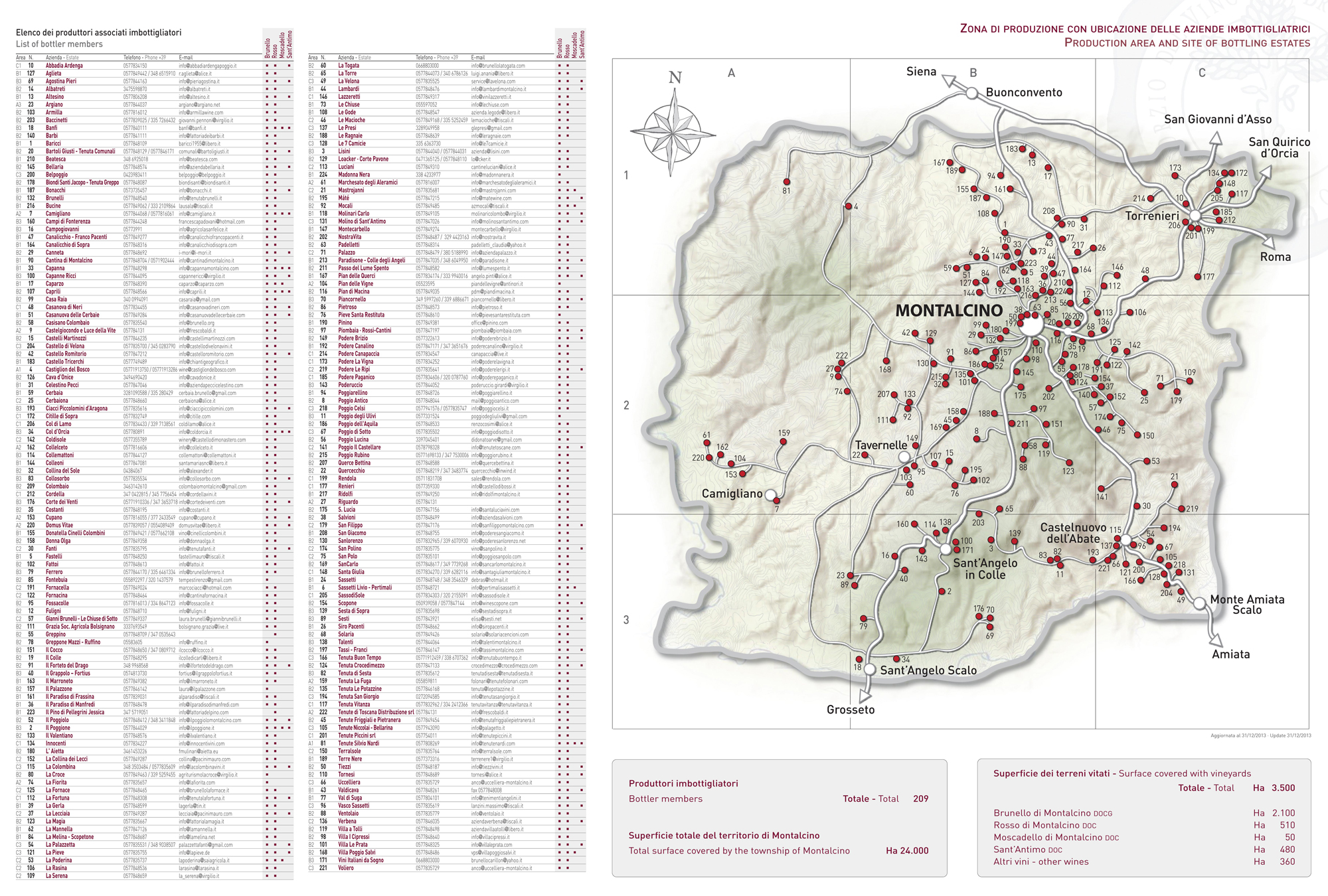
The Producers of Montalcino
The Rules
Brunello di Montalcino was recognized as a wine of DENOMINATION OF CONTROLLED AND GUARANTEED ORIGIN with the Presidential Decree: D.P.R. 1/7/1980, and various modifications ensued subsequently. The rules established by the disciplinary regulations in vigour according to the Decree of 19/5/1998 are detailed below.
Brunello di Montalcino DOCG
Denominazione di Origine Controllata e Garantita
Production area: Historical borders of the Municipality of Montalcino ≈ 2,100ha
Variety: Sangiovese (also called “Brunello” in Montalcino)
Maximum yield: 80 quintals per hectare. Maximum 680l of wine per tonne of fruit.
Wood Aging: 2 years in oak. Minimum aging in bottles: 4 months (6 months for the Riserva)
Minimum alcohol: 12.5% Vol.
Minimum total acidity: 5 g/lt Minimum net dry extract: 26 g/lt
Release: From 1 January of the year following the end of the fifth year calculated in consideration of the year of harvest (6 years for the Riserva)
Bottle: Bordelaise shaped bottles
Rosso di Montalcino DOC
Denominazione di Origine Controllata
Production area: Historical borders of the Municipality of Montalcino ≈ 520ha (≈ 870ha from 2024)
Variety: Sangiovese (also called “Brunello” in Montalcino)
Maximum yield: 90 quintals per hectare. Maximum 700l of wine per tonne of fruit.
Wood Aging: None required. Minimum aging in bottles: None required.
Minimum alcohol: 12% Vol.
Minimum total acidity: 4.5 g/lt Minimum net dry extract: 24 g/lt
Release: From 1 September year after harvest ~ 12months.
Bottle: Bordelaise shaped bottles
Sources:
You must be logged in to post a comment.