Benanti Etna Rosso DOC 2022

Product information

Benanti Etna Rosso DOC 2022

Nerello Mascalese from Sicily, Italy, Etna

$62

$59ea in any 3+
$56ea in any 6+
Closure: Cork

Description

The 2022 Etna Rosso wafts up with a perfumed blend of rosy florals and hints of juniper berry. This is vividly fruit-focused, with a wave of ripe wild berries and sweet spices that flow across a stream of brisk acidity. It leaves a staining of primary concentration and mildly grippy tannins to resonate as violet inner florals slowly fade. While more extroverted than expected, the 2022 is a total pleasure to taste and maintains fantastic balance.

Out of stock

Check out all of the wines by Benanti

Why is this Wine so Yummy?

About Benanti

Ever since they took the helm of the winery in 2012, with many new labels launched and new vineyard acquisitions and sales, siblings Salvino and Antonio Benanti have been leading the estate into a new dimension, one that they like to characterize as an “evolution of continuity,” assisted by historical collaborators such as their in-house winemaker Enzo Calì (full-time at Benanti since 2004) and their commercial director Agatino Failla (with them since 2011). The recent new bottlings continue in the same vein as what has been done at the estate since its beginning back in 1990, when they started bottling wines clearly linked to a specific terroir; for example, the Rovittello Etna Rosso from the volcano’s northern slope in the commune of Castiglione di Sicilia, and even the Nerello Cappuccio monovariety bottling, made with grapes picked on Etna’s southwestern flank in the territory of Santa Maria di Licodia. The Benantis are now aiming to produce as many as six different contrada wines. In 2019, they launched two more, the Etna Bianco Contrada Cavaliere and the Etna Rosso Contrada Cavaliere, after the Etna Rosso Contrada Monte Serra 2016 was released in 2018.

Ian D’Agata


In the Vineyard

Nerello Mascalese (c.80-85%), Etna’s noble red grape variety, and Nerello Cappuccio (c.15-20%) grown on sandy, volcanic soils that are rich in minerals, with sub-acid reaction. Vines range in age from 10 to 60 years and are trained in both “alberello” (head-trained bush) and spurred cordon systems, with densities of 6,000 to 8,000 vinestocks per hectare and yields of 7,000 to 8,000 kg/ha. Vineyards vary in elevation from 450 m (c. 1,500 ft) to 900 m (c. 2,950 ft) a.s.l. The climate type ranges from high hill to mountain, with a humid and rainy cooler season, high ventilation, luminosity and a significant diurnal range.

In the Winery

Grapes are harvested by hand in October and de-stemmed. The two varieties are vinified separately. Fermentation takes place in stainless steel vats at a controlled temperature, with medium-length maceration, with the aid of Benanti’s own indigenous yeast, which was selected from local vineyards through years of research and experimentation in the cellar. Nerello Cappuccio matures only in stainless steel. About 80% of the Nerello Mascalese matures in stainless steel, while the remaining 20% matures in second-passage French oak barriques for 8-10 months. After bottling, the wine refines for 2-3 months

About Nerello Mascelese and Nerello Cappuccio

Typically wines made from the Nerello’s exude an entrancing perfume with a delicacy, elegance, and, sophistication that carries through to the palate. With vineyards from 400-1000m in elevation, the lower lying vineyards tend to yield bolder styles, while the higher sites offer greater restraint often being quite ethereal. Texturally the tannins often remind of a more supple Barolo.

Wines of Nerello Mascelese and Nerello Cappuccio have been called the Barolo of the South by some, Italy’s Burgundy by others. I prefer to call them, simply, great wines from Etna.

Whilst Nerello Mascelese’s enormous bunches, with their big berries, result in wines of a relatively pale appearance, there is nothing insignificant about their aromas, flavours, and, textures.

Indigenous to the Etna region, Nerrello meaning Black and Mascelese derived from Mascali, a comune to the east of Etna. Research indicates it is possibly a cross between Sangiovese and Mantonico Bianco. That parentage would make it a sibling of Gaglioppo from Calabria. The full parentage is and number of different varieties have yet to be determined with commercial Nerello Mascelese plantings including several unidentified varieties. Some genetic work suggests Nerello Mascelese could be related to the white grape Carricante.*

What’s the Etna style?

Such a naff question in so many ways! Although many of the vines of Etna have been planted for decades if not centuries, Etna’s renaissance really only started 20 years ago. SRC first vintage less than a generation ago!

In 30 years we may have a better picture of the regions true capability. One thing is certain, Etna is producing some of the most exciting, personality-filled wines I’ve come across in a long time.

Like any variety, there is an array of styles being made with variation to maceration time, new vs old oak, small vs large oak, élévage (maturation before bottling), being the most significant factors.

One of the biggest factors yet to show itself fully is the difference between vine that are ‘Pei Franco’ (French Foot) planted on their own roots and those that are grafted onto rootstock ‘Pei Rupestris. Direct comparison from the same producer has typically shown own-rooted vines tend to make more elegant styles, vines on rootstock bolder styles. The jury is still out and until a proper scientific comparison can be made my opinion is simply from empirical evidence.

We are also seeing the introduction of other varieties to the hill. Buscemi with Grenache, others with Sangiovese.

If you take a short trip from Etna to Faro, with only 35 acres of vines for the entire appellation, located on the North East tip of the island, Casematte are making excellent blends. Their top wine the ‘Faro’ blends Nerello Mascelese wines blended with Nerello Cappuccio, Nocciola, and Nero d’Avola.  The level of intrigue is off-tap, such complexity and harmony. I was fortunate enough to devour one a week ago. Accidently leaving a half glass in the bottle proved I should have been more patient. The wine went to the next level with 24 hours of air! The Nocciola adds a degree of richness and generosity without overwhelming the Nerello. Casematte’s second wine the Peloro blends Nerello Mascelese with Nocciola and is a triumph.

In a nutshell, with varieties suited to the climate, old vines, and, good vineyard management there’s plenty of good material to work with. As lovers of delicious beverages, we got to watch, play, and, drink as the those who labour on the slopes of Etna and Faro strive to make even more exceptional wines.

Where in the World is Benanti?

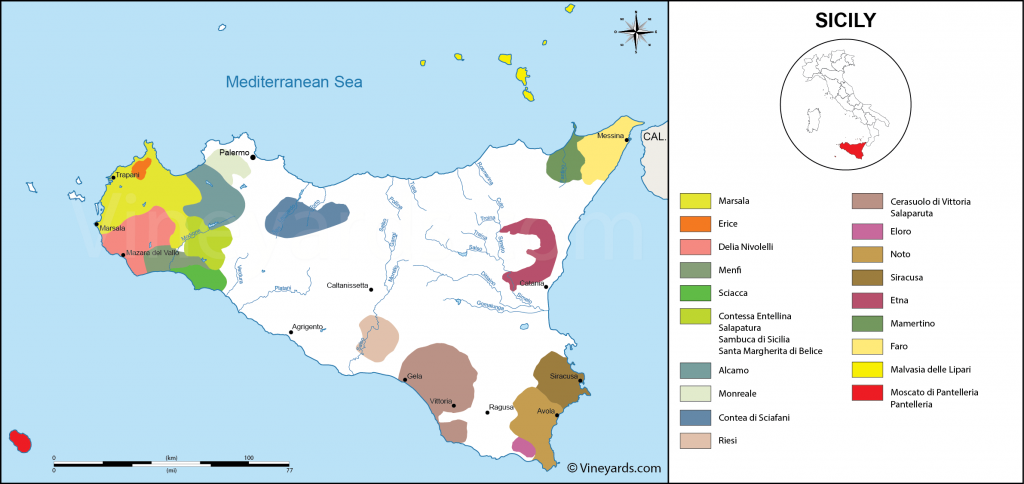
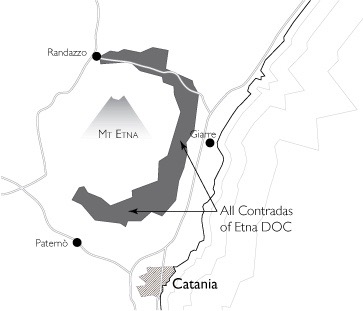
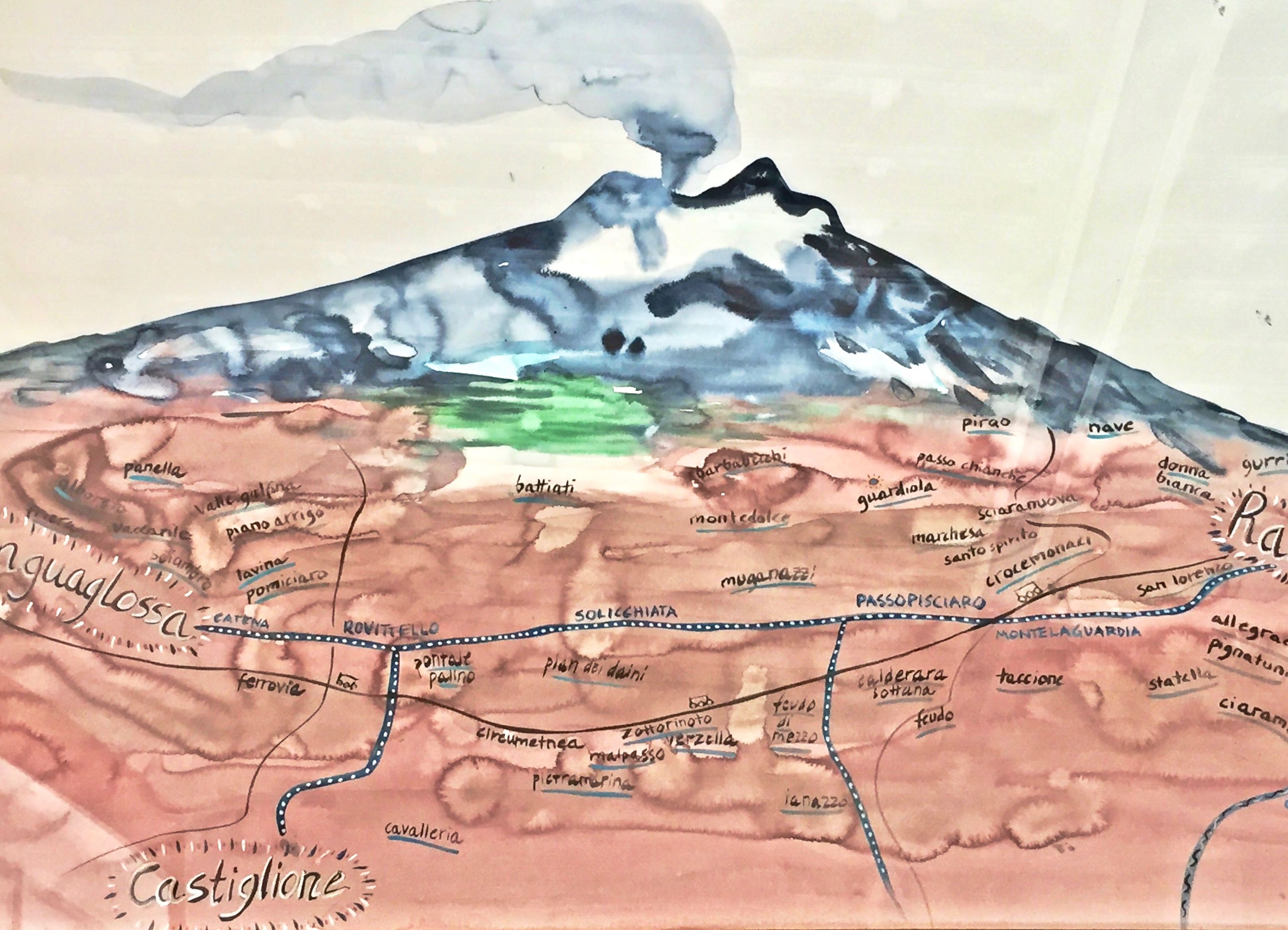
I thought I’d share these three maps to help you get your head around Etna and it’s place in Sicily. The first map gives you the big picture. The second highlights the general area planted on Etna, mostly South to South-East facing. The third shows most, but, not all of the Contrada (single vineyards) and their relative elevations.


90 Points

The 2022 Etna Rosso wafts up with a perfumed blend of rosy florals and hints of juniper berry. This is vividly fruit-focused, with a wave of ripe wild berries and sweet spices that flow across a stream of brisk acidity. It leaves a staining of primary concentration and mildly grippy tannins to resonate as violet inner florals slowly fade. While more extroverted than expected, the 2022 is a total pleasure to taste and maintains fantastic balance.

Eric Guido, Vinous

Where in the world does the magic happen?

BENANTI, Via Giuseppe Garibaldi, Viagrande, Province of Catania, Italy

Etna
Sicily
Italy